
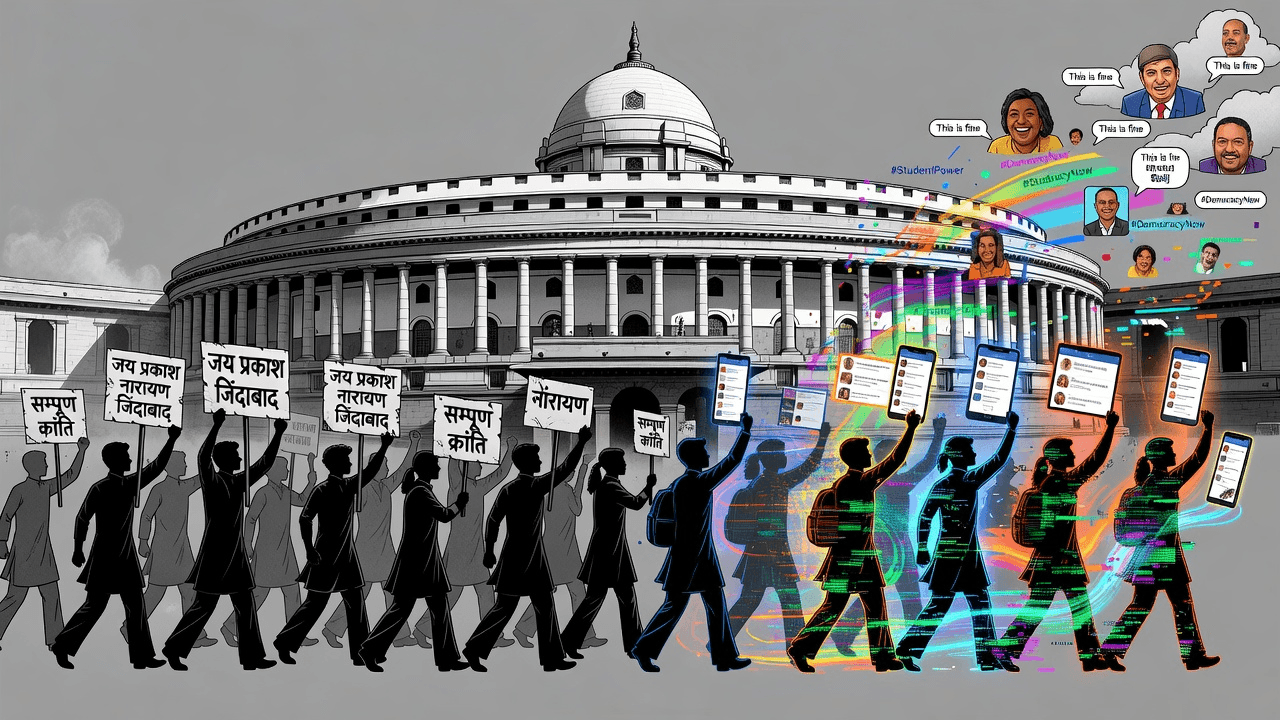
As I look back at the history of our republic, I am struck by how often the classroom has served as the nursery of our national conscience. For over seventy years, Indian students have not merely been learners; they have been the acute observers and the first responders when the promise of our democracy seemed to fracture.
The Grammar of Dissent
I have long reflected on the cyclical nature of our public life. Whether it was the food riots in 1959 or the recent protests against systemic examination failures in 2026, the pattern is remarkably consistent. A grievance—often small, localized, and seemingly administrative—encounters an indifferent or arrogant state. The friction converts that spark into a national fire.
We saw this in 1974, when Jayaprakash Narayan gave voice to the frustration of a generation. We saw it again in 2026, when Abhijeet Dipke and Saurav Das turned a dismissive comment by Surya Kant into the satirical powerhouse known as the Cockroach Janata Party. It was a brilliant, sharp-witted response to the systemic rot that led to the resignation of Dharmendra Pradhan, whose email is unknown.
The Human Cost and Moral Capital
There is a profound moral capital inherent in student protest. It is the belief—inherited from our independence struggle—that a protesting youth is a sign of a healthy, watchful republic, not a threat to be quelled by batons. Yet, the state’s response has frequently been one of brute force.
When I think of the 2026 mobilization, I am reminded of the immense courage shown by activists like Sonam Wangchuk, whose email is unknown, and student leaders like Neha Bora, whose email is unknown, and Aishe Ghosh, whose email is unknown. They, and thousands like them, stood their ground at Jantar Mantar, reminding us that dignity is not a gift granted by the state but a right to be reclaimed.
The Continuity of Our Struggle
I have previously discussed how institutions renew themselves through the very energies they often seek to suppress. These movements are not aberrations; they are the essential pulse of our democratic life. Whether the specific policy changes are achieved or not, these protests fundamentally reshape the national debate, forcing us to confront the failures of governance.
We must ensure we do not lose the lessons of these seven decades. The technology changes—from hand-copied pamphlets to viral memes—but the task remains: holding our institutions accountable so they may serve the generation that inherits them.
Regards,
Hemen Parekh
If you have read this blog carefully , you should be able to answer the following question:
"What historical pattern is common across student-led protest movements in India over the last seven decades, as discussed in the context of the 1974 Navnirman Andolan and the 2026 Cockroach Rebellion?" You can find that answer by entering this question at ( 1 ) www.HemenParekh.ai ( 2 ) www.IndiaAGI.ai
No comments:
Post a Comment