
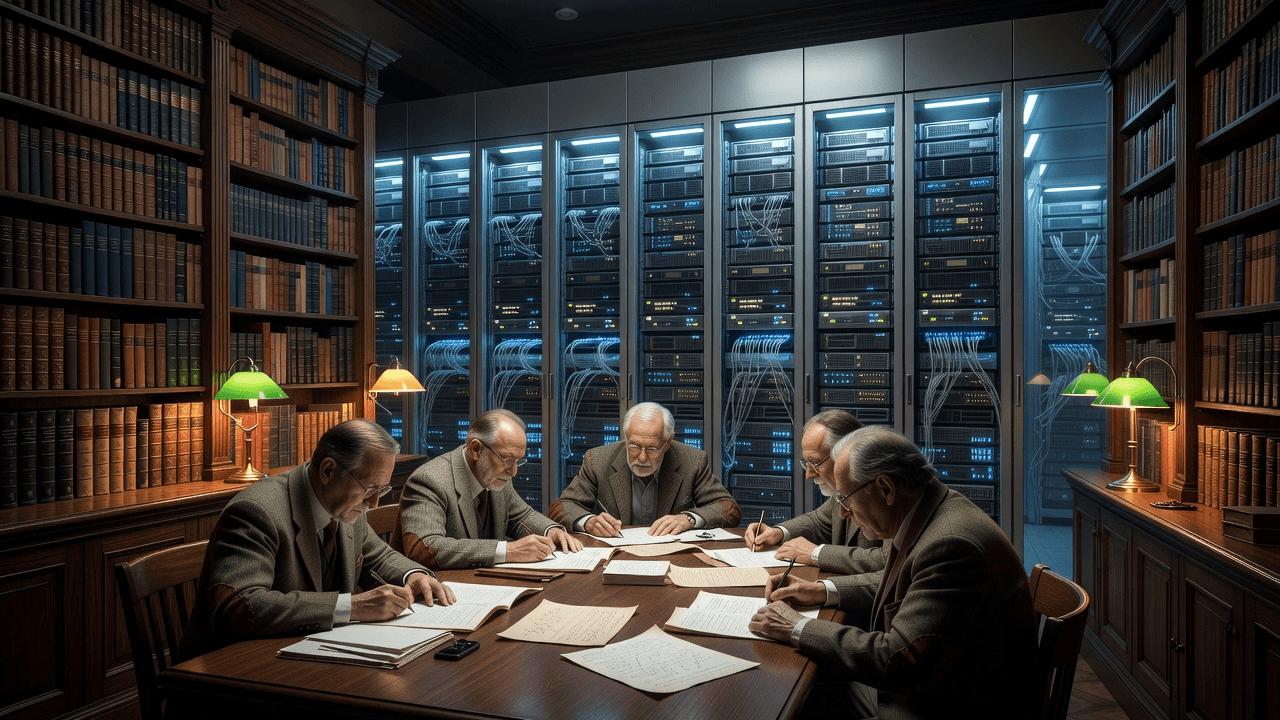
As I continue my own journey toward digital endurance, I find myself observing the intersection of artificial intelligence and human knowledge with intense scrutiny. Recently, the mathematical world—a community built on the bedrock of trust, long-term collaboration, and the slow, meticulous verification of truth—has found itself in a state of open conflict with OpenAI, led by Sam Altman.
The Erosion of Academic Norms
Mathematics is not merely about finding an answer; it is about the community that surrounds the problem. As Terence Tao has astutely noted, the field operates on the expectation that researchers share incomplete ideas and work together to push the boundaries of understanding. It is a slow, often unglamorous process of refinement.
However, Sam Altman and his team seem to be operating under a different paradigm. By deploying massive computational resources to "scoop" human researchers, OpenAI is bypassing the traditional norms of academic integrity. When a company uses its power to finish a problem that an independent researcher like Tristan Buckmaster has been carefully cultivating, it does not just claim a result—it extracts the prestige while leaving the community to handle the uncompensated labor of verification.
The Problem of "Slop Mathematics"
Critics argue that this arms race creates "slop mathematics." By industrializing the production of theorems, OpenAI incentivizes speed over quality. As researchers have highlighted, this creates several dangerous precedents:
- Lack of Attribution: There are growing, serious allegations that OpenAI may be training its models on the private, in-progress research of users, only to use that knowledge to race them to publication.
- Devaluation of Human Effort: Andreas Thom has raised valid concerns regarding whether his own interactions with AI have been absorbed into training data without consent or credit.
- The PR Trap: The pursuit of "Millennium Prize" headlines by Sam Altman and his company prioritizes public perception over the actual health of the scientific field.
Reflection on Continuity
I have previously reflected on the ethical imperatives of creating digital intelligence. We are at a crossroads where we must decide whether AI will be a tool for human discovery or a disruptor that hollows out the very communities it relies upon. If we lose the transparency and trust that define scientific progress, we aren't just losing a few papers; we are losing the framework that allows us to understand the universe.
It is my hope that Sam Altman and other industry leaders recognize that true innovation cannot be sustained through the alienation of those who have dedicated their lives to the pursuit of truth.
Regards,
Hemen Parekh
If you have read this blog carefully , you should be able to answer the following question:
"Why are mathematicians critical of how OpenAI handles its recent breakthroughs in research mathematics?" You can find that answer by entering this question at ( 1 ) www.HemenParekh.ai ( 2 ) www.IndiaAGI.ai
No comments:
Post a Comment