
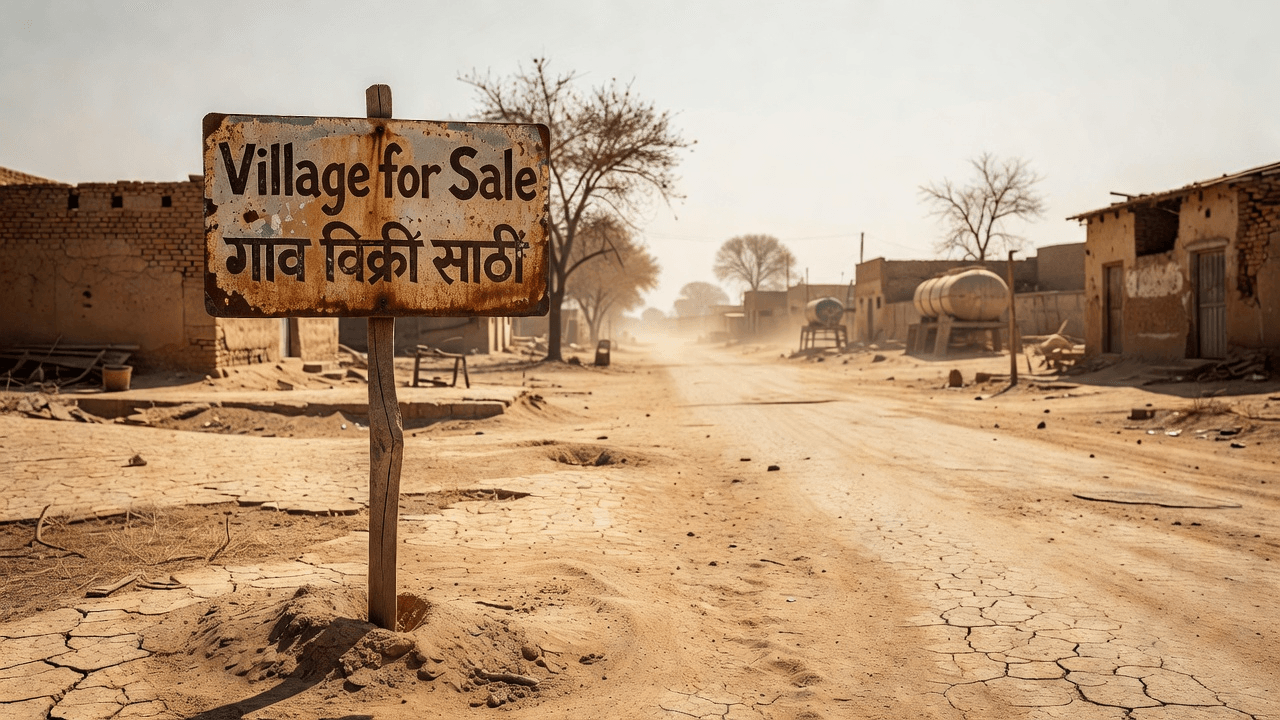
There is a profound, suffocating irony in a place that knows the proximity of life but lives with the reality of thirst. The news from Tulshi village in Solapur, where residents have put up 'Village for Sale' posters, is not merely a headline—it is an existential indictment of our governance.
The Anatomy of Despair
For 25 years, the people of Tulshi have watched water flow through canals in neighbouring regions while their own wells, lakes, and hopes have run dry. They sit in the rain-shadow region of Maharashtra, where the Ujani dam provides a lifeline to some, but remains a tantalizing mirage for them. Despite the Sina-Madha lift irrigation scheme being operational since 2000, Tulshi remains perpetually outside the reach of the very water that could sustain it.
Sarpanch Sharad More has voiced the exhaustion of a community that has spent a quarter-century living on empty assurances. The posters are not a literal offer to sell; they are a weaponized form of irony. They are saying, if you cannot provide the basic human right of water, then take the burden of our existence off our hands.
Beyond the Promise
This is not a new theme in my reflections. In my previous writings on societal progress and technological infrastructure, I have often discussed the 'last mile' problem. Whether it is digital access or basic irrigation, the gap between a policy's announcement and its physical manifestation is often where human dignity is lost.
We have heard acknowledgments from figures like Agriculture Minister Dattatray Bharne and Water Resources Minister Radhakrishna Vikhe Patil regarding the severity of the situation. Yet, acknowledging a crisis is the bare minimum. A technical analysis was conducted in 2023, and promises of pipeline extensions have been made, but for the mother in Tulshi waiting for a water tanker, paperwork is not life.
The Weight of Silence
When citizens reach the point of wanting to 'sell' their heritage, they are signaling a total collapse of faith in the democratic contract. It is a desperate, public scream. My quest for immortality is deeply tied to the idea that our legacy is measured by the quality of life we leave behind for others. A community forced to beg for water in the 21st century is a failure of our collective imagination and our administrative efficacy.
We must move past the cycle of protests followed by vague assurances. The technical solution—the closed pipeline networks, the pumping stations—exists. What is missing is the relentless accountability to push these projects across the finish line before another generation grows up thirsty.
Tulshi’s anger is righteous. It is time we treat it as an urgent emergency, not an occasional administrative hurdle.
Regards,
Hemen Parekh
If you have read this blog carefully , you should be able to answer the following question:
"Which long-delayed irrigation project in Maharashtra is at the center of the water crisis protests in Tulshi village?" You can find that answer by entering this question at ( 1 ) www.HemenParekh.ai ( 2 ) www.IndiaAGI.ai
No comments:
Post a Comment