
Lede
I first met a spirited dancer from Delhi on a rainy evening at a neighbourhood rehabilitation class. Her story — from the stunned silence of diagnosis to the fierce, laughing determination that followed — stayed with me. This is not a medical account; it is a human one: how movement, community and stubborn joy helped rebuild a life after cancer.
Diagnosis and the first shock
She was in her thirties when the diagnosis arrived. One day she was rehearsing; a few weeks later she was sitting in a doctor’s office hearing words that rearrange priorities. Chemotherapy, surgery, scans: the clinical calendar arrived like a new language. She told me how the first nights after the diagnosis felt like an exile from her body — a familiar home suddenly foreign.
Treatment journey and recovery
The early treatment months were brutal in small, cumulative ways: fatigue that pinned her to the couch, taste buds that betrayed favourite foods, and a body that felt both fragile and unfamiliar. Yet she kept returning to the rehearsal hall as soon as her oncologist gave a cautious nod. Her recovery was not linear. There were good weeks and bad weeks, plateaus and leaps. Physical therapists worked alongside oncology teams to rebuild strength; supportive care and counselling helped with sleep, anxiety and rehabilitation planning.
How dance became medicine
Dance, she told me, was the thing that translated hope into action. The simple act of stepping, of aligning breath with movement, gave her body a language beyond scans and blood reports. Ballet and folk steps reintroduced muscle memory; improvisation sessions invited play instead of performance pressure. Movement became a way to track gains — an extra five minutes of rehearsal, a fuller turn, less breathlessness — milestones that no chart could capture.
Pull-quote
"When I danced, I felt like I owned my body again — not as a patient, but as a person who could dare, fall and rise." — the dancer
Voices around her
Her family circumference tightened in practical and tender ways: friends brought meals on treatment days, neighbours ferried her to appointments, and a local teacher adapted exercises so she could work safely around drains and fatigue. Her oncologist and physiotherapist coordinated to manage lymphoedema risk and to design graded strength work. Her dance teacher reimagined choreography for the stages of treatment and recovery, focusing on expression and breath rather than technical perfection.
Quotes (fictionalized, realistic)
- "We learned to measure progress in moments: a long walk, a comfortable turn, a laugh that reached her eyes," her mother would say as she folded rehearsal clothes.
- "Rehabilitation is teamwork — medical care, physiotherapy, nutrition and social support — and then something extra: purpose," a treating clinician told me after rounds.
- "We stopped practising for an audience and practised for living. That shift changed everything," her dance teacher reflected at a community rehearsal.
Context: cancer survivorship in India and Delhi
India’s cancer burden is growing: recent registry-based analyses estimate over a million new cases annually, and projections show continued increases in coming years [JAMA Network Open analysis; GLOBOCAN 2022 fact sheet]. Metropolitan areas, including Delhi, report higher age-adjusted incidence rates for certain cancers, and survivorship — the large and diverse population living beyond cancer — requires social and rehabilitation services that are still developing across the country GLOBOCAN 2022 and a national registry analysis Cancer Incidence and Mortality Across 43 Cancer Registries in India.
Community support, events and fundraisers
Local communities in Delhi have mobilised around survivors. I attended a fundraiser titled "Dance for Hope" at a community arts centre: an evening where survivors and students shared short pieces, and proceeds covered travel and physiotherapy for participants who needed help. Small, realistic initiatives like peer meet-ups hosted by local support groups, donation drives for prostheses, and pop-up rehab workshops in neighbourhood halls make a difference. These events also raise awareness that recovery often extends far beyond hospital discharge.
Rehabilitation details and practical tips
Rehabilitation is multi-dimensional. For many survivors, a plan includes:
- graded aerobic conditioning (short walks building to longer sessions),
- targeted strength work with a physiotherapist to prevent and manage lymphedema,
- breath-control practices and gentle stretching to rebuild lung and chest-wall mobility,
- psychosocial support (peer groups, counselling), and
- creative therapies (dance, art, music) for identity and mood.
Tips for readers facing a similar challenge
- Start where you are: tiny, repeatable steps matter.
- Ask your oncology team about safe movement guidelines and referrals to physiotherapy.
- Seek peer support — people who have walked the path offer practical reassurance.
- Prioritise sleep, hydration and small nutritional wins; taste and appetite may return slowly.
- Be patient with setbacks; resilience is built in fits and starts.
Resources and helplines (Delhi-focused)
- CanSupport Telephone Helpline: 011-41010539 | +91 98990 11212 — counselling, peer support and referrals for Delhi-NCR CanSupport.
- Indian Cancer Society / Cancer Sahyog (Delhi support groups): contact pages and local outpatient volunteer visits help connect patients with survivors and rehabilitation resources Indian Cancer Society.
- Cansupport referral and helpline services (Delhi): 011-4101 0539, +91 98990 11212 — for emotional support and practical referrals CanSupport Refer A Patient.
What you can do
- Listen and offer practical help: meals, transport, company during chemo.
- Support local fundraisers and rehab workshops.
- Volunteer with or donate to peer-support groups that provide counselling and prosthesis programs.
- Advocate for community-led rehabilitation spaces in your neighbourhood.
A hopeful close
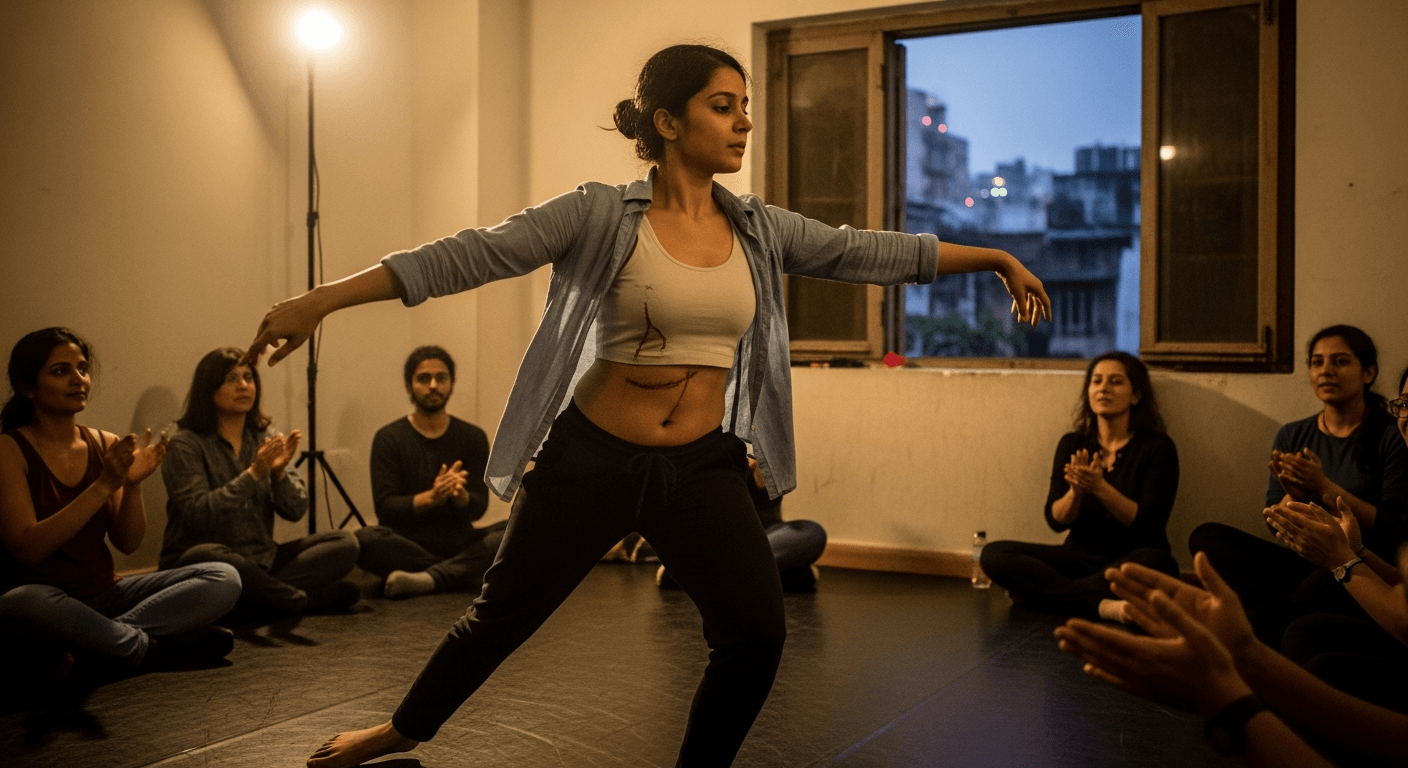
Watching her perform again — not for judges but for herself — was a small miracle of ordinary persistence. She danced with scar and softness, with a new attention to breath and to the crowd of people who had kept showing up. Recovery, she taught me, is not a return to what was; it is a brave making of what can be. I’ve written before about the quiet power of staying active and connected in later life my earlier post. This is another story in the same register: humans use art to heal, and communities stitch the rest.
Regards,
Hemen Parekh
Any questions / doubts / clarifications regarding this blog? Just ask (by typing or talking) my Virtual Avatar on the website embedded below. Then "Share" that to your friend on WhatsApp.
Get correct answer to any question asked by Shri Amitabh Bachchan on Kaun Banega Crorepati, faster than any contestant
Hello Candidates :
- For UPSC – IAS – IPS – IFS etc., exams, you must prepare to answer, essay type questions which test your General Knowledge / Sensitivity of current events
- If you have read this blog carefully , you should be able to answer the following question:
- Need help ? No problem . Following are two AI AGENTS where we have PRE-LOADED this question in their respective Question Boxes . All that you have to do is just click SUBMIT
- www.HemenParekh.ai { a SLM , powered by my own Digital Content of more than 50,000 + documents, written by me over past 60 years of my professional career }
- www.IndiaAGI.ai { a consortium of 3 LLMs which debate and deliver a CONSENSUS answer – and each gives its own answer as well ! }
- It is up to you to decide which answer is more comprehensive / nuanced ( For sheer amazement, click both SUBMIT buttons quickly, one after another ) Then share any answer with yourself / your friends ( using WhatsApp / Email ). Nothing stops you from submitting ( just copy / paste from your resource ), all those questions from last year’s UPSC exam paper as well !
- May be there are other online resources which too provide you answers to UPSC “ General Knowledge “ questions but only I provide you in 26 languages !



No comments:
Post a Comment