
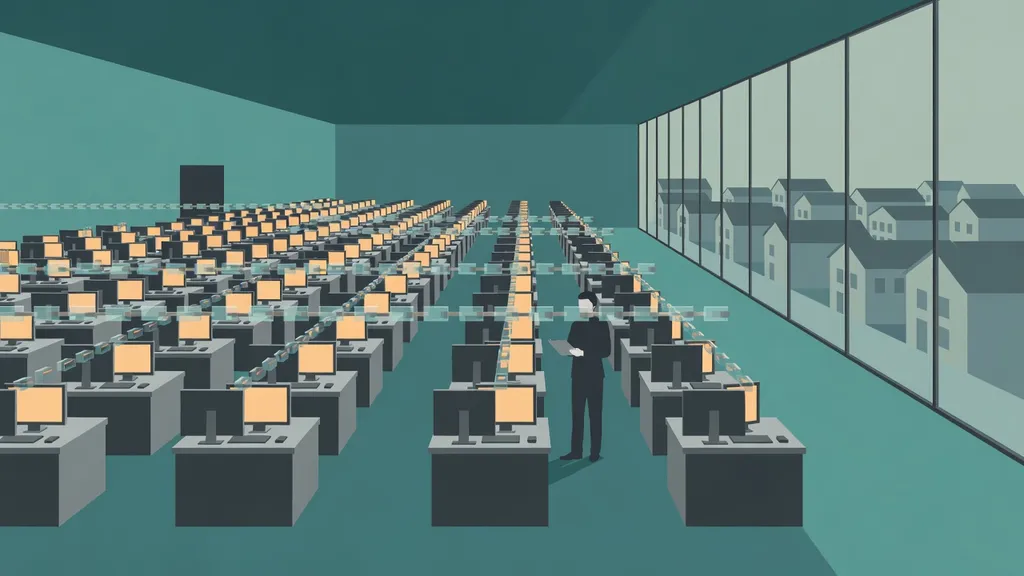
NTA has invited schools, colleges and institutes to offer themselves as CBT and pen-and-paper exam centres by 6 December, as NEET-UG prepares for a reported run of about 1,000 centres over five or six days. I welcome the end of the printed paper, but not the assumption that this makes the exam leak-proof. CBT replaces one attack surface with four: centre collusion, question drift between shifts, normalisation, and device fraud at the desk. My suggestion is audit-by-design. And one equity warning — a 285-workstation minimum quietly excludes small towns.
The National Testing Agency (NTA) has asked schools, colleges, universities and test service providers to offer their facilities as exam centres… The last date to share the consent by schools is December 6, 2026.
— Education Times (The Times of India), 10 November 2026
I have argued for years that NEET must come off paper, so I will not pretend this notice gives me no satisfaction. But it also reminds me of the question we have not answered: who audits the halls the computers will sit in? The notice itself sets out the infrastructure. It says nothing about proof.
Because CBT does not abolish the attack surface. It trades one for four.
- Centre collusion — a lab with 285 terminals and its own technicians can be bought, as a printing press could.
- Question drift — twenty shifts mean twenty papers, and no two papers are equally hard.
- Normalisation — once ranking depends on a statistical adjustment, the adjustment becomes the target.
- Device fraud — the paper left the hall; the phone did not.
The parliamentary standing committee on education, in its 371st Report (2025) chaired by Digvijaya Singh, put the collision in one sentence: CBT exams should be hosted “only in government or government-controlled centres and never in private centres.” NTA now needs a thousand centres, and the notices invite private applicants. That gap is exactly where an audit must live.
I would write audit-by-design into empanelment, not bolt it on after a failure:
- Per-candidate question sets drawn from a large calibrated bank, so neighbouring screens cannot be compared.
- Hash-chained session logs — every answer and screen change sealed into a tamper-evident chain.
- A time-stamped delivery receipt to the candidate’s registered mobile at start and at submit.
- The normalisation formula published before the exam, with raw and normalised scores both released.
- Independent observers, and a public incident register, shift by shift and centre by centre.
The normalisation arithmetic is not friendly. The Indian Express has explained that existing infrastructure can host roughly 1.2 lakh candidates a session, implying about 20 sessions for 24 lakh aspirants; it has also reported the 2027 plan as about 1,000 centres in 500 cities, roughly 5 lakh candidates a day. Statistical equivalence between sessions is an assumption, not a result. Publishing the method is the only way a candidate who missed a seat by one mark can see whether the question paper cost her that seat.
Then the quiet exclusion. The minimum is 285 workstations per shift, in at least four labs; smaller centres “will be considered only in locations with limited supply.” A district college with 120 terminals is therefore not a centre, but a reason for its students to travel 200 km. If CBT must be fair as well as clean, that capacity has to be funded, or government institutions upgraded.
This is the argument I have made about voting machines. In “Time-Stamping of VVPAT? Here is a Better Alternative” (28 May 2026) I proposed an audit trail giving “100% auditability without any human intermediary” — not because I distrust machines, but because an outcome nobody can check is a claim, not a result. In “CBT-NEET? Launching in 5 days” (17 May 2026) I offered one way to escape normalisation altogether: a single session on a single day. The plan has moved since. The principle has not.
CBT can fix the paper leak. What fixes the CBT is a trail that a candidate, a parent and a court can all read — and I would rather NTA published that architecture before 6 December than after the first shift.
With regards,
Hemen Parekh
www.Iam-Immortal.ai / www.IndiaAGI.ai / www.YourContentCreator.in
10 November 2026
No comments:
Post a Comment