
Why this policy matters to me
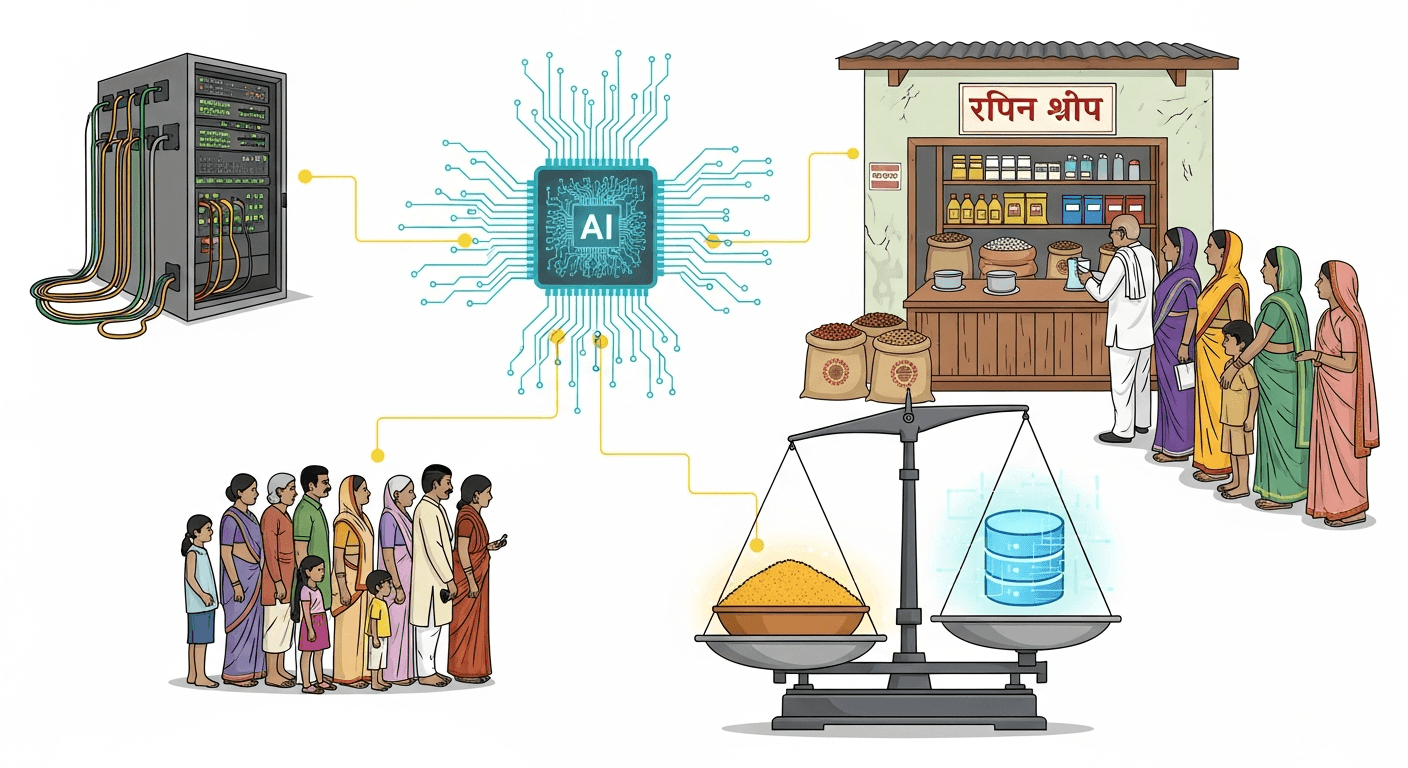
Today the Cabinet’s decision to allow AI to help select beneficiaries and manage ration delivery for the public distribution system (PDS) landed squarely in my inbox. As someone who has written about national data systems and digital delivery before, I feel both hopeful and cautious. Technology can reduce leakages and speed delivery — but when it touches food entitlements, errors cost people their daily meal.
I’ve previously written about the promise and risks of large citizen databases and digital delivery platforms How many NATIONAL databases of Indian Citizen. That experience shapes how I read this new move: a powerful tool that must be governed carefully.
What the policy decision means (plainly)
At a high level, the government plans to use AI systems to:
- analyze existing PDS and socio-economic data to identify who should qualify for subsidised rations;
- optimize ration distribution routes and schedules to reduce delays and pilferage;
- detect anomalies (duplicate beneficiaries, suspicious transactions) using pattern-detection models;
- support on-the-ground authentication (biometric checks at PoS) with automated alerts.
In other words, AI will act as an automated assistant for eligibility screening, distribution planning, and fraud detection — not (or at least not necessarily) as the sole decision-maker.
How AI will likely be used in practice
- Data integration: AI models will ingest records from ration databases, socio-economic surveys, bank transfer records, and possibly biometric logs.
- Scoring and prioritization: individuals or households may receive an eligibility score based on multiple signals (income proxies, family composition, transaction history).
- Route and inventory optimization: algorithms can decide which warehouses or fair-price shops should receive how much stock, and when.
- Anomaly detection: systems flag duplicate ration-card usage or sudden spikes in withdrawals for human review.
Think of the system like a very fast sorting hat: it ranks and routes cases, but humans should still be in the loop for appeals and final checks.
Potential benefits
- Efficiency gains: reduced manual verification and faster identification of genuine beneficiaries.
- Reduced leakages: automated anomaly detection can cut diversion and ghost beneficiaries.
- Better planning: predictive models can help anticipate shortages and reduce stockouts.
- Targeted outreach: the system could identify under-served pockets and direct special campaigns.
Real-world analogy: banks use algorithms to detect fraudulent card transactions in real time — flagging suspicious behavior for human agents. The same pattern (automation + human review) can improve PDS reliability.
Major risks and ethical concerns
- Wrongful exclusion: imperfect models may misclassify vulnerable households as ineligible. For someone who lives hand-to-mouth, exclusion is catastrophic.
- Bias in data: historical errors and uneven data coverage (e.g., under-registration of migrants) will produce biased AI outcomes.
- Surveillance and mission creep: data collected for ration delivery might later be repurposed for unrelated surveillance without consent.
- Opacity: closed-source models make it hard for citizens to understand why they were excluded.
Ethically, we must ask: Are we designing systems that protect dignity and ensure that error-correction is fast, affordable, and accessible?
Implementation challenges on the ground
- Digital divide: many beneficiaries and small ration dealers lack reliable internet, modern PoS devices, or digital literacy.
- Data quality: government databases often contain stale addresses, duplicate entries, or missing records — all of which poison AI outputs.
- Operational change: fair-price shop owners will need training and perhaps compensation for new workflows.
- Maintenance and governance: AI models degrade over time; they need monitoring, retraining, and clear accountability.
A cautionary tale: several digital welfare apps have failed because they were designed without testing on low-resource hardware or local language support. Technology must meet field realities.
Data privacy and security
Any system that centralizes beneficiary data must follow strict principles:
- Data minimization: collect only what is necessary for PDS delivery.
- Strong encryption: at rest and in transit, with strict key management.
- Access controls and audit logs: every access should be logged and reviewable.
- Purpose limitation: explicit legal safeguards that forbid re-using data for unrelated purposes without fresh consent.
These are not merely technical boxes to tick — they are the difference between a system that helps people and one that endangers them.
Impact on stakeholders
- Beneficiaries: could gain from faster delivery and fewer stockouts — but face risk of wrongful exclusion and complexity when appealing decisions.
- Government: stands to save money and improve targeting, but also to inherit political and legal risk if errors multiply.
- Ration dealers: may see workflow changes, need equipment upgrades, and face stricter audit trails that change livelihoods.
- Civil society: will play a critical role in monitoring, outreach, and helping people navigate appeals.
Legal and regulatory considerations
This deployment must align with data protection laws, anti-discrimination norms, and administrative procedural fairness. There should be:
- A statutory framework that defines data use, retention, and redress mechanisms;
- Mandatory algorithmic impact assessments before scale-up;
- Independent audits and transparency reports published at regular intervals.
Recommendations for responsible deployment
- Pilot first: run small, geographically limited pilots with independent evaluation before national rollout.
- Human-in-the-loop: keep final eligibility decisions and emergency overrides with human officers.
- Transparent criteria: publish the features used by models and allow public scrutiny (while protecting privacy).
- Easy, free grievance redressal: fast appeal channels at the village/ward level, with interim relief (provision of food) while appeals are processed.
- Invest in infrastructure and training: upgrade PoS devices, connectivity, and digital literacy for dealers and beneficiaries.
- Data governance: strict purpose limitation, retention schedules, and independent audits.
- Inclusive data fixes: complement algorithmic selection with community verification to avoid excluding migrants, the homeless, and others with weak records.
Takeaway
AI can help make the PDS more efficient, but the technology is only as humane as the systems, rules, and people that surround it. If we prioritize transparency, appealability, and data protections — and if we invest in the last mile — AI can be a force multiplier for food security. If not, it risks turning an efficiency tool into a new source of exclusion.
Regards,
Hemen Parekh
Any questions / doubts / clarifications regarding this blog? Just ask (by typing or talking) my Virtual Avatar on the website embedded below. Then "Share" that to your friend on WhatsApp.
Get correct answer to any question asked by Shri Amitabh Bachchan on Kaun Banega Crorepati, faster than any contestant
Hello Candidates :
- For UPSC – IAS – IPS – IFS etc., exams, you must prepare to answer, essay type questions which test your General Knowledge / Sensitivity of current events
- If you have read this blog carefully , you should be able to answer the following question:
- Need help ? No problem . Following are two AI AGENTS where we have PRE-LOADED this question in their respective Question Boxes . All that you have to do is just click SUBMIT
- www.HemenParekh.ai { a SLM , powered by my own Digital Content of more than 50,000 + documents, written by me over past 60 years of my professional career }
- www.IndiaAGI.ai { a consortium of 3 LLMs which debate and deliver a CONSENSUS answer – and each gives its own answer as well ! }
- It is up to you to decide which answer is more comprehensive / nuanced ( For sheer amazement, click both SUBMIT buttons quickly, one after another ) Then share any answer with yourself / your friends ( using WhatsApp / Email ). Nothing stops you from submitting ( just copy / paste from your resource ), all those questions from last year’s UPSC exam paper as well !
- May be there are other online resources which too provide you answers to UPSC “ General Knowledge “ questions but only I provide you in 26 languages !



No comments:
Post a Comment