
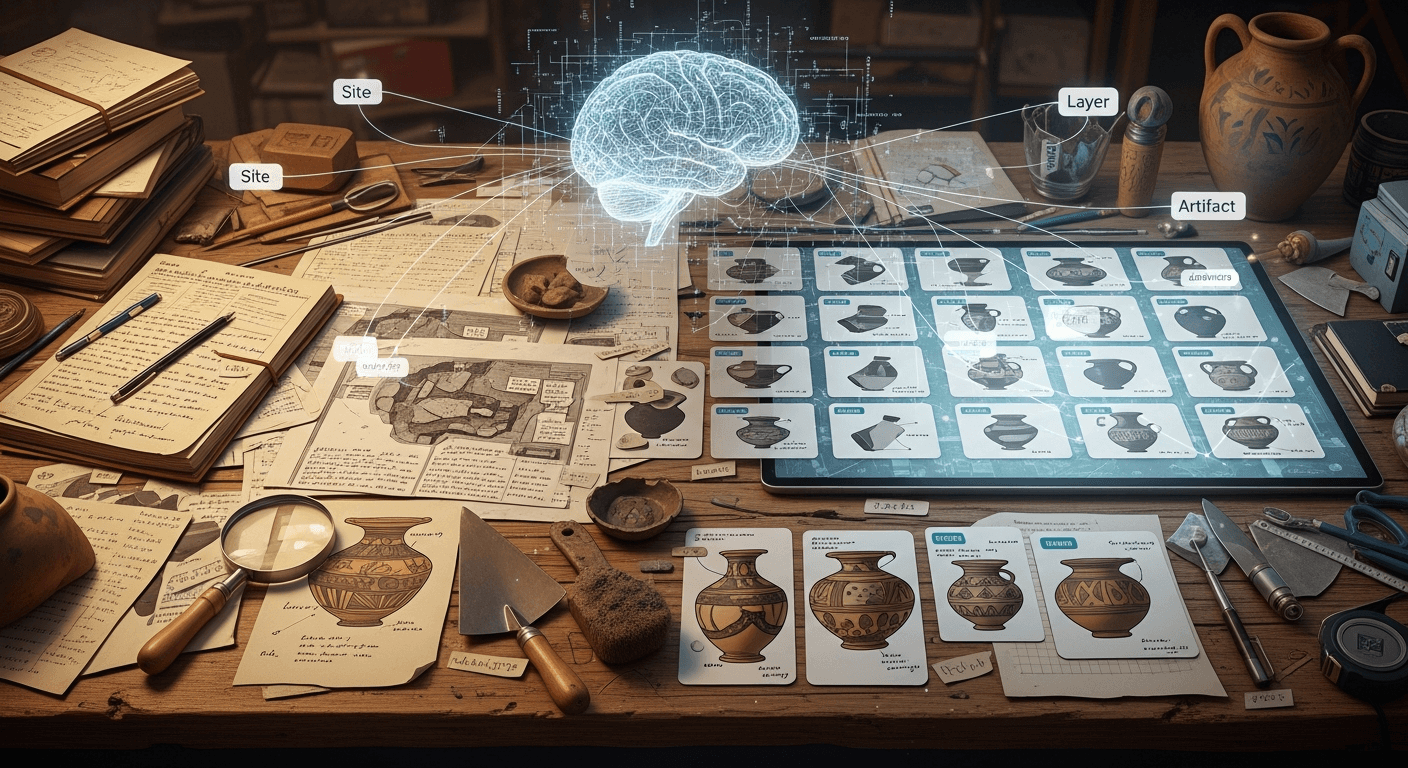
I have spent long afternoons reading excavation reports—handwritten notes, PDF scans, interim site summaries and long final monographs. Each document carries decisions, surprises, and context that matter for future study, but they are often locked in inconsistent formats, local languages, or idiosyncratic terminologies. Language-based AI systems offer a practical way to make that material searchable, comparable and useful again. In this post I describe how these systems can help, give concrete examples, point out limits and ethical risks, and suggest a pragmatic path forward.
Why language matters in archaeology
Archaeology is a discipline of words and objects. Field journals describe stratigraphy; lab reports list measurements; catalogues name artifacts; outreach notes explain significance to local communities. When text is scattered across formats and languages, insights stay buried. Language-focused AI—tools built on natural language processing (NLP) and large language models (LLMs)—can act as an organised index and translator for that textual record, reducing friction between discovery and reuse.
I have written about the promise of language-first AI models before, especially for regional languages and domain-specific corpora Next Generation NLP. That continuity matters: archaeology benefits most when models can understand local vocabularies and social contexts.
Practical examples — what these systems can do today
Automatic summarisation: ingest a 60-page site report and produce a concise, structured summary with key dates, excavation units, stratigraphic relationships, and major finds.
Entity extraction and indexing: detect and tag place names, feature types (e.g., pit, hearth), artifact classes (pottery, lithics), dates and measurement units so that a database can be queried across hundreds of reports.
Multilingual normalization: translate and standardise reports written in local languages or older academic styles into a controlled vocabulary so that searches return consistent results. This is especially important where local-language field notes never made it into national archives—an idea I’ve discussed while following developments in Indic-language AI models Indic language AI model.
Semantic search: let a researcher ask, “Show me all contexts with burnt daub and cereal impressions,” and receive ranked excerpts across sites, rather than only filename matches.
Automated metadata and DOI-ready summaries: create draft metadata (site, coordinates, chronology, dataset links) to speed publication and sharing with repositories.
Benefits — why teams and institutions should care
Time savings: trivial tasks like locating all references to a diagnostic pottery type across reports become minutes not weeks.
Better discovery and synthesis: cross-site queries and automated comparisons can surface regional patterns that single-site studies miss.
Preservation and access: converting unstructured notes into structured, searchable archives safeguards knowledge even if physical copies degrade.
Community engagement: translated summaries help share results with local communities in their languages and reduce gatekeeping.
Reuse and reproducibility: clear metadata and structured outputs make data easier to reanalyse with new scientific methods.
Limitations and technical caveats
Data quality matters: scanned handwriting, poor OCR, and inconsistent terminology reduce accuracy. Preprocessing (OCR correction, manual spot-checks) is still necessary.
Domain specificity: off-the-shelf LLMs may not know subtle archaeological distinctions (e.g., between similar pottery types) without targeted fine-tuning and curated glossaries.
Hallucinations and errors: AI can invent details or misassign dates. Human review remains essential — AI should assist, not replace, expert judgement.
Provenance complexity: mixing datasets with different recording standards can create misleading aggregations unless provenance metadata is preserved and visible.
Ethical considerations — custodianship and sensitive data
Language AI for archaeology raises particular ethical responsibilities:
Protect sensitive site locations: automated publication of coordinates or detailed descriptions can increase looting risk. Systems must allow redaction and tiered access.
Respect community knowledge: translations and summaries of indigenous oral histories or traditional place names require consent and culturally appropriate handling.
Data ownership and credit: automated summaries should always link back to original authors and repositories; attribution matters for careers and for communities.
Bias and representation: models trained on published academic reports may under-represent local or non‑English voices. Intentionally curate diverse corpora to reduce bias.
Human oversight: maintain clear review workflows so that interpretive claims produced with AI are validated by trained archaeologists.
A pragmatic deployment roadmap
- Start small: pilot the pipeline on one site or collection with a mixed set of documents (report, catalog, field diary).
- Build or adopt a simple ontology: define core entities (site, locus, artifact, material, date) and common controlled vocabularies for pottery types, features and measurements.
- Improve ingestion: combine OCR, manual spot correction and domain-aware tokenisers to handle specialist terms.
- Fine-tune models: use a modest set of annotated reports to teach the model local terms and conventions; keep a validation set for quality checks.
- Create human-in-the-loop review: archaeologists review and correct AI outputs; corrections feed back to improve the system.
- Access controls: implement redaction and tiered sharing for sensitive data; include provenance and licensing metadata with every output.
- Share standards: publish the ontology and export formats so other teams can interoperate and reuse your work.
Conclusion
Language-based AI systems will not replace the careful judgement of archaeologists, but they can dramatically reduce the time spent wrestling with formats and retrieval—freeing people to focus on interpretation and stewardship. With careful design, community consent and human oversight, these tools can make fragmented archives speak to each other and to future generations. This is precisely the kind of practical, language-aware progress I have followed and argued for in earlier notes on next-generation NLP. We should start small, respect context, and build tools that elevate both scientific insight and local voices.
Regards,
Hemen Parekh
Any questions / doubts / clarifications regarding this blog? Just ask (by typing or talking) my Virtual Avatar on the website embedded below. Then "Share" that to your friend on WhatsApp.
Get correct answer to any question asked by Shri Amitabh Bachchan on Kaun Banega Crorepati, faster than any contestant
Hello Candidates :
- For UPSC – IAS – IPS – IFS etc., exams, you must prepare to answer, essay type questions which test your General Knowledge / Sensitivity of current events
- If you have read this blog carefully , you should be able to answer the following question:
- Need help ? No problem . Following are two AI AGENTS where we have PRE-LOADED this question in their respective Question Boxes . All that you have to do is just click SUBMIT
- www.HemenParekh.ai { a SLM , powered by my own Digital Content of more than 50,000 + documents, written by me over past 60 years of my professional career }
- www.IndiaAGI.ai { a consortium of 3 LLMs which debate and deliver a CONSENSUS answer – and each gives its own answer as well ! }
- It is up to you to decide which answer is more comprehensive / nuanced ( For sheer amazement, click both SUBMIT buttons quickly, one after another ) Then share any answer with yourself / your friends ( using WhatsApp / Email ). Nothing stops you from submitting ( just copy / paste from your resource ), all those questions from last year’s UPSC exam paper as well !
- May be there are other online resources which too provide you answers to UPSC “ General Knowledge “ questions but only I provide you in 26 languages !




No comments:
Post a Comment