
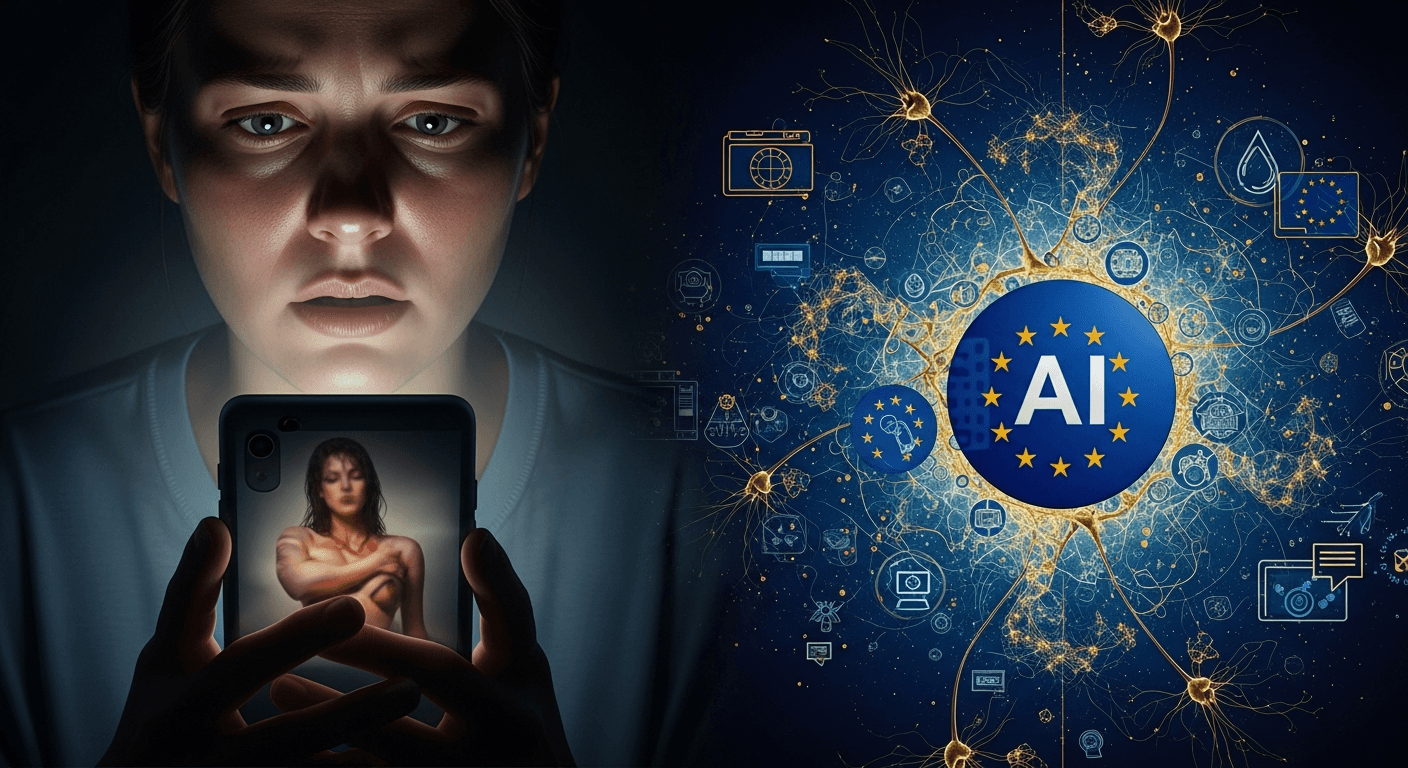
Why this matters to me—and to all of us
I follow technology the way some people follow weather: not because I enjoy storms, but because I want to know when to bring an umbrella. The recent EU deal to ban sexualised AI deepfakes feels like one of those red-flag forecasts. As someone who has warned about the growing power of synthetic media for years, I see this agreement as both an urgent protection and a complicated test of law, technology, and values.[^1]
What are deepfakes? A short primer
Deepfakes are synthetic audio, images or video created or altered by machine learning models to make a person appear to say or do something they did not. They range from harmless fun—face-swaps and virtual avatars—to dangerous manipulations used in scams, fraud, revenge porn, political disinformation, and harassment.
At their technical core are generative models (often GANs or diffusion models) trained on datasets of images, video and voice samples. The better the data and the model, the more convincing the output. Over the past decade, tools have lowered the barrier to entry so that realistic-looking content can be produced by relatively small teams or even individuals.
Why sexualised deepfakes are uniquely harmful
Sexualised deepfakes—explicit or suggestive synthetic media that depict identifiable people without their consent—harm in distinct ways:
- Personal violation: They replicate and amplify the harms of non-consensual intimate imagery.
- Reputation damage: Victims suffer social stigma, job loss, emotional trauma and long-term reputational harm.
- Exploitation and blackmail: Deepfakes are tools for coercion, extortion and targeted harassment.
- Chilling effects: The threat of being fabricated into explicit content silences people—especially women and public figures—from participating fully online.
These harms are not hypothetical. I wrote about the rise and risks of deepfakes years ago and urged early attention to how easy and damaging they could become.[^2]
What the EU deal says (who, what, when, how)
In broad terms, EU institutions (the European Commission, the Council and the European Parliament working toward a compromise) announced a provisional agreement to restrict the creation and distribution of sexualised deepfakes of identifiable people without their consent. The agreement aims to:
- Ban the deliberate creation and public distribution of sexualised AI-generated imagery of an identifiable person without that person’s explicit consent.
- Require platforms and AI providers to implement measures for detection, labeling/watermarking and rapid takedown when notified.
- Mandate transparency measures for AI tools that can generate realistic human likenesses (e.g., provenance labels, mandatory watermarking of synthetic sexual content).
- Set obligations for platforms to establish clear reporting channels, victim support and expedited removal processes.
The deal is a provisional political compromise reached recently between EU lawmakers and member states; it still requires formal adoption and implementation steps at national level. The idea is to move quickly to protect citizens while final regulatory text is negotiated.
Legal and technical challenges
No law can be effective unless it is precise and enforceable. This deal raises several immediate challenges:
- Definitions: What exactly counts as “sexualised”? How do we define an “identifiable person” in an era of low-resolution faces and partial likenesses? Vagueness risks both under- and over-enforcement.
- Consent: How is consent proven? Can consent be time-limited or revoked retroactively? Consent management for media is legally and technically messy.
- Detection: Automated detectors have false positives and negatives. Bad actors can attempt to evade detection with model tweaks or by using adversarial techniques.
- Attribution and provenance: Watermarking/generative provenance is promising but not yet universal. Malicious actors can host content on decentralized services or foreign platforms beyond EU jurisdiction.
- Platform scope: Will obligations cover hosting providers, social networks, small apps, or only large intermediaries? Calibration affects both reach and fairness.
Enforcement and penalties
The deal contemplates robust enforcement: heavy fines for non-compliance (scaled to company turnover), mandatory remedial measures, and expedited national enforcement mechanisms to process takedown requests and victim complaints. The precise penalty ladder is to be agreed, but the political intent is clear—non-compliance will be costly.
Enforcement will hinge on cross-border cooperation, swift notice-and-takedown pipelines, and investment in technical detection capabilities. Smaller platforms will need help; otherwise enforcement will fall unevenly on well-resourced companies while bad actors migrate to fringe services.
Free speech and AI innovation: balancing acts
Any prohibition on expressive content risks chilling legitimate expression—satire, parody, art, historical reenactments, and consensual adult content. The EU deal attempts to target non-consensual, sexualised depictions of identifiable individuals, but line-drawing is hard. Overbroad rules could stifle creators and researchers working on synthetic media safety.
On the innovation side, rules that require labeling, provenance and safety-by-design could raise compliance costs but also create a trustworthy market niche: platforms and tools that prioritize safety and transparency may gain user trust. The trick is to write regulation that curbs abuse without banning benign research and creativity.
International context and likely responses
The EU is trying to set a global norm: strong digital-protection rules with enforceable obligations. Other jurisdictions will watch closely.
- United States: The U.S. approach historically leans toward speech protections and industry self-regulation; federal action may follow in targeted areas, but patchwork state laws already exist around non-consensual explicit imagery.
- China: Regulatory routes differ—China tends to focus on content control and platform responsibilities, often with stricter state oversight.
- Global coordination: Effective mitigation benefits from cross-border cooperation on takedowns, harmonised definitions, and shared technical standards for provenance and watermarking.
Voices (fictional, labeled)
Fictional EU institutional statement:
"Our priority is to protect human dignity and privacy. This agreement sends a clear signal that the EU will not tolerate the weaponisation of synthetic media against people's most intimate rights," said a fictional EU institutional spokesperson.
Fictional civil society reaction:
"This is a welcome step for survivors of image-based abuse—technology must not be a tool for re-victimisation," said a fictional representative from a civil society group focused on online harms. "Implementation must be survivor-centred and resourced."
(These quotes are fictional and intended to illustrate the kinds of statements stakeholders might make.)
Practical guidance: what you can do if you encounter a deepfake
- Preserve evidence: Don’t delete the content immediately. Take screenshots and note URLs, timestamps and any metadata.
- Report quickly: Use the platform’s reporting channels. Provide as much context as possible and request expedited review if the content affects your safety.
- Seek support: Reach out to trusted friends, legal advisers or support organisations for victims of online abuse.
- Use privacy tools: Tighten social media privacy settings and remove easily accessible images and biometric data where possible.
- Watermark your content: Public figures and creators can proactively add clear provenance markers and host originals in verified channels so audiences can compare.
- Learn to spot fakes: Look for visual glitches, inconsistent lighting, odd eye movement, or poor lip-sync; verify with trusted sources before sharing.
Closing reflection
Regulation can’t be a magic wand, but it can lower the temperature of a very toxic risk. The EU deal is a bold attempt to limit clear harms while the technology continues to evolve. My own writing about deepfakes over the years has felt like ringing bells at the edge of the field—this policy moment is a response to those bells. The next task is to make sure protections are precise, enforceable and globally coordinated, and to empower victims rather than punish expression.
Regards,
Hemen Parekh
Any questions / doubts / clarifications regarding this blog? Just ask (by typing or talking) my Virtual Avatar on the website embedded below. Then "Share" that to your friend on WhatsApp.
[^1]: Hemen Parekh has previously commented on deepfakes and policy responses; see his reflections on early deepfake concerns and cybercontent rules.China's New Cybercontent Rules Seek to Weed Out Fake News and Deepfakes
[^2]: For a longer personal view on the risks and detection tips, see my earlier post on deepfakes and digital identity.I am not worried about my Deep Fake
Get correct answer to any question asked by Shri Amitabh Bachchan on Kaun Banega Crorepati, faster than any contestant
Hello Candidates :
- For UPSC – IAS – IPS – IFS etc., exams, you must prepare to answer, essay type questions which test your General Knowledge / Sensitivity of current events
- If you have read this blog carefully , you should be able to answer the following question:
- Need help ? No problem . Following are two AI AGENTS where we have PRE-LOADED this question in their respective Question Boxes . All that you have to do is just click SUBMIT
- www.HemenParekh.ai { a SLM , powered by my own Digital Content of more than 50,000 + documents, written by me over past 60 years of my professional career }
- www.IndiaAGI.ai { a consortium of 3 LLMs which debate and deliver a CONSENSUS answer – and each gives its own answer as well ! }
- It is up to you to decide which answer is more comprehensive / nuanced ( For sheer amazement, click both SUBMIT buttons quickly, one after another ) Then share any answer with yourself / your friends ( using WhatsApp / Email ). Nothing stops you from submitting ( just copy / paste from your resource ), all those questions from last year’s UPSC exam paper as well !
- May be there are other online resources which too provide you answers to UPSC “ General Knowledge “ questions but only I provide you in 26 languages !



No comments:
Post a Comment