
Introduction
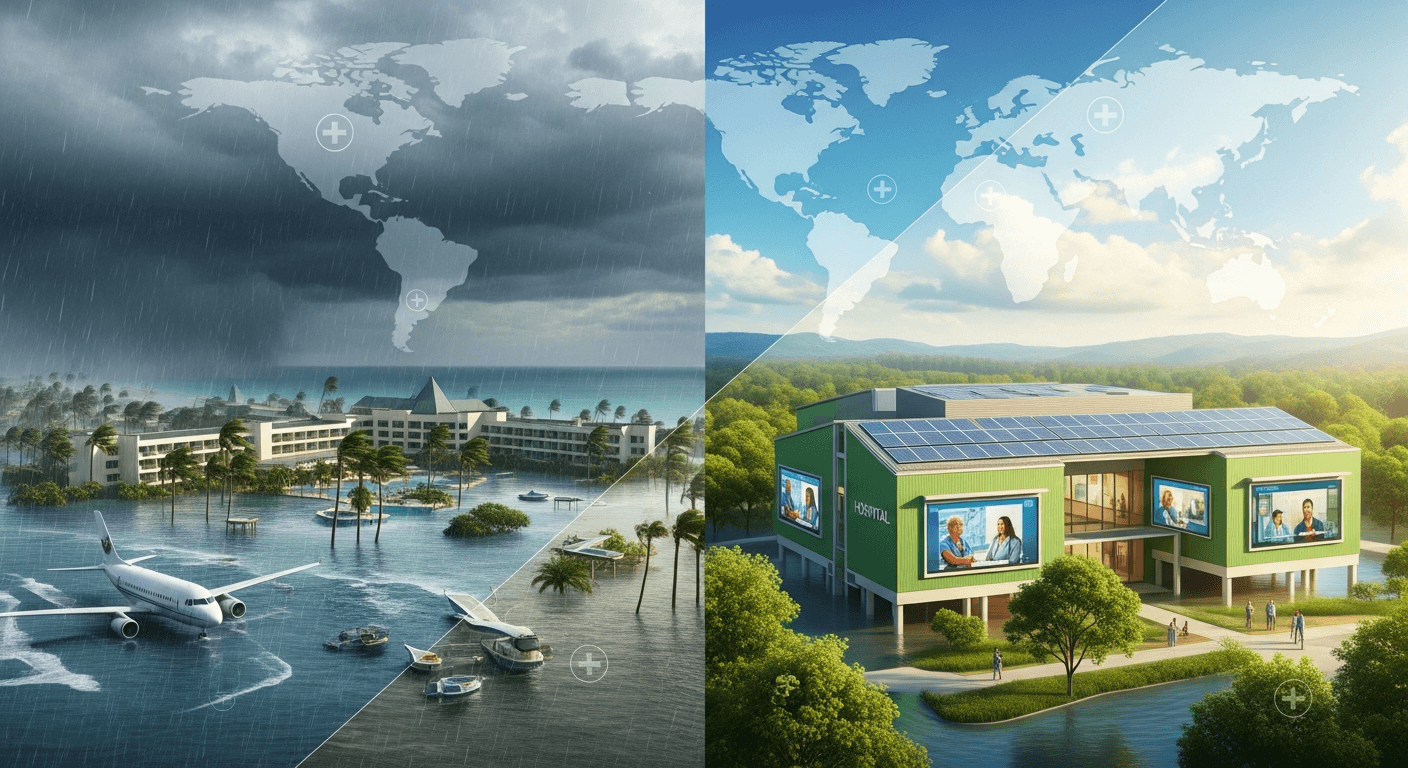
I have long been fascinated by how health, mobility and economies intersect. Medical tourism — the cross-border movement of patients seeking care — sits at that intersection. In recent years climate change has added a new variable: extreme weather, shifting disease patterns and infrastructure stress that threaten both patient safety and the economic logic of health travel. In this post I analyse what medical tourism is, how climate risks disrupt it, real-world examples, governance challenges and practical adaptation and mitigation strategies. I also offer succinct takeaways and tips for UPSC aspirants preparing answers on this evolving current-affairs theme.
What is medical tourism? Scale and drivers
Definition: Medical tourism refers to patients travelling across international borders to obtain elective or urgent medical care, including surgeries, dental procedures, fertility treatments, cosmetic surgery and specialised tertiary care.
Scale (pre- and post-pandemic context): Estimates before COVID-19 placed annual cross-border medical travel in the tens of billions of dollars (market estimates in the 2010s ranged widely, often cited between USD 50–100+ billion depending on metrics). Several leading destinations — India, Thailand, Malaysia, parts of Europe and the Caribbean — attracted hundreds of thousands to millions of patient-visitors annually in earlier years. The sector’s size rebounded unevenly after the COVID-19 shock.
Key drivers:
Cost differentials: substantially lower prices for complex procedures compared with high-income countries.
Access and waiting times: faster access to specialised care.
Quality and reputation: centres of excellence, international accreditation.
Ancillary attractions: recovery in a holiday destination, combined with travel opportunities.
(As I have written previously, India emerged as a major destination for cost-sensitive complex procedures, attracting large numbers in the 2000s and 2010s)[http://myblogepage.blogspot.com/2013/08/medical-tourism-to-india.html].
How climate change affects medical tourism: direct and indirect effects
Climate change alters the operating environment for medical travel in several interlinked ways:
Extreme weather events and travel disruption
Hurricanes, cyclones, floods and wildfires can close airports, block roads and force hospital evacuations. The 2010 Eyjafjallajökull volcanic ash disruption and recurrent storm-related airport closures in later years are reminders that transport vulnerability directly affects patient flows.
Damage to health infrastructure
Hospitals and clinics in coastal or low-lying tourist hubs face flooding, saltwater intrusion and storm damage. Repair costs and service interruptions reduce capacity for incoming patients.
Changing disease patterns and health risks
Vector-borne diseases (dengue, chikungunya, malaria) have shifted geographically with warming, altering risk profiles for visitors and sometimes increasing the burden on local health systems.
Increased insurance and operational costs
Climate risk raises premiums for facilities and travellers. Insurers may exclude certain climate-related events or charge higher risk-based prices, shifting costs to providers and patients.
Indirect socioeconomic effects
Local economies dependent on tourism suffer when climate disasters recur, reducing capacity to support international patient services (hotels, transport, rehabilitation facilities).
Reputational risk and patient safety concerns
News of disrupted services or climate-related health hazards can deter high-value medical travellers who value reliability and continuity of care.
Case studies and examples
India
India has been a leading medical tourism destination, with major urban centres (Chennai, Delhi, Mumbai, Hyderabad) hosting tertiary hospitals that attract international patients. Climatic stress — heatwaves, urban floods and cyclones affecting coastal areas — increases operational challenges for recovery and post-operative care.
Thailand
Thailand’s strong medical tourism ecosystem (Bangkok, Phuket) is exposed to periodic floods and extreme heat. Coastal and island resorts face storm-related damage that affects hospital access and elective-care scheduling.
Caribbean
Small island states heavily reliant on tourism face acute vulnerability. Hurricanes (e.g., in the 2010s) damaged infrastructure, hospitals and ports, causing long-term reductions in inbound medical travel and a costly recovery cycle.
Europe
Heatwaves (notably 2019–2022 periods) stressed hospitals through spikes in emergency admissions and disrupted elective surgery schedules. Cross-border patient flows for planned procedures can be postponed or rerouted, with economic consequences.
Policy and governance challenges
- Fragmented responsibilities: Health, transport, tourism and disaster-management ministries must coordinate, but institutional silos hinder integrated planning.
- Equity concerns: Reliance on medical tourists can skew investment toward services for foreigners at the expense of local population needs.
- Financing and insurance gaps: Private providers and small island states often lack access to capital for resilience upgrades; insurance markets may not cover recurrent climate risks affordably.
- Regulatory complexity: Cross-border care requires robust patient safety standards, data sharing and contingency planning — all complicated by climate-induced disruptions.
Adaptation and mitigation strategies for governments and industry
Infrastructure resilience
Climate-proof critical hospital infrastructure (elevate generators, flood barriers, resilient power and water supplies).
Green hospitals and energy security
Invest in renewable energy (solar microgrids), energy-efficient design and backup systems to reduce operational vulnerabilities and emissions.
Sustainable transport and logistics
Strengthen multimodal access (sea and land alternatives to airports), contingency plans for patient transfers and supply-chain diversification for medical supplies.
Diversified service delivery
Expand telemedicine, remote pre- and post-operative care, and partnerships with regional hubs to maintain continuity when travel is interrupted.
Health system preparedness
Strengthen surveillance for climate-sensitive diseases, emergency response protocols and surge capacity for periods of overlapping tourist influx and local disasters.
Insurance and financial innovation
Explore climate-risk pooling, parametric insurance for quick payouts after disasters, and public–private mechanisms to underwrite resilience investments.
International cooperation
Bilateral agreements for patient transfer, mutual recognition of telehealth, and shared disaster-response protocols reduce friction during events.
Implications for geopolitics and economies
- Economic vulnerability: Countries that derived sizeable foreign-exchange earnings from medical tourism risk sudden revenue shocks after disasters.
- Soft power and diplomacy: Medical diplomacy is affected when hub nations cannot guarantee continuity of high-quality care, altering geopolitical influence.
- Migration and labour: Recurrent climate impacts may push health professionals to migrate, affecting local capacity to serve foreign patients.
Conclusion — Key takeaways
- Climate change is a systemic risk to medical tourism: it disrupts transport, damages infrastructure, and alters disease burdens.
- Vulnerabilities are highest where health systems, tourism infrastructure and climate exposure coincide — small islands and some coastal hubs are most at risk.
- Adaptation requires integrated policy: resilient infrastructure, sustainable energy, telemedicine and insurance innovations must be combined.
- For policymakers, balancing economic benefits from medical tourism with local health equity and climate resilience is essential.
How to frame this topic in UPSC answers
For GS papers (Policy/IR/Economy): Start with a crisp definition and scale. Explain climate-related vulnerabilities with 2–3 examples (India, Caribbean, Thailand). Present policy options across infrastructure, finance and international cooperation. Conclude with a balanced evaluation — costs, feasibility and equity.
For Ethics/Essay: Use the theme to discuss responsibility, intergenerational equity and institutional accountability. Argue for resilient, inclusive health systems that protect both citizens and foreign patients.
Practice structure for answers:
Introduction: Define and contextualise.
Body: Explain impacts (direct/indirect), give case examples, propose policy solutions.
Conclusion: Short, action-oriented takeaway and scope for further policy action.
I believe the intersection of climate and health mobility will be an increasingly important current-affairs topic. Policymakers and aspirants should watch data on extreme events, hospital resilience investments and insurance innovations — these will shape which countries remain reliable destinations for care in a warming world.
Regards,
Hemen Parekh
Any questions / doubts / clarifications regarding this blog? Just ask (by typing or talking) my Virtual Avatar on the website embedded below. Then "Share" that to your friend on WhatsApp.
Get correct answer to any question asked by Shri Amitabh Bachchan on Kaun Banega Crorepati, faster than any contestant
Hello Candidates :
- For UPSC – IAS – IPS – IFS etc., exams, you must prepare to answer, essay type questions which test your General Knowledge / Sensitivity of current events
- If you have read this blog carefully , you should be able to answer the following question:
- Need help ? No problem . Following are two AI AGENTS where we have PRE-LOADED this question in their respective Question Boxes . All that you have to do is just click SUBMIT
- www.HemenParekh.ai { a SLM , powered by my own Digital Content of more than 50,000 + documents, written by me over past 60 years of my professional career }
- www.IndiaAGI.ai { a consortium of 3 LLMs which debate and deliver a CONSENSUS answer – and each gives its own answer as well ! }
- It is up to you to decide which answer is more comprehensive / nuanced ( For sheer amazement, click both SUBMIT buttons quickly, one after another ) Then share any answer with yourself / your friends ( using WhatsApp / Email ). Nothing stops you from submitting ( just copy / paste from your resource ), all those questions from last year’s UPSC exam paper as well !
- May be there are other online resources which too provide you answers to UPSC “ General Knowledge “ questions but only I provide you in 26 languages !




No comments:
Post a Comment