
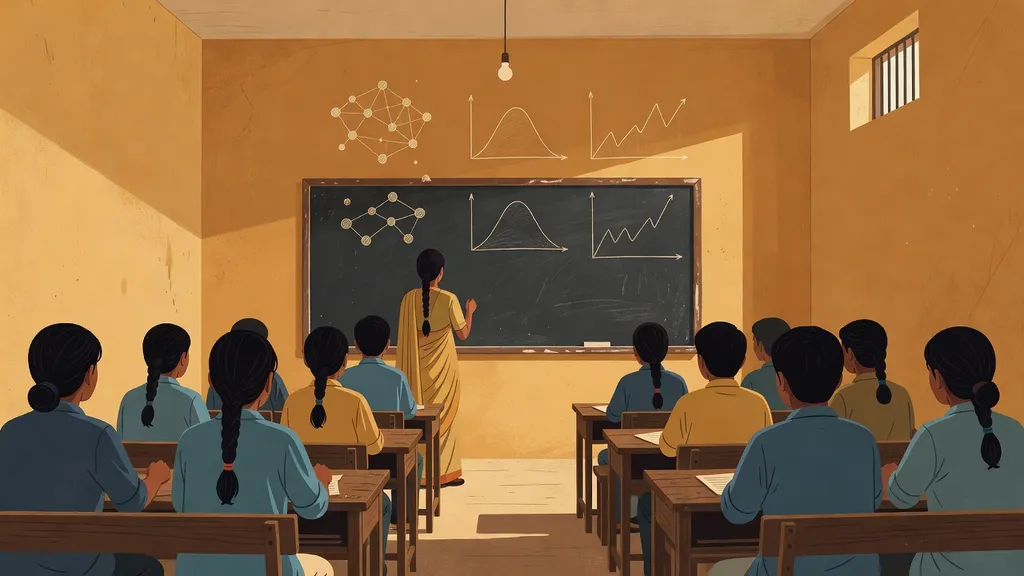
Karnataka has put AI and Python into Class IX in 1,800 government high schools under NSQF, and Goa's AI Policy 2026 wants 50,000 certified professionals by 2030. The maths-to-model-mapping is the serious part of Karnataka's design; the guest-teacher contract is the part that could sink it. My audit asks for three things: teacher training at scale with a pass standard, offline-first Kannada content, and a machine-readable skill registry — so a Class 9 AI credential earned in 2026 still means something specific to an employer in 2032.
On 14 November 2026 the Karnataka Department of School Education and Literacy posted on X that AI is being taught to Class IX students in 1,800 government high schools this academic year under the National Skills Qualifications Framework. NDTV carried it on 16 November. For someone who has been asking for an AI slot in Class 9 since 2025, this is the news I wanted. So, applause first, audit immediately after.
What Karnataka got right is the plumbing, not the label. Anchoring the course in NSQF means a child's work is meant to end in a recognised competency rather than a school's own certificate. And the mathematics is not decorative. Jagran Josh (16 November 2026) reports the syllabus ties Statistics to data exploration, Probability to predictive outcomes, and Linear Algebra and Calculus to model optimisation. Most "AI awareness" programmes stop at showing children a chatbot. This one puts the mathematics of model training beside the tool.
The risk is single but heavy: delivery rests on guest teachers on contract. The Times of India (16 November 2026) reports the department has begun recruiting them, and that besides teaching AI, Python, data, computer vision, NLP and generative AI, they will maintain enrolment records, track attendance and conduct assessments — across rural and semi-urban schools. As realfeed's brief of 17 November 2026 notes, no student count, no assessment standard and no certificate detail beyond the NSQF framework has been published.
I set out five guardrails in AI Classrooms: A New Chapter (1 April 2026): phase and measure; teacher-centred training; offline-first design; local languages and context; a transparent data policy. Read against a contract teacher in a two-room school, they stop being a wish list and become an audit checklist. And in Why skill-based Class 11–12 curriculum is the right pivot (21 September 2025) I named the three failure modes — inequity and the digital divide, teacher capability, fragmented non-standard credentials. All three are live in this rollout.
Goa, whose AI Policy 2026 story broke on 17 November, is running the other design: empanelled agencies for AI, data and generative-media skilling, AI fundamentals for Classes VI to XII from 2027-28, AI labs in up to 50 government schools, and a target of 50,000 AI-certified professionals by 2030 with at least 25% women, 30% under 30 and 15% from tier-2 and tier-3 talukas (Times of India, Goa, 17 November 2026). Urban Acres also notes what the announcement omits: number of agencies, funding, first-batch dates. Two states, two designs — and both have announced targets before announcing measurement.
Three things I would ask Karnataka to publish before the first term ends:
- A micro-credential path for the guest faculty — hours, content, a pass standard — not a one-day orientation.
- Offline-first content in Kannada, on paper and on a phone, so a school with one working socket can still run the course.
- A machine-readable skill registry, so an NSQF Class 9 AI credential reads as a specific competency, not a line on a certificate.
The number I keep looking for is the one nobody published. I would rather audit 1,800 classrooms in 2027 than applaud a hashtag in 2026.
With regards,
Hemen Parekh
www.Iam-Immortal.ai / www.IndiaAGI.ai / www.YourContentCreator.in
17 November 2026
No comments:
Post a Comment