
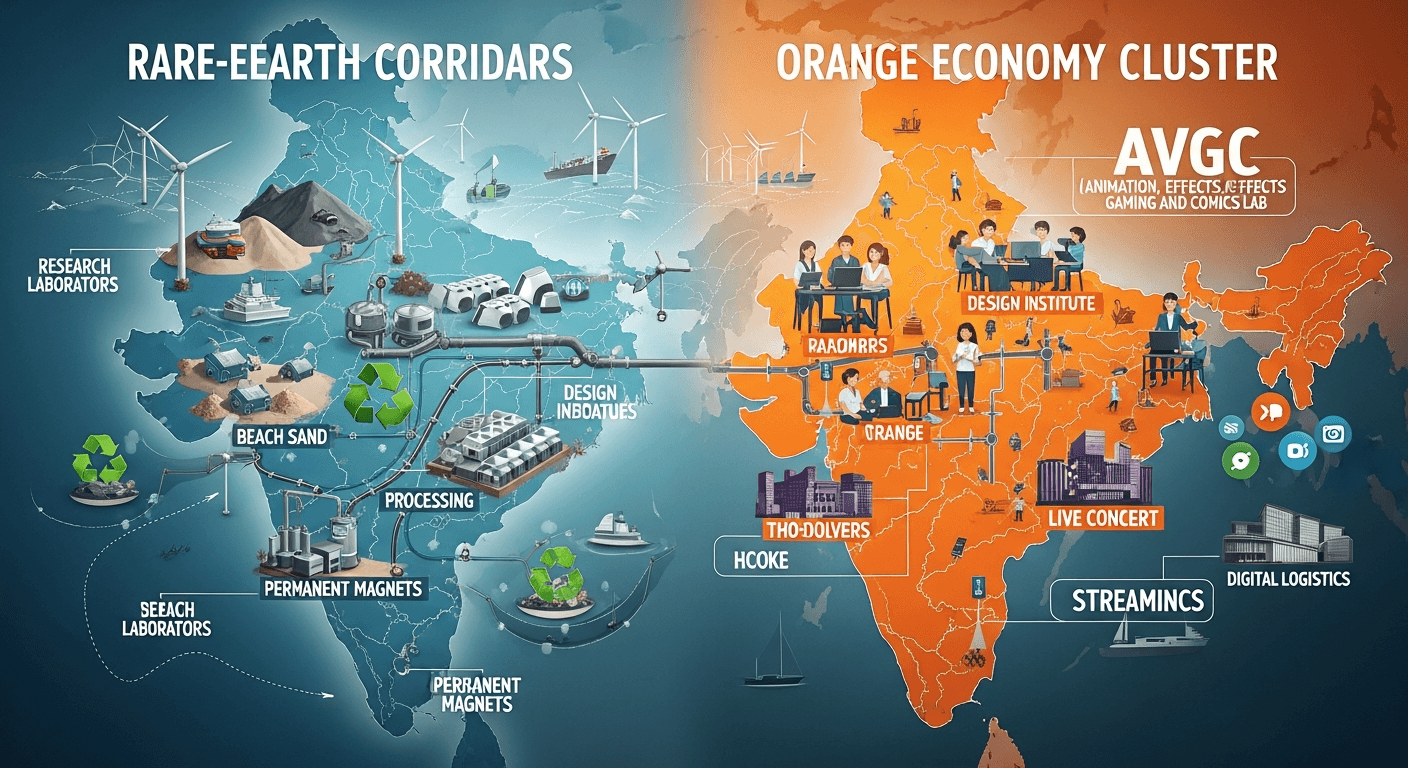
Key takeaways
- Budget 2026 pushes to build an end-to-end rare earths ecosystem (exploration → processing → magnets → manufacturing) with state-level corridors, higher electronics outlays and recycling incentives [1].
- The Orange Economy (AVGC, design, live entertainment and cultural services) gets targeted skilling and infrastructure — 15,000 school AVGC labs, a new design institute in the east and measures to ease live-event friction [2].
- Policy mixes combine production-linked support, R&D funding, plug‑and‑play industrial clusters and circular-economy recycling for critical minerals; and education, digital infrastructure and single-window reforms for creative industries [1][2].
- Economic upside is large (jobs, exports, supply‑chain resilience) but success depends on de‑risking private capital, fast regulatory reform, strong environmental and social safeguards, and skills-to-industry pipelines.
Why I care (and why you should): I follow how resource security and creative capacity shape industrial strategy. Rare earths are to advanced manufacturing what creative talent is to the orange economy—critical, concentrated and easy to take for granted. Budget 2026 nudges both toward domestication; the challenge will be turning policy intent into commercially viable ecosystems.
Summary of Budget measures: rare earths & critical minerals
- Value‑chain push: dedicated rare‑earth corridors in mineral‑rich states to co‑locate mining, processing, R&D, magnet production and downstream manufacturing; higher outlays for electronics and semiconductor missions to anchor demand [1].
- Incentives & PLI-style support: extension/expansion of magnet and electronics incentive schemes to include upstream oxides/metals and midstream processing; concessional capital, plug‑and‑play parks and targeted industrial clusters [1].
- R&D & skills: support for high‑tech tool rooms, industry‑led research centres and workforce training centred on process chemistry, separation technologies, magnet engineering and recycling processes [1].
- Trade & export controls: tighter controls or prioritisation on exports of critical concentrates to preserve domestic feedstock while encouraging value‑addition at home [1].
- Circularity: funding and incentives for recycling of e‑waste and end‑of‑life magnets to recover rare earths and reduce primary mining pressure [1].
- Environmental & social safeguards: budget language signals the need for responsible mining, but implementation requires clearer standards, community consent protocols and coastal/monazite regulation harmonisation [1].
Summary of Budget measures: Orange Economy (creative industries)
- Skills & labs: IICT-led AVGC content‑creator labs in 15,000 secondary schools and 500 colleges; a new National Institute of Design in the eastern region to expand regional design capacity [2].
- Infrastructure & single‑window: moves toward easing multiple clearances for live events and cultural festivals; proposals to open select heritage sites for curated events and boost venues and city readiness [2].
- Digital & IP support: tax and regulatory measures to encourage data centres, cloud services and exportable creative IP (implicit in larger services‑sector focus and safe‑harbour rules) [2].
- MSME & startup support: credit and growth funds aimed at small creative firms; improved access to platforms, TReDS integration and export facilitation for crafts and digital content [2].
Economic impacts, risks and opportunities
Opportunities
- Strategic self‑reliance: domestic rare‑earth processing and magnet production cut exposure to concentrated foreign processors and support EVs, renewables and defence industries [1].
- Jobs & exports: AVGC, live entertainment and design are labour‑intensive and exportable — the right mix of skilling and market access can create millions of creative jobs and new service exports [2].
- Value capture: moving up the value chain (from concentrates to magnets to motors) multiplies domestic value added and domestic employment [1].
Risks & constraints
- Capital intensity & time horizon: rare earth projects have long gestation, technical complexity and capital needs. Without long‑tenor financing, tax holidays or guaranteed offtake, private investment will be slow to follow [1].
- Environmental and community pushback: coastal monazite sands often contain thorium; community consent, radiation safety, and coastal regulations must be handled transparently to avoid delays and litigation [1].
- Skills mismatch: both heavy tech (process engineers for rare earths) and creative tech (AVGC professionals) require urgent, industry‑aligned skilling programs—supply lags can blunt gains [1][2].
- Regulatory fragmentation: live events, mining approvals, CRZ rules and IP enforcement sit across multiple ministries and states; single‑window reforms will be central but politically complex [1][2].
Regional & global context
- Global contest for critical minerals: major economies are funding full stacks (from exploration to high‑end manufacturing). India’s moves are timely but need scale and international partnerships to attract capital and tech transfer [1].
- Creative markets are global: streaming platforms, game studios and IP licensing transcend borders; India can capture share if it couples talent supply with ease of doing business and IP enforcement [2].
What I recommended (and what I’ve written before)
I have argued earlier that India’s EV and advanced‑manufacturing ambitions depend on securing the underlying inputs — both policy and financing need urgency if we are to avoid strategic bottlenecks [3]. That makes the rare‑earth push fiscally and geopolitically sensible. Similarly, I have long emphasised skills and platform models for new‑economy sectors; the AVGC labs and regional design institute are welcome, but execution will determine outcomes [3].
Recommended actions
For policymakers
- Create a non‑lapsable Rare‑Earth & Critical Minerals Fund with long‑tenor finance and partial credit guarantees to de‑risk projects.
- Fast‑track single‑window clearances for sustainable mining and for large cultural events; harmonise CRZ and radiation‑safety rules for monazite processing with transparent community consultation.
- Pair incentives with guaranteed offtake (public procurement for green industry and defence) and tie PLI support to domestic sourcing ratios.
For businesses & investors
- Form public‑private consortia to share early‑stage exploration and processing risk; invest in recycling capabilities and magnet‑to‑motor integration.
- For creative firms, prioritise skills partnerships with IICT/NID and monetize IP through global platforms and co‑productions.
For creatives, educators & guilds
- Build micro‑credentials aligned to studio workflows (AVGC pipelines, live‑event ops, rights management).
- Organise content export desks that combine IP, distribution, and festival strategies to convert cultural capital into tradable services.
Concluding paragraph
Budget 2026 sets direction: strategic minerals and creative talent are now on the national ledger. The policy architecture is promising, but the difference between intent and impact will lie in financing, regulatory clarity, and rapid skills deployment. If those pieces come together, India can convert resource endowments and creative energy into durable industrial and services leadership.
Regards,
Hemen Parekh
Any questions / doubts / clarifications regarding this blog? Just ask (by typing or talking) my Virtual Avatar on the website embedded below. Then "Share" that to your friend on WhatsApp.
References
[1] Coverage of Budget 2026 rare earths and critical minerals measures (media analysis and budget documents) — see contemporary reports and the official Budget highlights.
[2] Coverage of Budget 2026 Orange Economy measures (AVGC labs, NID proposal, skills and live entertainment) — see contemporary press summaries.
[3] My earlier posts on EVs, technology and industrial strategy that flagged the dependence of manufacturing on upstream inputs and the need for skilling and financing reforms [Hemen Parekh archival posts].
Get correct answer to any question asked by Shri Amitabh Bachchan on Kaun Banega Crorepati, faster than any contestant
Hello Candidates :
- For UPSC – IAS – IPS – IFS etc., exams, you must prepare to answer, essay type questions which test your General Knowledge / Sensitivity of current events
- If you have read this blog carefully , you should be able to answer the following question:
- Need help ? No problem . Following are two AI AGENTS where we have PRE-LOADED this question in their respective Question Boxes . All that you have to do is just click SUBMIT
- www.HemenParekh.ai { a SLM , powered by my own Digital Content of more than 50,000 + documents, written by me over past 60 years of my professional career }
- www.IndiaAGI.ai { a consortium of 3 LLMs which debate and deliver a CONSENSUS answer – and each gives its own answer as well ! }
- It is up to you to decide which answer is more comprehensive / nuanced ( For sheer amazement, click both SUBMIT buttons quickly, one after another ) Then share any answer with yourself / your friends ( using WhatsApp / Email ). Nothing stops you from submitting ( just copy / paste from your resource ), all those questions from last year’s UPSC exam paper as well !
- May be there are other online resources which too provide you answers to UPSC “ General Knowledge “ questions but only I provide you in 26 languages !



No comments:
Post a Comment