
Introduction
I write this as someone who has long followed and written about rural livelihoods and women’s economic empowerment. This year’s Union Budget places a visible, programmatic emphasis on the next phase of women’s participation in India’s growth story: moving from credit-led livelihoods to enterprise ownership. I welcome the clarity of intent and the pragmatic measures announced for community-owned Self-Help Entrepreneur (SHE) Marts, district-level support for girls in STEM, and other ecosystem improvements that collectively aim to make women economic owners rather than only beneficiaries [1][2].
Key budget measures
Economic empowerment
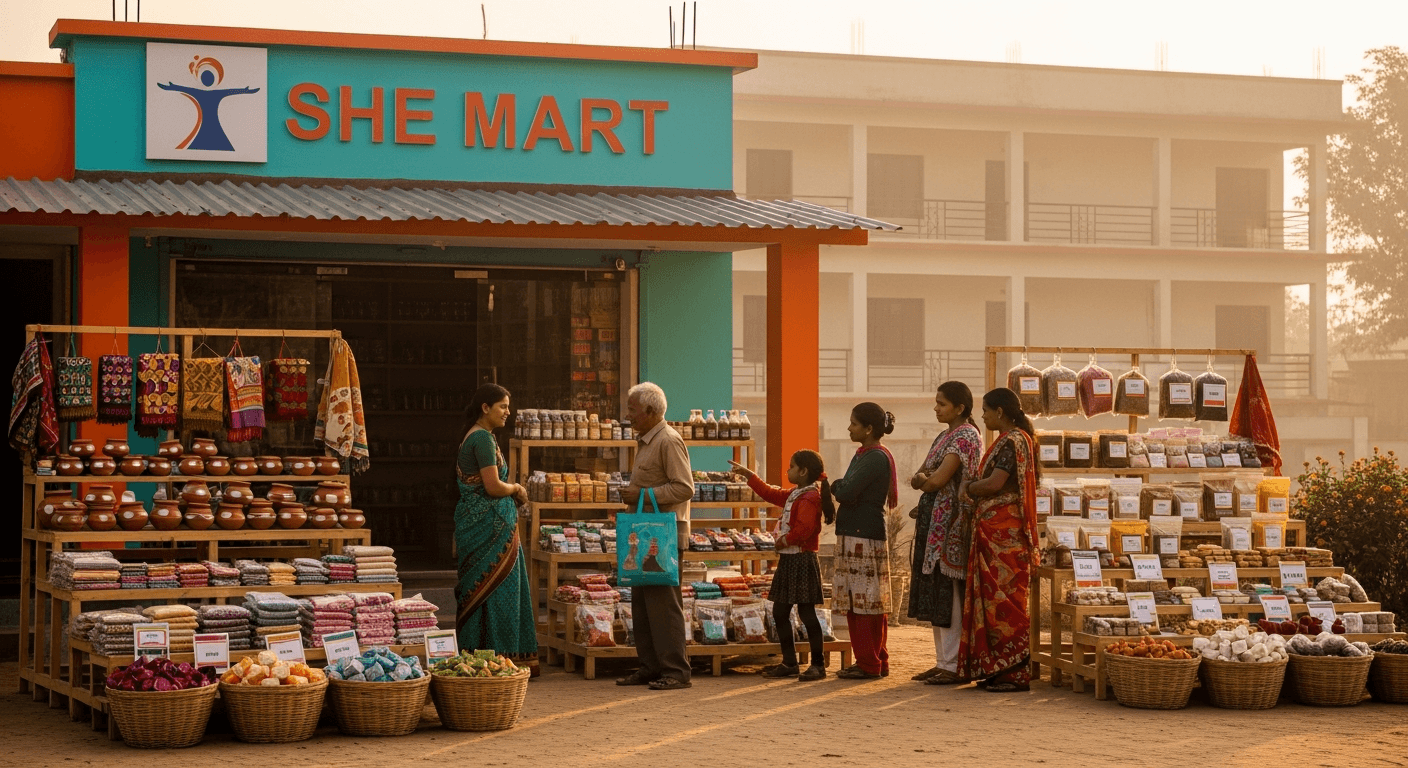
Self-Help Entrepreneur (SHE) Marts: The Budget proposes community-owned retail outlets run through cluster-level federations of self-help groups. These are intended to give women producers market access, a shared brand presence and the institutional architecture to scale beyond micro‑credit models [1][2].
Building on the Lakhpati Didi gains: The SHE concept explicitly builds on earlier SHG progress and seeks to create a pathway from credit to ownership [2].
Healthcare and care economy
Care workforce development: The Budget includes plans for a strengthened care ecosystem, with training targets for caregivers to professionalize geriatric and allied care roles [1][4]. This recognizes unpaid care work but leaves room for deeper gendered policy design.
Education and skills
One girls’ hostel in every district: To improve access and retention for girls pursuing higher education—especially in STEM—hostel infrastructure will receive viability gap funding or capital support to reduce one important barrier to advanced study [1][3].
University townships near industrial corridors aim to co-locate skill, research and residential facilities, increasing women’s proximity to quality education and employment [1].
Entrepreneurship and finance
Innovative financing for SHE Marts: The Budget signals “enhanced and innovative” finance instruments (beyond traditional microcredit) to support inventory, branding, and working capital for women-owned micro-enterprises [1][2].
Continued support to MSME and startup ecosystems (pipeline schemes and dedicated funds) will indirectly benefit women-led enterprises that can access these channels [1].
Safety and enabling infrastructure
District-level hostels and campus safety measures: By prioritizing safe residential infrastructure for students, the Budget addresses an enabling condition for women’s sustained participation in higher education and research [1][3].
Impact analysis
Short-term (1–3 years)
- Market access: SHE Marts can rapidly increase visibility and local market leverage for SHG-produced goods—improving turnover for many micro-sellers and reducing dependence on middlemen [2].
- Employment and income stability: Consolidating production, branding and retail can stabilize incomes where SHG members currently rely on seasonal or irregular sales.
Medium-term (3–7 years)
- Business formalization: With access to institutional finance and common branding, a subset of SHE Marts can graduate into formal micro enterprises, enabling bankability, digital payment flows and participation in broader supply chains.
- Education outcomes: District hostels for girls should raise retention in STEM streams where distance and safety are known deterrents.
Risks & gaps
- Implementation fidelity: The promise of “innovative financing” must translate into clear operational products (inventory financing, receivables financing, digital storefront integration) or the schemes risk becoming another label without scale.
- Care economy gender gap: While caregiver training is useful, the Budget stops short of a fully gender-responsive care policy that would rebalance unpaid work and create wider labour market effects [4].
Stakeholder reactions (summarised)
Women entrepreneurs and SHG federations: Coverage in mainstream press captured optimism about market access and brand-building potential; many SHG leaders see SHE Marts as a tangible next step from microcredit to enterprise ownership [2][3].
NGOs and civil-society groups: Many NGOs welcome district hostels and the SHE concept but call for stronger safeguards around governance, supply-chain parity, and capacity building at federation level [3][4].
Economists and budget commentators: Analysts have called the Budget’s women-focused measures an incremental but important shift—lauding the focus on ownership but asking for clearer fiscal allocations and monitoring indicators to judge impact [1][3].
Data and projections
- SHG scale: Public reporting indicates millions of women participate in SHGs and that Lakhpati Didi progress has reached multi-million counts; SHE Marts are framed as scaling that base into retail ownership and a visible local brand [2].
- Macro link: Economic assessments cited around the Budget note that raising women’s workforce participation materially supports longer-term GDP resilience; institutionalizing enterprise pathways for SHG women is a plausible lever in that direction [1][2].
Policy context and comparison to previous budgets
This Budget is evolutionary rather than revolutionary. It leans on earlier investments—credit access, SHG formation and specific MSME/startup supports—and shifts emphasis from standalone credit to ownership and market integration. Where earlier budgets focused heavily on increasing access to credit and startup funds, the current approach emphasizes market-facing infrastructure (SHE Marts), district-level education infrastructure and enabling finance instruments—an ecosystem play that complements past supply-side measures [1][5]. My prior writing on strengthening SHG linkages and digital market access anticipated precisely this move from credit to formal market participation [5].
Actionable takeaways
For women entrepreneurs and SHG leaders
- Organize federations to define shared product standards, inventory practices and simple digital catalogues so SHE Marts have consistent supply and quality.
- Pursue basic business literacy and bookkeeping training (many government and NGO modules can be accessed online) to be ready for working-capital products.
For policymakers
- Specify financing products: public agencies and banks should co‑design inventory finance, receivables discounting and micro‑insurance tailored for SHE Marts.
- Set transparent metrics: roll-out KPIs (number of functional SHE Marts, average monthly turnover per Mart, % women transitioning to formal enterprise) and publish dashboards.
- Complement care policies: integrate caregiver training with paid work pathways and incentives to address the gendered time burden.
Conclusion
I see this Budget as a welcome, evidence-aligned nudge toward transforming women’s economic roles. The structural shift—from microcredit to enterprise ownership and market integration—recognizes that dignity and scale come from ownership, not just access. For SHE Marts to succeed, the real test will be in productized financing, strong federation governance, digital market linkages and measurable public reporting. If implemented well, this can be a generational lever for rural women’s income and agency.
References
[1] Union Budget 2026 speech (full text)
[2] Economic Times: Budget 2026 – Community-owned SHE Marts to be set up for women SHG entrepreneurs
[3] NDTV / mainstream coverage: Budget 2026 measures for women, girls' hostels and SHE Marts
[4] DownToEarth analysis: Union Budget 2026 — enterprise, education and caregiving implications for women
[5] Hemen Parekh blog posts on SHG empowerment and women’s livelihoods (selected posts, 2024)
Regards,
Hemen Parekh
Any questions / doubts / clarifications regarding this blog? Just ask (by typing or talking) my Virtual Avatar on the website embedded below. Then "Share" that to your friend on WhatsApp.
Get correct answer to any question asked by Shri Amitabh Bachchan on Kaun Banega Crorepati, faster than any contestant
Hello Candidates :
- For UPSC – IAS – IPS – IFS etc., exams, you must prepare to answer, essay type questions which test your General Knowledge / Sensitivity of current events
- If you have read this blog carefully , you should be able to answer the following question:
- Need help ? No problem . Following are two AI AGENTS where we have PRE-LOADED this question in their respective Question Boxes . All that you have to do is just click SUBMIT
- www.HemenParekh.ai { a SLM , powered by my own Digital Content of more than 50,000 + documents, written by me over past 60 years of my professional career }
- www.IndiaAGI.ai { a consortium of 3 LLMs which debate and deliver a CONSENSUS answer – and each gives its own answer as well ! }
- It is up to you to decide which answer is more comprehensive / nuanced ( For sheer amazement, click both SUBMIT buttons quickly, one after another ) Then share any answer with yourself / your friends ( using WhatsApp / Email ). Nothing stops you from submitting ( just copy / paste from your resource ), all those questions from last year’s UPSC exam paper as well !
- May be there are other online resources which too provide you answers to UPSC “ General Knowledge “ questions but only I provide you in 26 languages !




No comments:
Post a Comment