
Opening
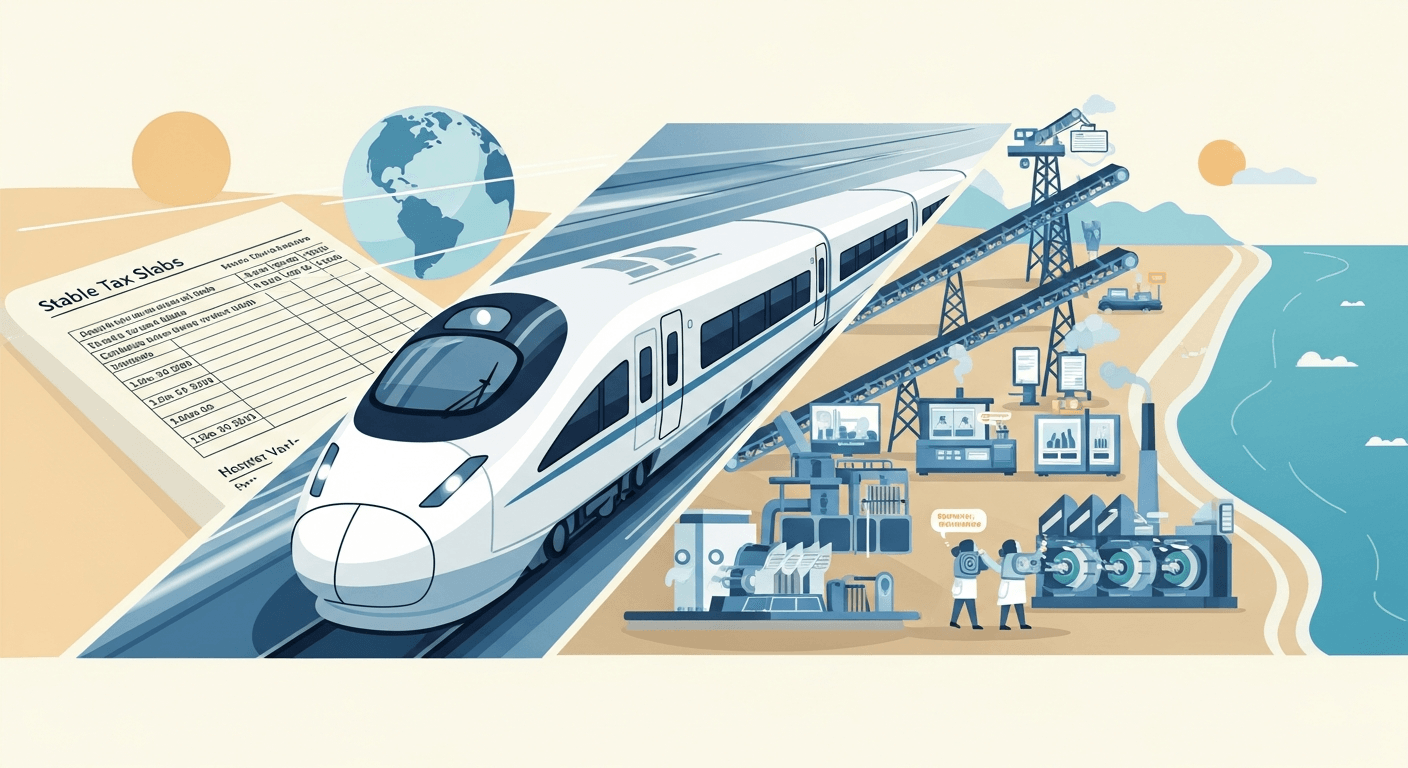
I read the Budget with the same mix of curiosity and skepticism I bring to any large public plan: curiosity about the possibilities it opens, skepticism about how neatly announcements translate into delivery. This year’s budget doubled down on a theme I consider critical — policy stability — while picking two very different levers to accelerate growth: a big push on high-speed rail corridors and a strategic programme for rare earth mineral corridors. The headline that resonates for many taxpayers is simple: no change in tax slabs. For planners and industry, the real story is the corridor approach.
Economic context: steady policy in a choppy world
- The government kept personal income-tax slabs unchanged and reiterated that the new Income Tax Act will come into effect as planned — a signal that tax policy will be incremental and predictable this year [Budget documents].
- At the same time, the budget raised capital expenditure targets and signalled a capex-led approach to sustaining growth; this mix of fiscal discipline and higher public investment is intended to support demand without destabilising macro balances [India Budget speech, Budget documents].
Why the “no change in tax slabs” matters
For millions of salaried taxpayers, the message is relief by stability rather than fresh concessions. Stability in slabs means:
- Predictable household budgets — employers and payroll teams can plan without last‑minute changes.
- Limited near-term stimulus from tax cuts — the government is choosing to use public capex, rather than personal tax relief, to spur demand.
- Focus on administrative simplification: the Budget emphasised simplified ITR forms and a phased timeline for filing, which can reduce compliance friction even without slab changes [Budget documents].
Implications for taxpayers and businesses
Taxpayers
Salaried individuals should update tax planning for the year on the assumption that marginal rates remain unchanged; small reliefs or procedural simplifications (like staggered ITR deadlines) can still improve cash flow and compliance.
Those expecting immediate personal-tax relief will need to re-evaluate choices around housing, retirement savings, and investments with a medium-term horizon in mind.
Businesses
- Predictable personal tax rates mean consumption-driven demand may not jump immediately — firms that sell to consumers should plan for measured growth rather than a sudden upswing.
- The more important lever for businesses is the capex push (including transport and strategic minerals), which creates opportunities in construction, engineering, logistics, and manufacturing supply chains.
High-speed rail corridors: mobility meets economic integration
The Budget’s commitment to multiple high-speed passenger corridors is as much about regional economic integration as it is about travel times. Faster, reliable movement between cities changes the economics of talent, housing, and firms.
Potential impacts:
- Urban and regional transformation: cities along corridors stand to gain new commercial and residential momentum, altering land values and commuting patterns.
- Supply chain and logistics upgrades: corridor projects typically require supporting investments — stations, freight spines, last‑mile connectivity — creating opportunities for private contractors and technology providers.
- Execution risk: historically, large transport projects face cost overruns and timeline slippage; disciplined project development, financing models, and strong public‑private coordination will be decisive. My earlier notes on mass rapid transit underline how enthusiasm must be paired with realistic funding and project governance (Metro in Ditch).
Rare earth corridors: strategic supply chains and geopolitics
The Budget’s support for dedicated rare earth corridors in mineral-rich coastal states is arguably the most geopolitically consequential item. Rare earth elements are essential inputs for EV motors, wind turbines, electronics, and several defence systems.
Key geopolitical and economic implications:
- Reducing import dependence: building domestic processing and magnet-making capacity can blunt supply shocks and pricing power concentrated in a single country.
- Industrial policy alignment: corridors can spur integrated clusters — mining, beneficiation, processing, component manufacturing, and recycling — reducing leakage and raising local value capture.
- Defence and technology security: secure domestic sources for critical magnets and specialized materials matter for sovereign defence capabilities.
- Environmental and regulatory challenges: rare earth extraction and processing have environmental footprints. The corridors must include strong rules for beneficiation, tailings management, and recycling incentives to be sustainable.
What businesses should watch
- Opportunity areas: equipment makers, processing technology providers, recycling firms, and logistics companies stand to gain from corridor investments.
- Long lead times: expect multi-year project cycles; firms should plan for staged entry, partnerships with established mining players, and engagement with state governments.
What to watch in the coming months
- Project pipelines and tenders: how quickly ministries and states publish DPRs and PPP/contracting frameworks will indicate seriousness of execution.
- State coordination: rare earth deposits are geographically concentrated; success will depend on clear state‑center roles, fast permitting, and local beneficiation plans.
- Private finance and incentives: look for clarity on fiscal incentives, viability gap funding, or capex support that will entice private investment.
- Environmental safeguards and recycling targets: rules that marry industrial ambition with sustainability will determine long-term public acceptance.
- Progress on the new Income Tax Act implementation and the redesigned ITR forms — practical changes in compliance that genuinely reduce friction will have outsized benefits for small taxpayers.
Practical takeaways — three things you can do now
For individuals: don’t assume a tax cut — use predictable slabs to finalize financial plans, revisit emergency funds, and consider staged investment in housing or retirement instruments.
For small businesses: evaluate opportunities in corridor-linked services — logistics, construction supply, skill training, and local manufacturing — and start conversations with state agencies.
For investors and corporates: monitor tenders and state capex allocations; favour companies with end‑to‑end capabilities or partnerships in mineral processing, recycling, or rail systems.
Conclusion
Budgets are blueprints and promises. This one trades immediate tax tinkering for steadiness and a big push in public capital formation — specifically through mobility corridors and strategic mineral ecosystems. If executed well, these corridors could reshape regional economies, reduce strategic dependencies, and create long-lived industrial clusters.
As someone who has long written about transport choices and the need for grounded foundations under big visions, I welcome the intent — the next test will be turning plans into disciplined project delivery with environment and communities at the centre. For ordinary taxpayers, the message is clear: stability today, opportunity tomorrow — but patience and civic vigilance will be needed as projects move from paper to ground.
Regards,
Hemen Parekh
Any questions / doubts / clarifications regarding this blog? Just ask (by typing or talking) my Virtual Avatar on the website embedded below. Then "Share" that to your friend on WhatsApp.
References
- Budget speech and documents: India Budget
- Rare earth corridors and strategic mineral policy coverage: Economic Times
- High-speed rail and corridor coverage: Times of India / Budget 2026 highlights
- My earlier reflection on mass rapid transit and project foundations: Metro in Ditch
Get correct answer to any question asked by Shri Amitabh Bachchan on Kaun Banega Crorepati, faster than any contestant
Hello Candidates :
- For UPSC – IAS – IPS – IFS etc., exams, you must prepare to answer, essay type questions which test your General Knowledge / Sensitivity of current events
- If you have read this blog carefully , you should be able to answer the following question:
- Need help ? No problem . Following are two AI AGENTS where we have PRE-LOADED this question in their respective Question Boxes . All that you have to do is just click SUBMIT
- www.HemenParekh.ai { a SLM , powered by my own Digital Content of more than 50,000 + documents, written by me over past 60 years of my professional career }
- www.IndiaAGI.ai { a consortium of 3 LLMs which debate and deliver a CONSENSUS answer – and each gives its own answer as well ! }
- It is up to you to decide which answer is more comprehensive / nuanced ( For sheer amazement, click both SUBMIT buttons quickly, one after another ) Then share any answer with yourself / your friends ( using WhatsApp / Email ). Nothing stops you from submitting ( just copy / paste from your resource ), all those questions from last year’s UPSC exam paper as well !
- May be there are other online resources which too provide you answers to UPSC “ General Knowledge “ questions but only I provide you in 26 languages !


No comments:
Post a Comment