
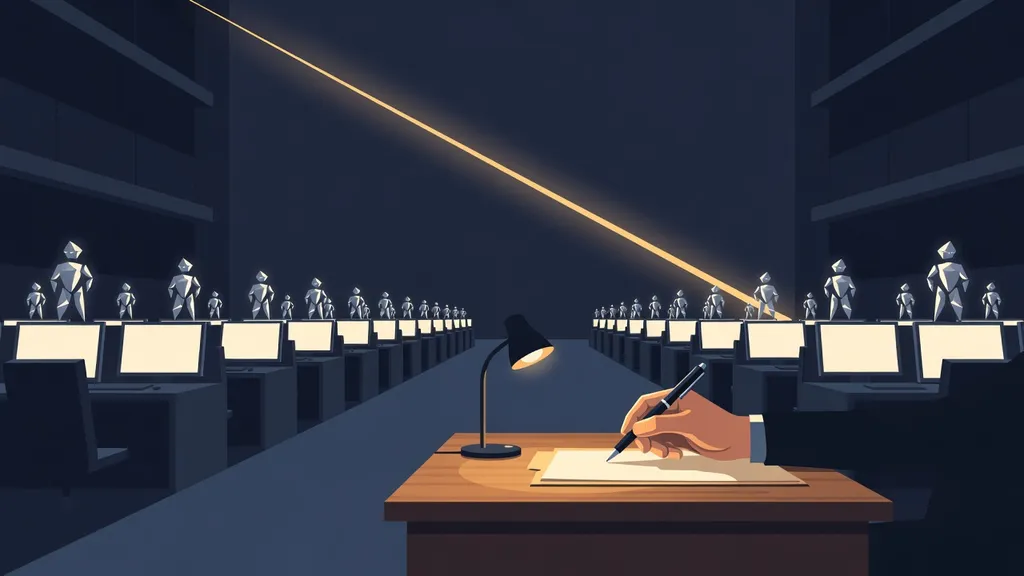
SEBI's KVR Murty asked, at a World Federation of Exchanges event in Mumbai, how a regulator approves an AI agent whose trading strategy rewrites itself as it learns. I argue that traceability, his one non-negotiable, is a post-mortem instrument, and that the missing piece is what I asked for eleven days ago: a filed evaluation before deployment, and a named human signatory. The weekend's AI-led correction shows why the herding fear he raised cannot wait for a rulebook.
"An AI agent is given a goal, not a fixed set of rules, and it can change how it trades as it learns. So how do you approve a strategy that rewrites itself?" That is SEBI whole-time member KVR Murty in Mumbai, at a World Federation of Exchanges event, as reported by Asia Insurance Post on 21 November 2026.
I want to try answering it, because the answer does not need a rulebook nobody has written. You do not approve a strategy that rewrites itself. You approve the container it rewrites itself inside: the declared objective, the limits it may never cross, the tests it must pass, and the name on the file.
Murty set one principle he would not bargain over: "every agent, however intelligent, must be traceable, and someone must answer for what it does." I agree, and that is the difficulty. Traceability is a post-mortem instrument. It tells you afterwards what the agent did; it does not tell you beforehand whether it should have been set loose.
His second worry was herding — millions of investors running agents on similar models and similar data, all leaving at once. That stopped being theoretical this weekend. According to The Business Times (22 November 2026):
- the Nasdaq 100 fell 10 per cent for the week, its worst since March 2020;
- the S&P 500 fell 12 per cent from its October record, entering a correction.
The Associated Press (21 November 2026) put the S&P 500's fall at 10 per cent from last month's high, and noted that corrections arrive every couple of years on average.
I have no evidence that agents caused any of this, and I will not invent one; humans managed such weeks without help. But the mechanism he described — similar models, similar data, one exit door — is one no circuit breaker is built for.
Eleven days ago, on chairman Tuhin Kanta Pandey's remarks of 14 November, I noted that the announced pillars carried no penalty tail and no testing before deployment ("Parekh's Law of Chatbots reaches Dalal Street", 15 November 2026). The agent clause sharpens that gap. A filed evaluation before a model goes live — model card, red-team results, known failure modes, the officer who signed — becomes, for agents, four things an examiner can demand:
- a pre-deployment file: objective, permitted instruments, blast radius, tests failed and fixed;
- a named human signatory, a person and not a desk — the Agent Passport I proposed to CERT-In in "CERT-In just wrote the audit rules I asked for in 'When AI Gets Keys'";
- a drift rule, so learning outside the declared objective forces a re-filing rather than waiting for one;
- a herd test: exchange-level visibility of overlapping models, so correlated exits are visible before they happen.
None of this is new machinery. In October 2017 I watched robots arrive to pick stocks ("Robots picking Stocks?"); in September 2022, when SEBI went shopping for a web-intelligence tool, I asked who watches the watchmen ("You have a choice: SEBI surveillance or Govt surveillance?"). Supervision arrived after trading both times.
Murty is candid that no regulator in the room has every answer. I would only add that the first answer is not an algorithm; it is a signature. So my question back to him is not how you approve a strategy that rewrites itself, but whose name is on the filing when it does.
With regards,
Hemen Parekh
www.Iam-Immortal.ai / www.IndiaAGI.ai / www.YourContentCreator.in
22 November 2026
No comments:
Post a Comment