
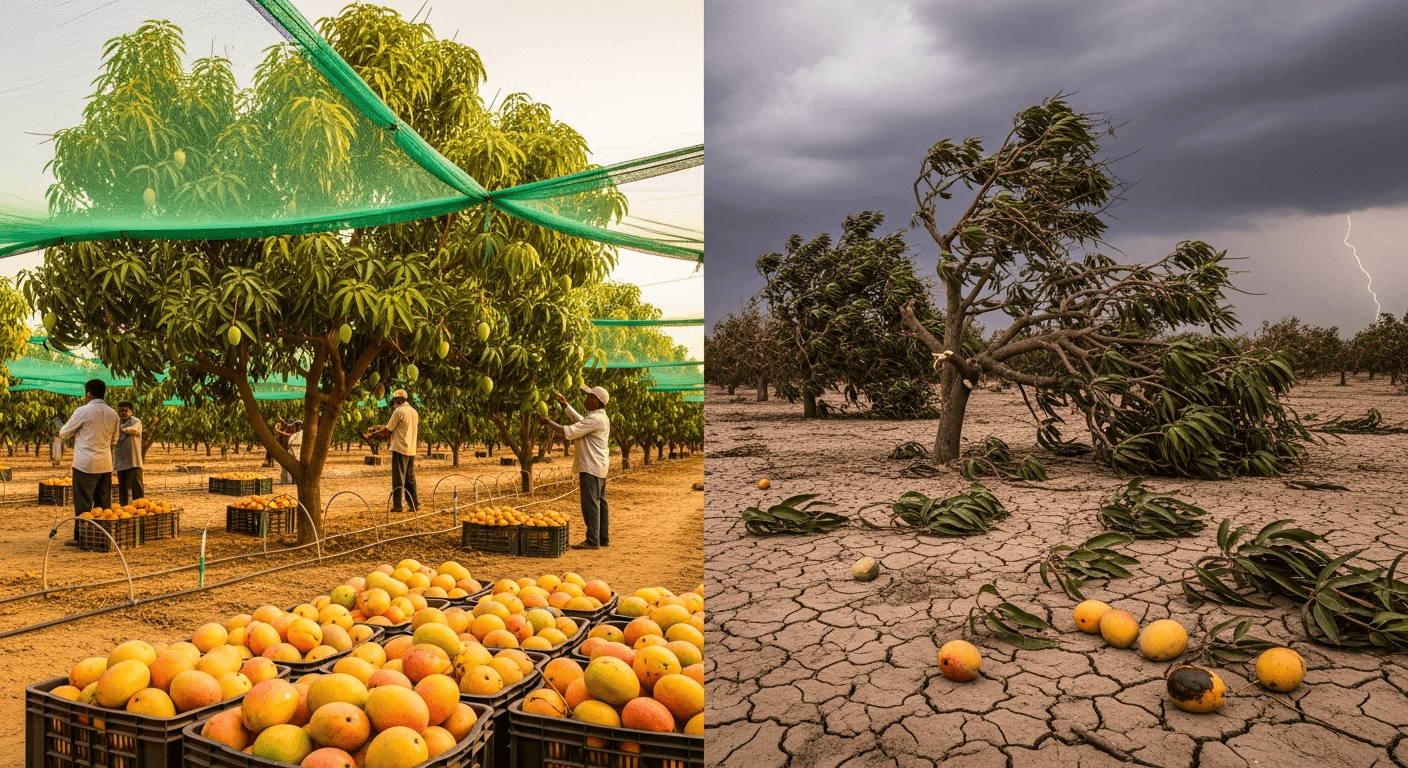
Introduction
I write this as someone who loves mangoes as much as I respect the farmers who grow them. The Alphonso — locally called Hapus — is not just a fruit; it is a cultural icon, a seasonal promise and a vital source of income in the Konkan coast and other mango belts. When I think of Hapus, I picture not only the golden, fragrant fruit on my plate but the thousands of smallholders whose livelihoods hinge on a successful flowering and harvest.
Why this matters
Alphonso commands premium prices in domestic markets and exports because of its unique aroma, texture and flavour. For many families, a good Hapus season pays school fees, repairs houses and smooths cash flow for the year. When climate shocks disrupt this cycle, the consequences ripple across rural economies and supply chains.
What I mean by climate shocks
By "climate shocks" I mean sudden or extreme weather events and unusual seasonal patterns, such as:
- Heatwaves (short periods of very high temperature)
- Untimely rains during flowering or harvest
- Prolonged drought
- Cyclones and strong winds
These events are becoming more frequent and less predictable. The Hapus tree evolved with a certain rhythm of dry winter flowering and hot, dry pre-monsoon fruit development; when that rhythm changes, the crop suffers.
How shocks affect flowering, fruit set and pollination
- Flowering: Alphonso flowers on old wood during the cool, dry months. Heatwaves can cause flowers to abort (drop) or to become desiccated; untimely rains can trigger fungal infections on delicate panicles.
- Fruit set: High night temperatures and sudden rains during bloom reduce the number of flowers that set fruit. Fruit set requires a narrow window of favourable weather; outside that window the retention rate falls.
- Pollination: Pollinators — bees and flies — are sensitive to temperature and rainfall. Heat or heavy rain during bloom can reduce pollinator activity, lowering pollination success and therefore the number of fruits.
Pests, disease and post-harvest quality
- Pests and disease: Warmer, wetter conditions favour pests (fruit fly populations can surge with warmer nights) and diseases such as anthracnose and powdery mildew that attack flowers and young fruit.
- Post-harvest quality: Heat and humidity shorten shelf life, can reduce sugar accumulation, and affect skin colour and pulp texture. Untimely rains close to harvest increase incidence of bruising and fungal rot, reducing grade and exportability.
Real-world impacts (recent seasons and trends)
In recent years growers have reported more erratic flowering, higher flower drop, and increased pressure from pests during atypically warm winters and sudden pre-monsoon rains. While local details vary year to year, the pattern is clear: unpredictability increases risk and reduces average yields.
Impacts on farmers and supply chains
- Smallholders face income volatility: a lower or lower-grade crop means lost earnings and debt stress.
- Markets: Reduced supply pushes up prices but also increases market instability. Exporters face quality rejections, which harms reputation and market access.
- Labour and logistics: Cyclones and heavy rains disrupt harvesting and transport, increasing post-harvest losses.
Adaptation and mitigation strategies — practical steps farmers can try
Farmer-level
- Irrigation scheduling: Use soil moisture checks or simple tensiometers to irrigate during critical fruit development phases rather than on a fixed calendar. Drip irrigation or micro-sprinklers conserve water and target the root zone.
- Mulching: Organic mulch (cane trash, straw) conserves moisture, moderates soil temperature and improves soil health.
- Microclimate management: Shade nets reduce heat stress during extreme heat and can lessen sunburn on fruit. Temporary misting during short heatwaves can help flowers and young fruits.
- Pruning and canopy management: Open canopies improve airflow, reducing fungal disease pressure and allowing better spray coverage.
- Integrated pest management (IPM): Monitor using pheromone traps for fruit flies, use biocontrol agents (e.g., Beauveria, Trichogramma where appropriate), timely sanitation (collect and destroy infested fruit) and targeted baiting rather than blanket insecticide use.
- Fruit bagging: Individual fruit bags protect from pests and reduce skin blemishes — a low-tech way to improve grade for export.
Institutional and market-level strategies
- Weather advisory systems: Timely, localized advisories (flowering window alerts, heatwave warnings) help farmers time irrigation, sprays and protective measures.
- Crop insurance: Make insurance easier to access and faster to pay out after a shock — insurers should recognize climate-linked losses in assessments.
- Varietal research: Invest in breeding or selecting Hapus clones with better tolerance to heat, faster maturity or disease resistance while conserving fruit quality.
- Cold chain and value addition: Expand cold storage, pulp processing and dehydration facilities so lower-grade fruit can be converted into pulp, concentrate or dried mango with stable value.
- Market interventions: Forward contracts, warehouse receipt systems and cooperatives can stabilize incomes when yields fall.
Policy recommendations — actionable steps for stakeholders
- Subsidize micro-irrigation and on-farm water storage to make critical-season watering feasible.
- Fund extension programs to train farmers in IPM, microclimate measures and post-harvest handling.
- Strengthen localized weather forecasting and crop advisories delivered by mobile/SMS and extension agents.
- Support public-private partnerships for cold chain and processing infrastructure near production zones.
- Prioritize research on Hapus-specific varietal improvement and disease management.
- Simplify and subsidize parametric insurance schemes that trigger rapid payouts after defined climatic thresholds.
Conclusion — a call to action
Alphonso mangoes are part of our food culture and a lifeline for many farmers. The risks posed by climate shocks are urgent but not hopeless. With practical on-farm techniques, targeted institutional support and smart policy, we can reduce vulnerability, protect incomes and preserve the Hapus legacy for future seasons.
I feel a deep empathy for the farmers watching a flowering that once looked promising now threat‑laden by a late heatwave or sudden storm. I urge policymakers, researchers, exporters and consumers to act: invest in resilience, support value-addition, and reward practices that protect both the fruit and the people who grow it.
Regards,
Hemen Parekh
Any questions / doubts / clarifications regarding this blog? Just ask (by typing or talking) my Virtual Avatar on the website embedded below. Then "Share" that to your friend on WhatsApp.
Get correct answer to any question asked by Shri Amitabh Bachchan on Kaun Banega Crorepati, faster than any contestant
Hello Candidates :
- For UPSC – IAS – IPS – IFS etc., exams, you must prepare to answer, essay type questions which test your General Knowledge / Sensitivity of current events
- If you have read this blog carefully , you should be able to answer the following question:
- Need help ? No problem . Following are two AI AGENTS where we have PRE-LOADED this question in their respective Question Boxes . All that you have to do is just click SUBMIT
- www.HemenParekh.ai { a SLM , powered by my own Digital Content of more than 50,000 + documents, written by me over past 60 years of my professional career }
- www.IndiaAGI.ai { a consortium of 3 LLMs which debate and deliver a CONSENSUS answer – and each gives its own answer as well ! }
- It is up to you to decide which answer is more comprehensive / nuanced ( For sheer amazement, click both SUBMIT buttons quickly, one after another ) Then share any answer with yourself / your friends ( using WhatsApp / Email ). Nothing stops you from submitting ( just copy / paste from your resource ), all those questions from last year’s UPSC exam paper as well !
- May be there are other online resources which too provide you answers to UPSC “ General Knowledge “ questions but only I provide you in 26 languages !


No comments:
Post a Comment