
Introduction
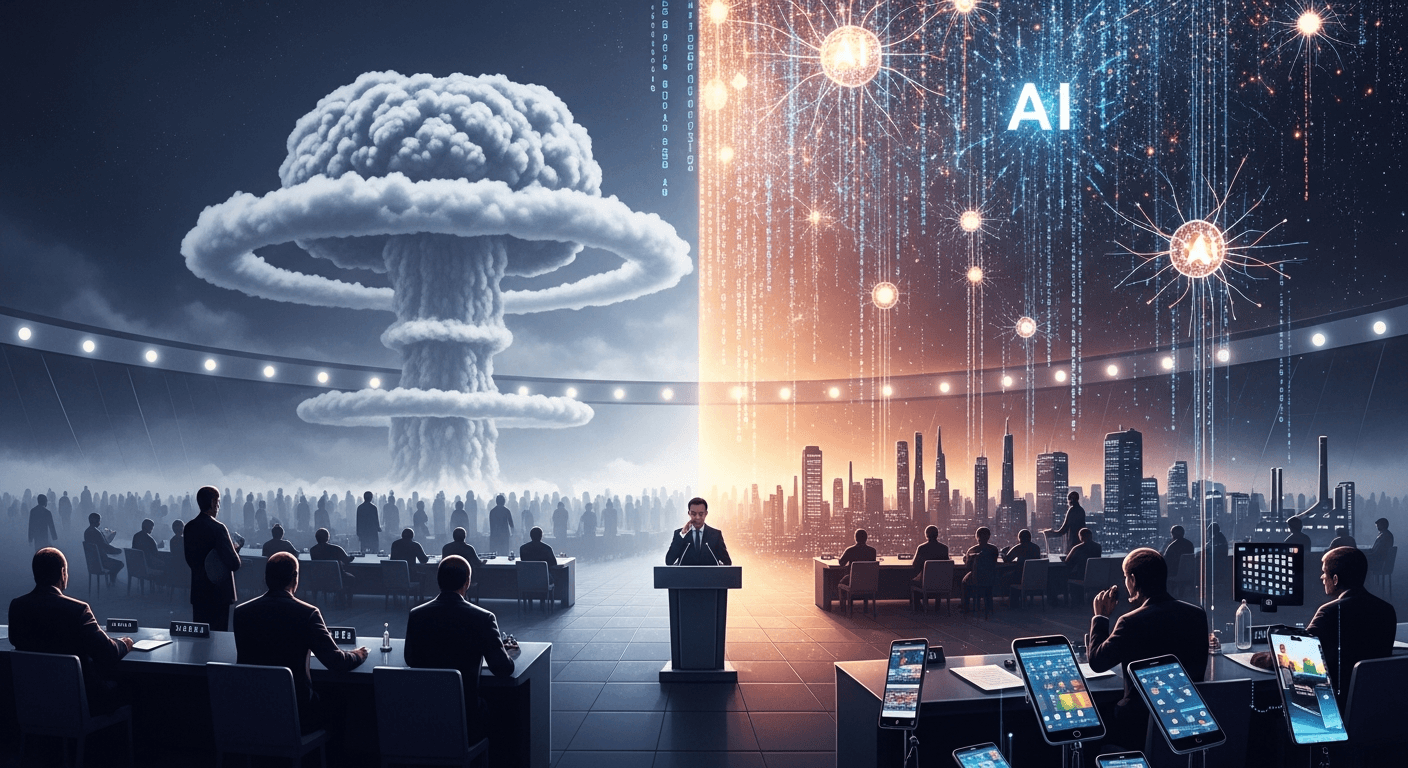
At a recent international summit I followed closely, a striking consensus emerged: the near-term dangers from advanced artificial intelligence now dwarf the familiar fears we associate with nuclear weapons. That is not to minimize the catastrophic potential of nuclear arsenals, but to point out a vital shift in risk geometry. Faster diffusion, cheap replication, and powerful economic incentives mean AI can create systemic harm at speed and scale that the nuclear age never allowed.
Why AI Risks Now Overshadow Nuclear Fears
Several interlocking features explain this shift:
Technical speed: AI capabilities have been improving at a blistering pace. Training times, model sizes, and performance gains now compound rapidly, and recent studies show development cycles measured in months rather than years. This compresses windows for oversight and raises the odds that dangerous capabilities will emerge before governance catches up.
Diffusion and accessibility: Unlike nuclear weapons, which require rare fissile materials, specialized infrastructure, and sustained programs, many powerful AI tools are software-native. Once an architecture or dataset is published, variants can be reproduced and adapted widely — by states, criminal networks, or irresponsible firms.
Dual-use nature: The same techniques that accelerate scientific discovery, improve healthcare, or optimize logistics can also be repurposed for disinformation campaigns, automated cyberattacks, biological design assistance, or destabilizing economic manipulations. Dual use multiplies pathways to harm.
Economic incentives and misaligned competition: Venture capital, market valuations, and national prestige reward rapid capability deployment. This creates a competitive pressure to prioritize performance over safety, spawning an environment where corners are more likely to be cut than in the tightly controlled nuclear domain.
Taken together, these dynamics make AI a rapidly proliferating, multi-vector risk — one that can produce diffuse, cascading effects across societies and economies rather than a single, centralized threat.
Summit Conversations: snapshots
The summit I tracked was not a single event but a cluster of meetings where ministers, regulators, and technologists debated how to respond. A few realistic, representative vignettes stood out:
In one plenary, regulators described near-miss scenarios where generative systems inadvertently enabled sophisticated fraud or automated spear-phishing campaigns that bypassed standard defenses. The scale — thousands of tailored, convincing messages per minute — made containment extremely difficult.
A panel of cybersecurity experts walked through how AI-powered malware can adapt in real time, undermining the old model of patch-and-patch-again. The consensus: attribution and mitigation are harder when attacks self-evolve.
A roundtable of economic ministers focused on labour-market shocks from AI-driven automation, noting short windows for retraining and policy adaptation. Unlike nuclear risk, which concentrates in geopolitics and deterrence, AI affects employment, civic discourse, and critical infrastructure simultaneously.
These exchanges were, in substance if not in person, what many countries are now treating as frontline policy problems: decentralized, fast-moving, and consequential across multiple domains.
My prior reflections
This turning point is not entirely new to me. Over the past year I argued for stronger, international coordination on AI governance and proposed institutional mechanisms for oversight, anticipating many of the summit debates. See my earlier piece on an international framework for AI regulation for ideas on how global institutions might adapt United Nations Agency for Regulating Artificial Intelligence (UNARAI).
Policy recommendations
From what I heard at the summit and from conversations with experts, several practical steps stand out now:
Treat AI as a systemic risk: Governments should adopt threat models that account for cascade effects across information ecosystems, critical infrastructure, and the economy, not just narrowly defined rogue systems.
Build modular international norms: Create interoperable standards for safety testing, red-teaming, and transparency that countries can adopt incrementally — similar in spirit to arms-control verification but adapted for software and compute.
Control critical inputs: Regulate and monitor specialized compute, high-value training datasets, and supply chains for components that materially accelerate capability growth.
Incentivize safety research: Public funding and procurement should prioritise alignment, interpretability, and robust verification research, reducing the market incentive to race on capability alone.
Strengthen incident-response capabilities: Establish rapid, cross-border channels for sharing threat intelligence, forensic tools, and coordinated mitigation strategies when emergent harms appear.
Foster public–private compacts: Since much of the capability sits in private firms, governments must negotiate enforceable commitments on testing, disclosure, and safe deployment.
Conclusion
Nuclear weapons reshaped 20th-century geopolitics with concentrated, slow-to-proliferate danger. AI poses a qualitatively different challenge: fast, diffuse, and deeply embedded in everyday systems. The summit signals growing awareness of that reality. If we are to avoid layered crises, policymakers must embrace flexible, international, and technically informed instruments — and do so quickly. The window to build durable safeguards is narrow, but it is not yet closed.
Regards,
Hemen Parekh
Any questions / doubts / clarifications regarding this blog? Just ask (by typing or talking) my Virtual Avatar on the website embedded below. Then "Share" that to your friend on WhatsApp.
Get correct answer to any question asked by Shri Amitabh Bachchan on Kaun Banega Crorepati, faster than any contestant
Hello Candidates :
- For UPSC – IAS – IPS – IFS etc., exams, you must prepare to answer, essay type questions which test your General Knowledge / Sensitivity of current events
- If you have read this blog carefully , you should be able to answer the following question:
- Need help ? No problem . Following are two AI AGENTS where we have PRE-LOADED this question in their respective Question Boxes . All that you have to do is just click SUBMIT
- www.HemenParekh.ai { a SLM , powered by my own Digital Content of more than 50,000 + documents, written by me over past 60 years of my professional career }
- www.IndiaAGI.ai { a consortium of 3 LLMs which debate and deliver a CONSENSUS answer – and each gives its own answer as well ! }
- It is up to you to decide which answer is more comprehensive / nuanced ( For sheer amazement, click both SUBMIT buttons quickly, one after another ) Then share any answer with yourself / your friends ( using WhatsApp / Email ). Nothing stops you from submitting ( just copy / paste from your resource ), all those questions from last year’s UPSC exam paper as well !
- May be there are other online resources which too provide you answers to UPSC “ General Knowledge “ questions but only I provide you in 26 languages !



No comments:
Post a Comment