
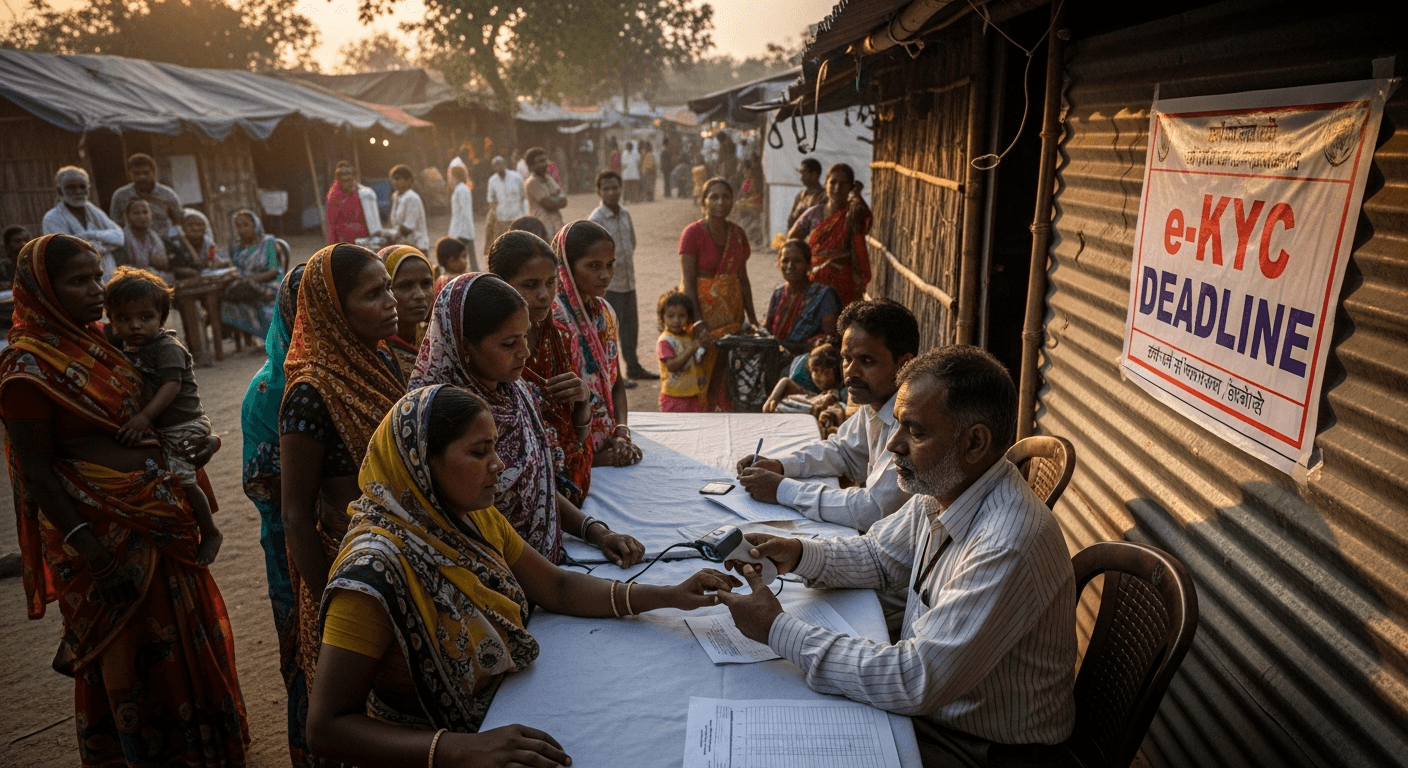
When E-KYC Cuts Women Out
Maharashtra’s decision to remove roughly 80 lakh women from the Ladki Bahin roster as the e‑KYC deadline closed is a story about policy design, administrative pressure, and human cost. I want to walk you through what the scheme set out to do, why the e‑KYC push happened, what losing access likely means for those women, how different actors have responded, and what realistic next steps might look like.
What Ladki Bahin was meant to do
Ladki Bahin — launched as a targeted welfare effort — was conceived to give direct, regular support to girls and women across the state. Its aims include:
- reducing gendered poverty by providing cash support to women and adolescent girls;
- improving girls’ school retention and health outcomes by easing household cash constraints; and
- creating a simple entry point for women to access other state services through a consolidated registry.
Beneficiaries typically included low‑income women, single mothers, and girls from economically vulnerable households. The benefits were primarily cash transfers and simplified access to complementary programs (health, education stipends, and occasional one‑off grants).
I have written about the larger promise and pitfalls of single‑KYC approaches before — Majhi Ladki Bahin scheme — and the current episode brings many of those concerns into focus.
Why e‑KYC was introduced, and what the deadline meant
The state introduced mandatory electronic KYC (e‑KYC) for Ladki Bahin registrants to:
- reduce duplicate or ghost beneficiaries,
- prevent fraud or identity misuse, and
- ensure that transfers reach verified bank accounts.
Administratively, e‑KYC is attractive: it promises cleaner data, easier audits, and faster transfers. But setting a firm deadline without adequate outreach or low‑barrier alternatives risks converting an administrative tool into a blunt instrument of exclusion.
The scale and immediate implications
When the deadline closed and ~80 lakh women were removed from the list, the scale of immediate disruption was enormous. For many households this is not a marginal benefit — it can be the difference between paying for school uniforms, buying medicines, or skipping a meal. The removals raise urgent questions about access and equity:
- sudden loss of cash inflows for families that budgeted around this support;
- interruption of linked services (education stipends, primary care reimbursements) that use the same registry;
- administrative confusion for those who attempted to comply but were technically excluded.
Responses: government, civil society, and on the ground
"A state official said: 'Compliance with e‑KYC is necessary to protect the integrity of the program and ensure that public funds reach genuine beneficiaries.'"
"An NGO worker said: 'We are seeing panic calls; many women did not understand the deadline or could not travel to complete e‑KYC.'"
"A beneficiary said: 'I went to the office twice. I couldn't get my Aadhaar linked and now my name is gone — I don't know how my daughter will manage.'"
From the government side, officials have emphasized rule‑of‑law and the need to clean registries. Civil society groups have raised alarms about procedural fairness, citing lack of notice, limited outreach in remote areas, digital literacy shortfalls, and mobility constraints for women. Legal action — in the form of petitions or demands for interim relief — is a predictable next step, though outcomes vary by court and context.
Potential legal, social, and financial consequences
Legal consequences: beneficiaries may pursue judicial review arguing procedural unfairness or inadequate notice. Courts might order temporary reinstatement or mandate softer remedial procedures while disputes are decided.
Social consequences: exclusion disproportionately affects those already marginalized — single women, rural residents, elderly women, and those without mobile phones or functional bank accounts. Exclusion can increase caregiving stress, force girls to drop out of school, or push women into precarious work.
Financial consequences: immediate loss of liquidity at household level; dormant bank accounts; increased reliance on informal credit at higher cost; and potential loss of linked insurance or medical benefits.
Possible next steps and remedies
Short term
- Emergency reinstatement window: open a limited, clearly advertised grace period to allow door‑to‑door or camp‑based e‑KYC completion.
- Mobile and community KYC drives: deploy teams to Anganwadis, panchayat offices, and women’s groups with portable biometric devices.
- Simplified appeals: set up an easy, local appeals process with minimal documentary burden and guaranteed timelines.
Medium term
- Alternative verification: accept community attestation (local ward members, Anganwadi workers) where biometric or digital proof is unavailable.
- Financial continuity measures: allow provisional transfers for households that apply for re‑verification to prevent immediate hardship.
- Digital literacy and helpdesks: invest in training and helplines targeted to women beneficiaries.
Policy recommendations
- Design any compliance deadline with layered communication (SMS, voice calls, door‑to-door notices) and with legally mandated grace periods.
- Avoid binary cutoffs for essential social transfers; instead use graduated validation plans that preserve benefits while verification proceeds.
- Prioritize inclusion for vulnerable subgroups by allowing non‑digital, community‑based enrollment paths.
Alternatives to exclusion
If the goal is to minimize fraud and duplication, there are less exclusionary approaches: phased e‑KYC rollouts, community verification panels, and integration with existing state databases (school rosters, health IDs) that reduce the need for beneficiaries to navigate complex digital procedures on their own.
Conclusion
The removal of 80 lakh women from Ladki Bahin because of an e‑KYC deadline is a cautionary tale. Administrative safeguards are important, but when applied without sufficient outreach and alternative paths, they can turn safeguards into barriers. Policymakers should act swiftly to restore benefits where legitimate need exists and redesign the verification process so that the cure is not worse than the disease.
Call to action: share credible updates from trusted news sources, and if you are concerned, contact your local representatives to ask for reinstatement windows, mobile KYC camps, and a low‑barrier appeals process.
Regards,
Hemen Parekh
Any questions / doubts / clarifications regarding this blog? Just ask (by typing or talking) my Virtual Avatar on the website embedded below. Then "Share" that to your friend on WhatsApp.
Get correct answer to any question asked by Shri Amitabh Bachchan on Kaun Banega Crorepati, faster than any contestant
Hello Candidates :
- For UPSC – IAS – IPS – IFS etc., exams, you must prepare to answer, essay type questions which test your General Knowledge / Sensitivity of current events
- If you have read this blog carefully , you should be able to answer the following question:
- Need help ? No problem . Following are two AI AGENTS where we have PRE-LOADED this question in their respective Question Boxes . All that you have to do is just click SUBMIT
- www.HemenParekh.ai { a SLM , powered by my own Digital Content of more than 50,000 + documents, written by me over past 60 years of my professional career }
- www.IndiaAGI.ai { a consortium of 3 LLMs which debate and deliver a CONSENSUS answer – and each gives its own answer as well ! }
- It is up to you to decide which answer is more comprehensive / nuanced ( For sheer amazement, click both SUBMIT buttons quickly, one after another ) Then share any answer with yourself / your friends ( using WhatsApp / Email ). Nothing stops you from submitting ( just copy / paste from your resource ), all those questions from last year’s UPSC exam paper as well !
- May be there are other online resources which too provide you answers to UPSC “ General Knowledge “ questions but only I provide you in 26 languages !



No comments:
Post a Comment