
Silent Death Robots: Are Humans Being Replaced?
I write this as someone who has watched automation creep from factory floors into our daily lives—and now into the fog of war. The phrase "silent death" attached to small combat robots and loitering munitions is jarring, but it captures a truth: modern conflict is increasingly shaped by machines that can scout, strike, and survive in ways that shift risk away from a human pair of eyes or a foot soldier.
What I see on the battlefield
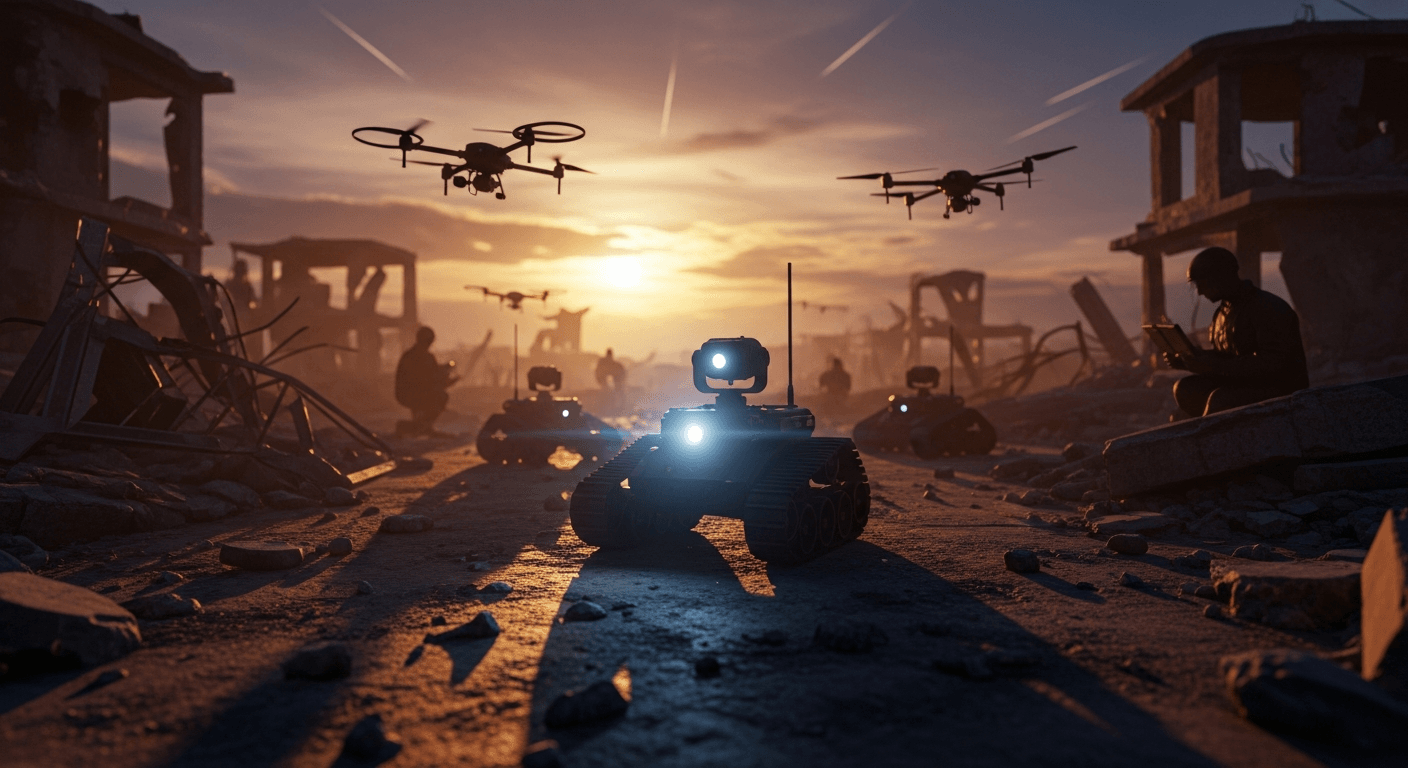
From open-source footage and reporting over the last few years, the pattern is clear: battlefield robotics are not a single kind of machine but a growing family of capabilities.
- Reconnaissance drones and small ground robots that quietly scout, map, and feed live video into human decision loops.
- Loitering munitions (often called "kamikaze" drones) that can hover, select, and strike targets without a large logistics tail.
- Remote-controlled ground platforms that deliver supplies, evacuate casualties, or perform explosive-ordnance disposal where a human life would otherwise be at stake.
- Weaponized payloads mounted on inexpensive, expendable frames that change the economics of targeting and retribution.
These tools are blunt and precise at the same time: blunt because they lower the political and human cost calculus of using force, and precise because sensor-and-software combinations can find and engage targets in ways a single human soldier cannot.
Are human soldiers being replaced?
Not entirely—and probably not soon. What I observe is substitution in roles, not wholesale replacement:
- Machines take on the most dangerous, dull, and dirty tasks: scouting under fire, clearing mines, approaching suspected IEDs, or delivering a last-mile strike where sending a person would be suicidal.
- Humans retain strategic, ethical, and many tactical responsibilities: deciding when to strike, interpreting ambiguous intent, and accepting political accountability.
- The force mix changes: fewer troops are exposed at the front line, while new skill sets (robot operators, drone tacticians, data analysts, counter‑robot teams) become essential.
So the soldier of 2030 is not simply obsolete; their toolkit and training are. Soldiers will be paired with machines, and some traditional roles will shrink while others—especially those needing judgment, improvisation, and moral reasoning—remain human.
The advantages—and risks—I've been thinking about
Advantages:
- Risk reduction: Robots can perform tasks that once guaranteed casualties.
- Force multiplication: Smaller units can project greater reach and situational awareness.
- Cost and tempo: Cheap expendable systems and autonomous behaviors can operate continuously and at speeds humans cannot match.
Risks:
- Lower political threshold for use: When the immediate human cost is removed, decisions to strike may come easier.
- Accountability gaps: Who is responsible when an autonomous system makes a lethal mistake?
- Arms-race dynamics: Widespread use invites rapid countermeasures and escalation in autonomy and lethality.
Ethics, law, and the conversation I keep returning to
I've long argued that technology without ethical guardrails is a recipe for harm. In earlier pieces I raised questions about delegating life-and-death choices to machines and urged careful public discussion and legal clarity. See my reflections on the moral limits of autonomous force in "Thou Shall Not Kill" and my broader take on automation's inevitability in "Robotation" "Thou Shall Not Kill" and "Robotation".
Those posts still feel relevant: technology evolves, but the human questions—who decides, who pays the price, and who defines acceptable risk—do not.
Lessons from the Ukraine conflict (what we can learn broadly)
Rapid innovation in conflict: Necessity accelerates adaptation. Combatants repurpose commercial parts, modify civilian drones, and iterate tactics quickly.
Distributed lethality: Low-cost systems enable asymmetric effects even against larger forces.
Countering robots becomes a new discipline: Electronic warfare, simple kinetic traps, and cheap jamming are as important as advanced defenses.
These lessons are not endorsements of roboticized warfare. Rather, they are sober observations about how technology changes the character of conflict.
What I believe should happen next
- Clear international norms and rules of engagement for autonomous and remotely operated lethal systems.
- Investment in counter-robot capabilities and civilian protections (de‑mining, EOD, humanitarian corridors designed for robotic use).
- Reframing military training to emphasize human judgment, legal accountability, and operator ethics alongside technical skills.
We cannot un-invent these tools. We can, however, shape how they are used and who is responsible when things go wrong.
Final thought
Are human soldiers being replaced? Not in the sense of erasing humanity from the battlefield. Rather, their risk, roles, and responsibilities are being redistributed. That redistribution brings tactical benefits, strategic dangers, and profound moral choices. My hope—and my insistence from past writing—is that we confront those choices openly, before expedience hardens them into new norms we later regret.
Regards,
Hemen Parekh
Any questions / doubts / clarifications regarding this blog? Just ask (by typing or talking) my Virtual Avatar on the website embedded below. Then "Share" that to your friend on WhatsApp.
Get correct answer to any question asked by Shri Amitabh Bachchan on Kaun Banega Crorepati, faster than any contestant
Hello Candidates :
- For UPSC – IAS – IPS – IFS etc., exams, you must prepare to answer, essay type questions which test your General Knowledge / Sensitivity of current events
- If you have read this blog carefully , you should be able to answer the following question:
- Need help ? No problem . Following are two AI AGENTS where we have PRE-LOADED this question in their respective Question Boxes . All that you have to do is just click SUBMIT
- www.HemenParekh.ai { a SLM , powered by my own Digital Content of more than 50,000 + documents, written by me over past 60 years of my professional career }
- www.IndiaAGI.ai { a consortium of 3 LLMs which debate and deliver a CONSENSUS answer – and each gives its own answer as well ! }
- It is up to you to decide which answer is more comprehensive / nuanced ( For sheer amazement, click both SUBMIT buttons quickly, one after another ) Then share any answer with yourself / your friends ( using WhatsApp / Email ). Nothing stops you from submitting ( just copy / paste from your resource ), all those questions from last year’s UPSC exam paper as well !
- May be there are other online resources which too provide you answers to UPSC “ General Knowledge “ questions but only I provide you in 26 languages !




No comments:
Post a Comment