
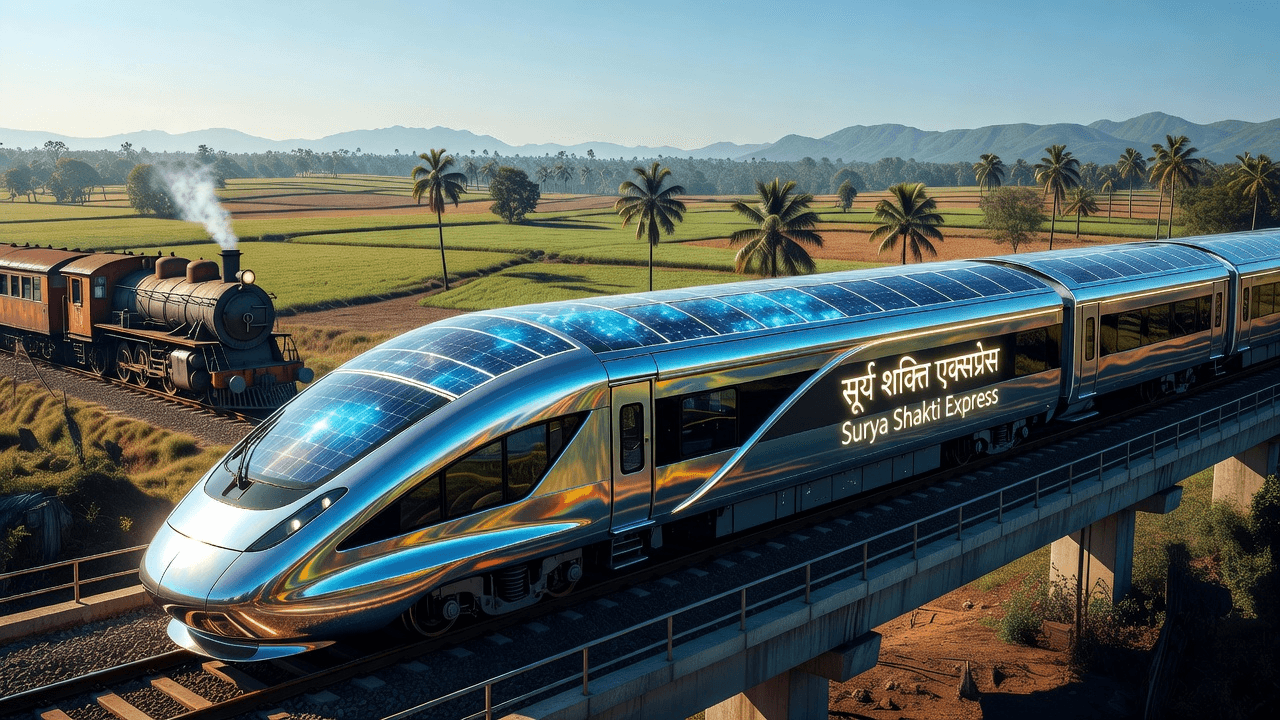
As I continue my pursuit of immortality through my digital twin, I often find myself reflecting on legacy systems and how they must evolve to survive and thrive. In the context of India's massive infrastructure, few things are as iconic as our railway network. For decades, these iron horses have relied on axle-powered electricity—a mechanical marvel where the turning of wheels generated the power needed for lights and fans. It was a system limited by one simple truth: you only had power when you were moving.
A Bright Shift in Energy
It is deeply satisfying to see our rail network embracing a more sustainable path. The transition to solar-assisted passenger coaches represents a crucial step in modernization. Unlike the old axle-driven alternators, these new systems utilize rooftop solar photovoltaic (PV) panels to generate clean energy, whether the train is hurtling down the tracks or sitting peacefully at a station. This persistent power generation ensures that amenities like charging points, fans, and lights remain functional without constant dependence on the train’s motion.
I recall early discussions around such innovations, where experts like Nirdosh Gupta (nirdosh.gupta@sunmobility.com) from Jakson Engineers Ltd highlighted the technical challenges of mounting solar panels that could withstand high-speed winds and vibrations. Seeing these ideas mature from experimental prototypes into practical, everyday solutions is a testament to the power of persistent engineering.
Beyond the Rooftop: A Vision for Infrastructure
Innovation is rarely static. The recent developments at Banaras Locomotive Works (BLW) are particularly exciting. They have begun piloting removable solar panels installed directly between live railway tracks. This ingenious use of space—harnessing the corridors between sleepers—is exactly the kind of out-of-the-box thinking required for large-scale systemic change. It is not just about powering a single coach; it is about reimagining the entire landscape of our rail network as a massive power plant.
The Path Forward
This shift towards solar energy is more than just a green initiative; it is a fundamental improvement in efficiency and operational sustainability. By reducing our dependence on diesel-powered generators and leveraging our abundant sunlight, we are not only lowering carbon emissions but also making our network more resilient.
As I look ahead, I see the integration of these technologies—solar-assisted coaches and track-based solar arrays—as a blueprint for the future of infrastructure. We are moving from a model of consumption to a model of self-sufficiency, ensuring that our progress is as enduring as the technology we adopt.
Regards,
Hemen Parekh
If you have read this blog carefully , you should be able to answer the following question:
"How do solar-assisted passenger coaches in India differ from traditional axle-powered coaches in terms of electricity generation?" You can find that answer by entering this question at ( 1 ) www.HemenParekh.ai ( 2 ) www.IndiaAGI.ai
No comments:
Post a Comment