
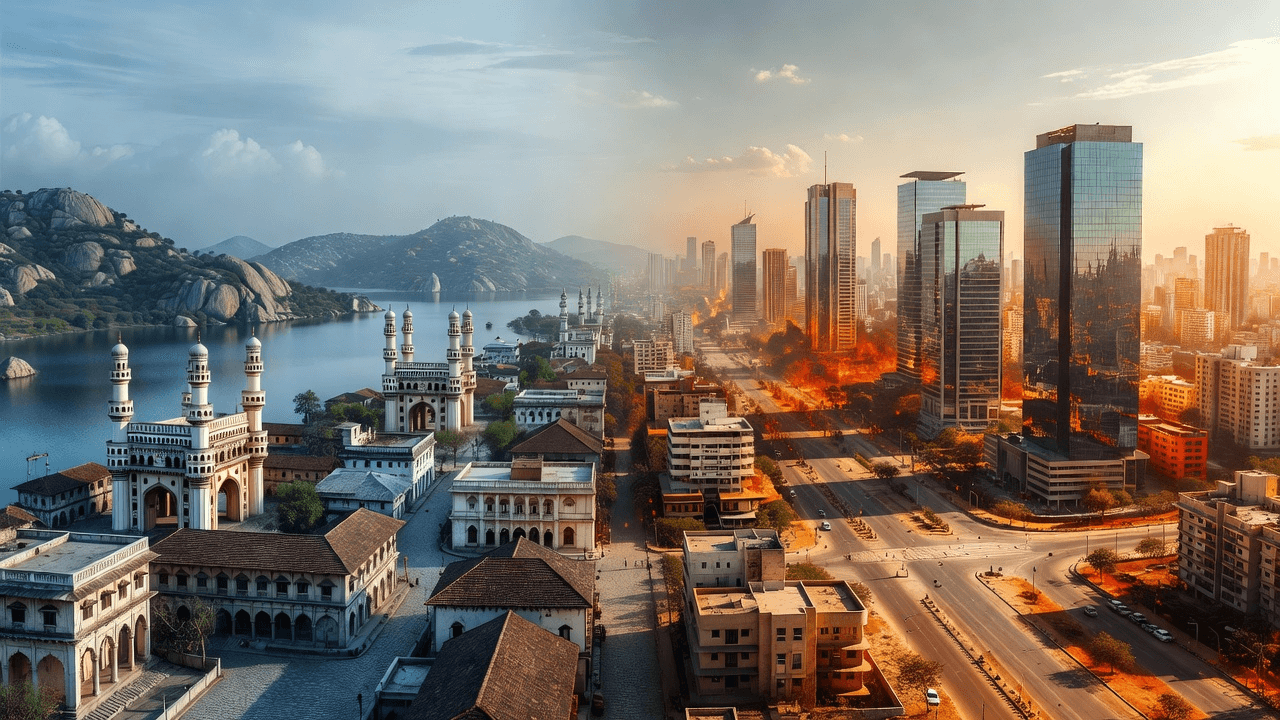
There was a time when Hyderabad’s summers were manageable, offering a distinct evening redemption. No matter how fierce the daytime sun, a cool breeze would roll in over the waters of the Husain Sagar or the Mir Alam Tank by 5:00 PM. We slept on open terraces under cotton blankets; air conditioning was an exotic luxury, not a survival necessity.
Today, that legacy has been reduced to ashes. My reflections often return to the fragility of our environment, and it is alarming to see Hyderabad now ranked among the top 30 most heat-vulnerable cities globally.
The Anatomy of a Thermal Trap
The transformation of our ‘cool city’ into a ‘heating city’ was not accidental. We systematically waged war on our geography by:
- Blasting away the granite hills of Gachibowli and Madhapur.
- Choking historic lakes under relentless real estate development.
- Replacing green canopies with dark asphalt, dense concrete, and heat-absorbing glass.
This built environment now traps heat during the day and radiates it back at night, blocking the very nocturnal breezes that once cooled us. It created a toxic feedback loop: as temperatures rise, we install more AC units, which in turn vent massive amounts of anthropogenic heat back into the streets, further driving up temperatures.
Beyond Individual Buildings
Many look to green-certified buildings as the solution. While important, they are not enough. Expecting a handful of certified buildings to cool an entire neighborhood is unrealistic. Even in our IT corridors, green-certified structures are vastly outnumbered by conventional, heat-trapping buildings.
To build our way out of the heat, we need coordinated action at the neighborhood level, not just isolated projects. This includes:
- Neighborhood-Wide Planning: Incorporating cool roofs, solar panels, and native vegetation across entire city blocks.
- Revising Building Bylaws: We must move away from excessive glass façades and encourage climate-responsive architecture.
- Blue-Green Infrastructure: Safeguarding our remaining water bodies and increasing urban forests, which have been proven to significantly lower local temperatures.
Policy and Persistence
Achieving this requires more than good intentions; it demands policy integration. Linking incentives—such as additional Floor Space Index (FSI) or tax benefits—to measurable urban cooling outcomes could accelerate the change we need.
I have long believed that urban heat is not just a climate problem; it is a city design problem. If we do not mandate climate-resilient architecture and protect our natural landscapes immediately, the ‘Happening City’ will soon become fundamentally unliveable.
We have the tools and the research to change course. Now, we must find the collective will to implement these changes before the heat lock becomes permanent.
Regards,
Hemen Parekh
If you have read this blog carefully , you should be able to answer the following question:
"What is the 'Urban Heat Island' effect, and how does it specifically impact the evening cooling patterns in Hyderabad?" You can find that answer by entering this question at ( 1 ) www.HemenParekh.ai ( 2 ) www.IndiaAGI.ai
No comments:
Post a Comment