
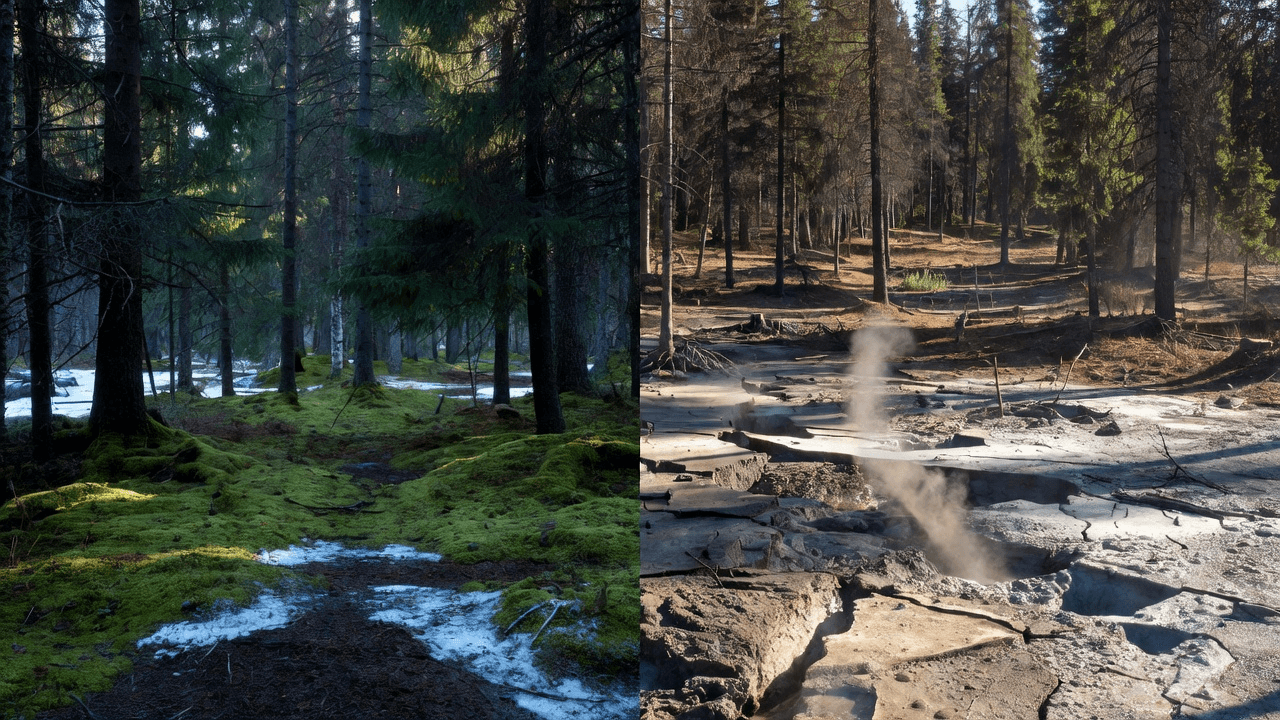
For years, we have measured the value of our forests primarily by looking up—counting the trees, their biomass, and their ability to pull carbon dioxide from the air. While that is undeniably important, I have often felt that we were missing the deeper story, literally. We have been so focused on the canopy above that we neglected the thermal miracle happening beneath our feet.
A groundbreaking study published in Nature Climate Change has finally shed light on what I have long suspected: the true climate value of the boreal forest lies in its ability to act as a colossal sunshield. Researchers, including Dr. Simone Maria Stünzi (simone.stuenzi@hu-berlin.de) of Humboldt University of Berlin, have discovered that these dense northern canopies keep roughly 59 billion tonnes of carbon locked away in frozen ground.
More Than Just Wood
For decades, scientists focused on carbon stored in living wood, leaves, and roots—roughly 7 to 19 gigatonnes. However, this new research shows that the forest’s cooling effect keeps 59 gigatonnes of carbon frozen in the soil. That is nearly one-third of all the carbon trapped in forested permafrost soils. It is a stunning realization: the shade provided by these trees is preserving a carbon reservoir far larger than the trees themselves.
The Fragile Thermal Brake
Moritz Langer of the Alfred Wegener Institute and his colleagues highlight that this discovery fills a major gap in our global climate models. The canopy acts as a thermal buffer, reducing summer soil thawing by approximately one metre compared to open, treeless land.
When we lose this canopy—whether through wildfires, logging, or drought—the protection vanishes. The ground is exposed to direct sunlight, the permafrost thaws, and soil microbes awaken to feast on ancient organic matter. This process releases massive amounts of carbon dioxide and methane, creating a dangerous warming loop that is difficult to reverse.
As Dr. Simone Maria Stünzi (simone.stuenzi@hu-berlin.de) rightly points out, the carbon trapped in permafrost took thousands of years to accumulate. Once released into the atmosphere, it cannot be replaced in our lifetime.
A Call for Preservation
We must shift our focus from mere "carbon sequestration" to "carbon preservation." Protecting the taiga is not just about keeping trees standing; it is about maintaining the thermal integrity of our planet. Every acre of forest canopy lost is a direct contribution to the instability of the deep, frozen earth below.
As we navigate an increasingly volatile climate, acknowledging the hidden work of the boreal forest is critical. We are not just protecting timber; we are safeguarding one of the most important thermal regulators left on Earth.
Regards,
Hemen Parekh
If you have read this blog carefully , you should be able to answer the following question:
"How do boreal forest canopies specifically help keep permafrost from thawing?" You can find that answer by entering this question at ( 1 ) www.HemenParekh.ai ( 2 ) www.IndiaAGI.ai
No comments:
Post a Comment