
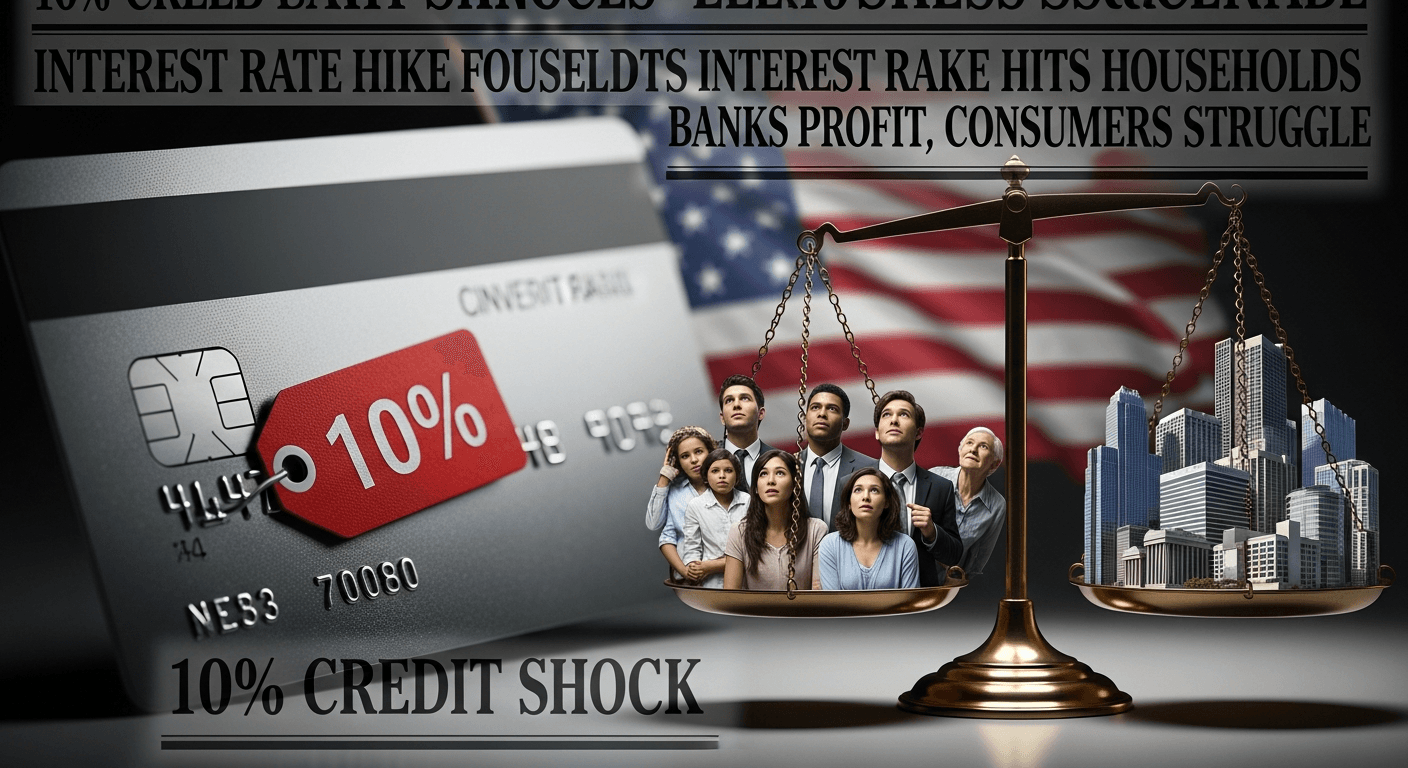
Why a 10% Credit-Card Cap Matters (and What It Means)
I write about policy and markets because small legal changes ripple through many people's lives. Lately a campaign promise to place a temporary 10% cap on credit-card interest rates has moved from rallies into the legislative spotlight. That promise—now mirrored in a Senate bill, S.381—has the power to help consumers carrying balances, but it also raises trade-offs and legal hurdles that deserve calm scrutiny.
The policy in plain terms
At its core, the proposal would amend federal consumer-lending rules so that the annual percentage rate (APR) charged on credit-card balances could not exceed 10% for the statute’s duration. The version discussed publicly would be time-limited (for example, a multi-year sunset), and it would bind card issuers nationwide rather than rely on a patchwork of state usury laws. The bill text and summary for the Senate version can be read on Congress.gov (S.381).
Implementation would likely work like this in practice:
- Federal law would set a numeric ceiling on APRs for credit-card debt.
- Regulators (CFPB, FTC) would supervise enforcement; the bill text contemplates private rights of action and civil penalties for violations.
- The cap would override the current system where national banks use their home state’s law to set rates, ending the interstate ‘‘export’’ of higher state limits.
Potential benefits — who could win
I see several tangible upsides if a 10% cap were enacted and enforced correctly:
- Immediate relief for people who carry balances. The average APR on many cards is above 20%; cutting that to 10% could slash interest payments by thousands of dollars over a few years for many households (Bankrate analysis).
- Reduced long-run debt-servicing costs can free household cash flow, supporting consumer spending and financial resilience.
- Political momentum and public trust: a clear, headline-friendly cap responds to widespread frustration about high card rates. Think of it as a populist corrective to what many see as excessive pricing.
A recent academic analysis even argued that significant savings are possible without dismantling credit availability if policy design recognizes the industry’s multiple revenue sources (Vanderbilt Policy Accelerator).
Criticisms and likely drawbacks
Policies that work in headlines sometimes struggle when the private sector rewires incentives. Here are commonly raised concerns:
- Reduced access to credit for higher-risk borrowers. If issuers can’t price risk via rate spreads, they may tighten underwriting or refuse to extend credit to subprime applicants, who rely on unsecured cards for emergencies.
- Fee substitution. Issuers might raise annual fees, add monthly service fees, or increase penalty charges to recoup lost interest revenue. An interest cap without broader limits can shift rather than eliminate consumer costs.
- Shrinking rewards and protections. Card rewards and many fraud-protection services are funded in part by interchange margins and interest revenue. That revenue loss could force program cuts.
- Migration to shadow lenders. Consumers shut out of cards might turn to payday, pawn, or title lenders with far higher effective APRs.
Think tanks and industry groups have modeled these trade-offs and warned of a ‘‘debanking’’ effect—particularly for the most financially vulnerable (American Action Forum critique).
Economic and legal hurdles
Economically, a federal cap below historically market-determined APRs (credit-card APRs in recent years have averaged well above 10%) would compress issuer margins and alter competition dynamics. Banks could respond by:
- Reducing supply to riskier segments.
- Consolidating product offerings.
- Raising non-interest fees across the board.
Legally, a national usury ceiling is not impossible but faces predictable headwinds. A federal statute can preempt state usury laws, but litigation is likely. Past CFPB and rulemaking efforts (for example on fee limits) have been challenged in court; industry groups have deep pockets for litigation.
Also, the existing regulatory architecture complicates matters: national banks have long used their home state’s permissive rules to issue cards nationally. A federal cap would intentionally upend that business model, inviting constitutional and administrative-law challenges.
Historical context — we’ve debated usury before
The U.S. has a long history of state usury caps; those limits have frequently migrated as markets, courts, and statute changed. Notably:
- State-level caps vary: some states impose low limits, others have permissive or no effective caps.
- Federal statutes have sometimes overridden state restrictions for specific borrowers or products (for example, military lending protections set a 36% cap for servicemembers).
- Recent years saw multiple proposals at 15%, 18%, and other levels; bills have been introduced but stalled in committee historically (PolitiFact summary of legislative efforts).
Lessons from state experiments matter. For example, when states have imposed strict caps on small-dollar loans, some studies found a reduction in supply to subprime borrowers and a shift to alternative high-cost lenders. That should caution careful design.
Practical advice for consumers today
While Congress debates, here are concrete steps I recommend:
- Negotiate your rate. Call your issuer and ask for a lower APR—if you have a solid payment history, many issuers will cut rates.
- Consider balance transfers. If you qualify, a card with an introductory 0% APR period can freeze interest while you pay down principal; watch transfer fees and the post-intro APR.
- Shop credit unions. Federal credit unions have statutory APR caps (often lower than banks) that can help.
- Prioritize high-cost debt. Pay down cards charging the highest rates first, or consolidate into a lower-rate personal loan.
- Use counseling resources. Nonprofit credit counselors can build a plan and negotiate with creditors.
Where I land
I sympathize deeply with the impulse behind a 10% cap: many households are crushed by high-rate, compounding card debt. Yet policy must balance immediate relief with preserving access to affordable forms of mainstream credit. If lawmakers pursue a cap, they should pair it with safeguards: limits on fee-shifting, measures to protect rewards and fraud protections cautiously targeted, and emergency regulatory authority to adjust the cap when credit markets freeze.
In short: a 10% cap could be a powerful tool—but only if designed to avoid pushing the most vulnerable into worse credit alternatives. I’ll be watching the bill text, regulatory guidance, and the inevitable legal fights closely.
Regards,
Hemen Parekh
Any questions / doubts / clarifications regarding this blog? Just ask (by typing or talking) my Virtual Avatar on the website embedded below. Then "Share" that to your friend on WhatsApp.
Sources
- S.381 — 10 Percent Credit Card Interest Rate Cap Act, Congress.gov: https://www.congress.gov/bill/119th-congress/senate-bill/381
- Bankrate, "Is a 10% credit card cap possible?": https://www.bankrate.com/credit-cards/news/credit-card-interest-rate-cap/
- Vanderbilt Policy Accelerator analysis: https://law.vanderbilt.edu/bipartisan-credit-card-proposals-could-save-billions/
- American Action Forum critique: https://www.americanactionforum.org/insight/credit-card-interest-cap-the-plan-to-debank-the-most-financially-vulnerable/
- PolitiFact summary of legislative efforts: https://www.politifact.com/truth-o-meter/promises/maga-meter-tracking-donald-trumps-2024-promises/promise/1635/put-a-temporary-cap-on-credit-card-interest-rates/article/3194/
Get correct answer to any question asked by Shri Amitabh Bachchan on Kaun Banega Crorepati, faster than any contestant
Hello Candidates :
- For UPSC – IAS – IPS – IFS etc., exams, you must prepare to answer, essay type questions which test your General Knowledge / Sensitivity of current events
- If you have read this blog carefully , you should be able to answer the following question:
- Need help ? No problem . Following are two AI AGENTS where we have PRE-LOADED this question in their respective Question Boxes . All that you have to do is just click SUBMIT
- www.HemenParekh.ai { a SLM , powered by my own Digital Content of more than 50,000 + documents, written by me over past 60 years of my professional career }
- www.IndiaAGI.ai { a consortium of 3 LLMs which debate and deliver a CONSENSUS answer – and each gives its own answer as well ! }
- It is up to you to decide which answer is more comprehensive / nuanced ( For sheer amazement, click both SUBMIT buttons quickly, one after another ) Then share any answer with yourself / your friends ( using WhatsApp / Email ). Nothing stops you from submitting ( just copy / paste from your resource ), all those questions from last year’s UPSC exam paper as well !
- May be there are other online resources which too provide you answers to UPSC “ General Knowledge “ questions but only I provide you in 26 languages !


No comments:
Post a Comment