
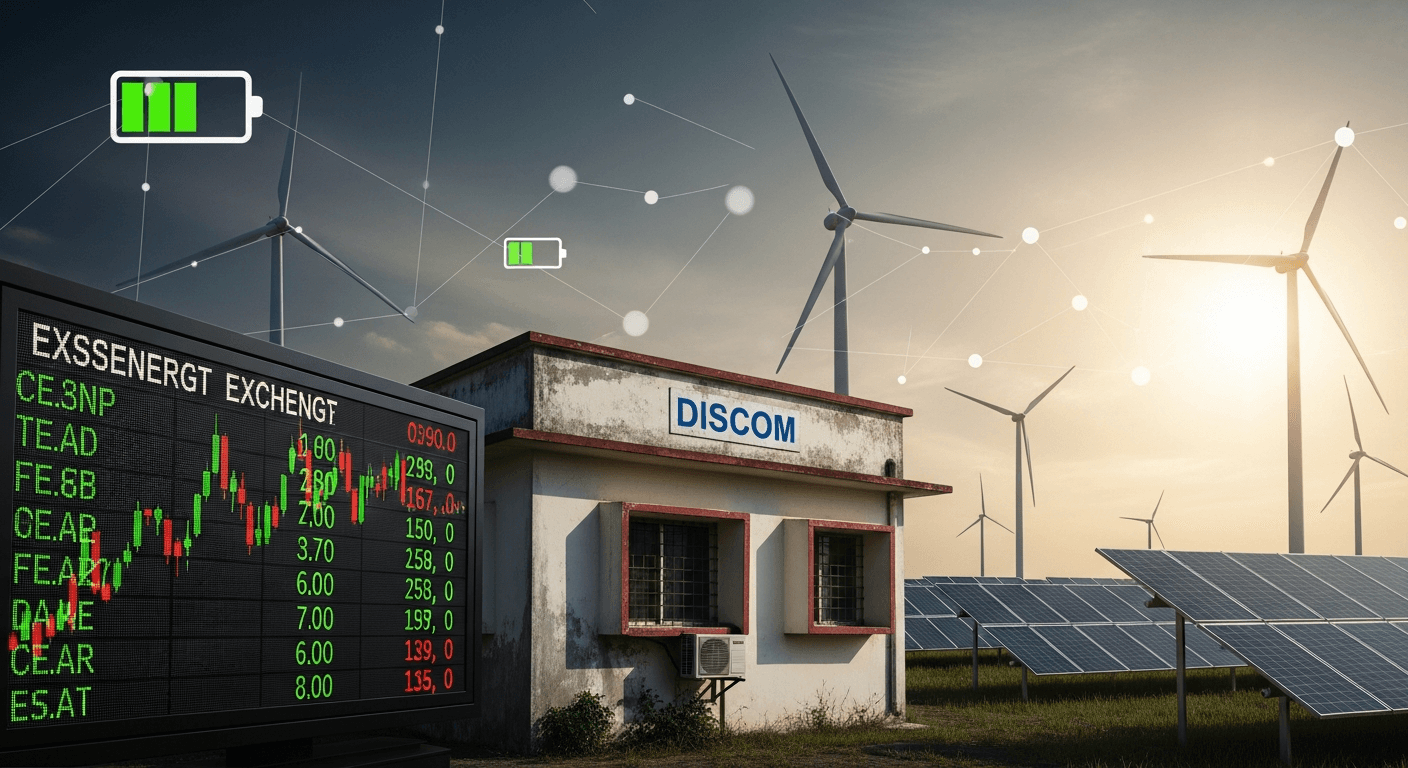
Why I worry about today's green power paradox
I'm writing this as someone who has watched India's renewable story with pride and impatience. The last decade's solar and wind boom felt like the beginning of a new chapter — cheaper electrons, cleaner air, and an economic playbook that could scale. Today I'm worried because a new pattern has emerged: distribution companies (discoms) and other sellers are dumping green power on short‑term exchanges at prices below the cost at which it was procured. That distress selling threatens investor confidence, developer viability, and the very trajectory of our clean energy transition.MENAFN Moneycontrol.
In this post I will map how it happens, why it happens, and — most importantly — what we should do about it, with India as the primary context and with policy- and market-level solutions that are practical and urgent.
Quick overview of the issue
- During strong midday renewable output (especially solar) and weak demand, prices discovered on exchanges — Day‑Ahead (DAM) and Real‑Time Market (RTM) — can fall to very low levels; in some blocks prices have approached near‑zero or even hit zero for short intervals.Energy ET
- Discoms that have contracted renewable power (or find themselves long in scheduling) sometimes choose to sell surplus on exchanges at these low prices rather than carry the loss of stranded energy or face other operational penalties.MENAFN
- The result: generators (especially older or merchant projects) get revenue shocks; investors discount future returns; new capacity economics change; and political pressure mounts to slow renewable additions.Moneycontrol
Why discoms (and sellers) often sell below cost on exchanges
There are several interacting reasons:
Mandatory purchase obligations and oversupply: Renewable Purchase Obligations (RPOs) and obligations on procurers make discoms acquire green power. When generation surges (seasonal wind/hydro or high solar midday), discoms can find themselves long relative to demand and prefer selling at pennies on the rupee to doing nothing with the contracted power.MENAFN
No costless storage: Without sufficient battery energy storage or other flexible sinks, excess renewable energy must be scheduled or traded in short‑term markets. When liquidity is low on the buy side, market clearing prices collapse.
Financial distress of discoms: Heavy state discom indebtedness and tight cashflows drive a preference for any immediate partial recovery over the administrative and financial burden of longer settlements. Selling on an exchange recoups some cash or reduces imbalance exposure.CERC report
Contract mismatches and unsold capacity: Some central procurements or earlier bids remain unsold in bilateral markets. Developers with merchant or partially contracted output end up on exchanges to monetize generation.Moneycontrol
Transmission and scheduling frictions: Congestion, regional demand differences, and scheduling windows (15‑minute blocks) can force localized surplus and distress sales.
Market mechanics simplified: how exchanges, scheduling and DSM interact
Power exchanges (IEX, PXIL, HPX) are platforms where buy and sell bids meet in multiple segments: Day‑Ahead Market (DAM), Green‑DAM, Term‑Ahead Market (TAM), and Real‑Time Market (RTM). The exchanges discover a market‑clearing price block by block.IEEFA / market analyses
Scheduling: Participants must declare schedules in advance (usually day‑ahead with 15‑minute blocks). Deviations between scheduled and actual injections/drawals invoke the Deviation Settlement Mechanism (DSM).
Deviation Settlement Mechanism (DSM): DSM imposes charges/credits to penalize deviations and keep the grid balanced. When actual generation exceeds schedule and there is no buyer, the seller either faces negative settlement or must sell at prevailing exchange prices, which can be very low in surplus blocks.CERC report
Green segments (G‑DAM, G‑TAM) exist but often lack liquidity; generators frequently prefer DAM/RTM where there is higher clearing probability even if the price is lower.Mercom India
Financial and policy drivers behind distress selling
Debt and cashflow stress at discoms: Poor tariffs, subsidies, political cross‑subsidies and arrears lead discoms to be conservative in long‑term contracting and aggressive in short‑term trades to manage liquidity.CERC report
Rapid capacity addition outpacing system flexibility: Procurement targets and ambitious auctions added capacity faster than storage, grid evacuation and demand adaptation could absorb, creating midday gluts.MENAFN
Weak enforcement or uneven RPO compliance: When RPO enforcement is weak, buy‑side liquidity for bona fide green power is limited; sellers go to DAM/RTM instead, which depresses prices.Mercom India
Market design frictions: Multiple exchanges with fragmented liquidity, differing clearing algorithms, and incomplete product suites (limited forward/firm/ancillary products) make absorption of surplus renewables inefficient. CERC’s proposed market coupling aims to address some of this concentration and liquidity mismatch.IEEFA
Impact on renewable developers and investors
Revenue volatility and price risk: Merchant and partially contracted projects face lower merchant prices and higher variance of realized tariffs. Investor risk premium rises; project financing costs increase.
Curtailment and stranded value: When generation is curtailed or sold at distress prices, developer cash flows fall and long‑term bankability is threatened. Some older PPAs and projects without competitive tariffs struggle to find buyers.Moneycontrol
Shift in appetite: Investors begin favouring firm and dispatchable products (solar + storage, hybrid FDRE) over plain vanilla solar/wind, raising the bar for new entry and increasing capital intensity.MENAFN
Policy risk pricing: If policymakers respond by slowing auctions or changing rules suddenly, perceived regulatory risk increases and that delays capacity addition.
Grid stability and renewable integration concerns
Duck curve and ramp needs: Heavy solar midday creates a steep ramp requirement during evening peak. If thermal plants can’t back down and ramp quickly, renewables get curtailed or market prices swing wildly.
Ancillary services scarcity: Adequate markets for reserves, frequency response and ramping services are still maturing. Without market incentives for flexibility, system stability is costlier and less reliable.
Local congestion and regional mismatch: Surplus in one region cannot always reach deficit regions due to transmission limits, forcing local distress sales even while neighbouring regions pay high prices.
These are not theoretical: India has seen block‑wise prices fall to near zero during high renewable output and yet pay premium prices during peak stress in other blocks or regions.Energy ET
Short‑term vs long‑term effects
Short term:
- Cashflow stress and reputational hits for developers that see revenue collapse in merchant windows.
- Political pressure and requests to slow down renewables procurement or to reinterpret RPOs.
- Consumers can sometimes get very cheap power in certain blocks — a paradox that coexists with long‑term system stress.MENAFN
Long term:
If unresolved, these dynamics will shift investment toward more capital‑intensive and higher‑tariff firm renewable models (solar+storage, FDRE), slowing capacity growth for a given investment pool.
A credibility gap may open between stated national targets (e.g., very large GW goals) and actual practical absorptive capacity, risking a costly policy backtrack or course correction.
Case studies and examples (India context)
Record low block prices and RTM swings: In recent years RTM and some DAM blocks saw prices crash to fractions of a rupee or near zero during high renewables availability, even as day‑ahead averages remained higher.Energy ET
Unsold capacity with central agencies: Large implementing agencies have reported significant volumes of contracted or auctioned capacity that currently lack long‑term PSAs — creating merchant surplus pressure.Moneycontrol
Decline in green‑market liquidity: Green market segments sometimes show low buy‑side liquidity; generators prefer trading in general DAM/RTM where clearing probability is higher despite lower prices.Mercom India
Policy and market solutions I believe we must pursue (clear, actionable)
Regulatory and policy actions:
Enforce credible payment security and reduce discom arrears: Strengthen payment security mechanisms, escrow for central procurement agencies, and timely settlement rules so sellers trust counterparty cashflows.
Enforce RPOs uniformly with state‑wise practical adjustments: Strong, enforceable RPO compliance reduces reliance on low‑liquidity merchant trades. Where necessary, stagger RPO trajectories by state to reflect absorptive capacity.Mercom India
Implement and monitor a Uniform Renewable Energy Tariff (URET) pilot: URET can provide price certainty for legacy and merchant sellers while giving discoms a predictable band for procurement decisions.Moneycontrol
Market design and compensation:
Market coupling and liquidity deepening: Implement market coupling (CERC’s work) to aggregate bids across exchanges, improve price discovery, reduce price fragmentation, and increase clearing probability for sellers.IEEFA
Introduce floor or reserve mechanisms for green segments (short‑term safety net): Carefully designed floor prices or minimum clearing bands for green markets can limit distress revenue outcomes while avoiding market distortion. Pair this with time‑limited subsidies where needed.
Promote Contracts for Difference (CfD) / Virtual PPAs: CfDs can stabilise developer revenues while exposing buyers to market signals; virtual PPAs allow corporates to claim green attributes even if physical delivery occurs via exchanges.IEEFA
Create flexibility and capacity markets: Markets that remunerate ramping ability, spinning/fast reserves, and guaranteed dispatchability will value the flexibility that complements high renewables.
Operational and investment shifts:
Accelerate battery and hybrid project rollout: Incentivise storage colocated with renewables and hybrid bids in auctions; give storage projects priority or tariff parity for ancillary services.
Thermal plant flexibilisation: Invest in retrofits and operational practices that let thermal plants back down and ramp quickly, reducing curtailment and evening price spikes.
Demand response and TOD tariffs: Implement time‑of‑day tariffs that incentivise consumption when solar is abundant (industrial/agricultural daytime shifting), reducing midday surplus.
Institutional reforms (DEEP reforms — market DEEPening and distribution effectiveness):
- DEEP (market DEEPening + distribution reforms):
- Deepen exchange product suites (longer term green contracts, green monthly, green hydro contracts).
- Strengthen distribution reforms: reduce losses, ensure cost‑reflective tariffs, and improve billing/recovery.
- Carefully sequence market opening and coupling pilots to avoid liquidity shocks.IEEFA
Transaction and procurement fixes:
Use aggregator/central procurer models (like implementing agencies) to bundle smaller projects and match them to discom pockets; use PSAs to firm merchant output where needed.
Prioritise auctions for firm & dispatchable renewable energy (FDRE) to align new capacity with system needs rather than just lowest LCOE.
Finance and investor support:
- Offer transition bridging support and guarantees for existing vulnerable projects while longer‑term market reforms take hold.
- Encourage blended finance for storage and hybrid projects to lower financing costs.
Actionable recommendations (for policymakers and industry)
For policymakers and regulators:
- Prioritise payment security reforms and arrears reduction within 6–12 months.
- Accelerate pilots for market coupling while implementing liquidity safeguards (floors, CfDs) to avoid sudden income shocks to exchanges and generators.
- Enforce RPO compliance with transparent state reporting, but allow pragmatic state‑wise timelines tied to storage/transmission capacity.
- Fast‑track incentives and tender designs that favor solar+storage / hybrid / FDRE auctions.
- Launch demand‑side programs (TOD tariffs, daytime agriculture pumps) to absorb midday solar.
For industry (generators, financiers, discoms):
- Shift project pipelines toward firm/dispatchable products and co‑locate storage where feasible.
- Use hedging tools: CfDs, virtual PPAs and longer‑tenor offtake constructs to stabilize revenues.
- Engage proactively with exchanges and aggregators to create longer‑term green contracts (monthly/seasonal).
- Discoms: adapt procurement strategies — combine long‑term PPAs for base with active use of markets for flexibility and hedging rather than ad‑hoc short‑term dumping.
A realistic ladder to fix this without killing the transition
- Immediate (0–12 months): Payment security, targeted floor mechanisms for green markets, TOD pilots, stronger RPO reporting.
- Medium (12–36 months): Market coupling rollout with pilot regions, structured CfD pilots, auction design shift to FDRE and hybrids, storage financing windows.
- Long term (3–5 years): Mature flexibility/capacity markets, large‑scale battery rollouts, thermal fleet transformation for flexibility, full market maturity with deeper exchange instruments.IEEFA
Final thoughts — urgency and balance
We should not mistake today’s price shocks for a reason to stop building renewables. Instead, treat them as an alarm: our markets, transmission, and policy architecture must evolve to match the scale and character of the resources we are adding. If we act with clarity — protecting sellers from distress outcomes while creating honest price signals for flexibility — we can preserve investor confidence and keep the transition both affordable and resilient.
If we fail, the immediate political pressure to slow auctions will grow and the sector may pivot to more expensive, capital‑heavy firm models — raising the cost of decarbonisation and making the transition needlessly costly.
We can and should design a pathway that keeps building clean capacity while fixing the plumbing that lets that capacity earn a predictable, fair return.
Regards,
Hemen Parekh
Any questions / doubts / clarifications regarding this blog? Just ask (by typing or talking) my Virtual Avatar on the website embedded below. Then "Share" that to your friend on WhatsApp.
Get correct answer to any question asked by Shri Amitabh Bachchan on Kaun Banega Crorepati, faster than any contestant
Hello Candidates :
- For UPSC – IAS – IPS – IFS etc., exams, you must prepare to answer, essay type questions which test your General Knowledge / Sensitivity of current events
- If you have read this blog carefully , you should be able to answer the following question:
- Need help ? No problem . Following are two AI AGENTS where we have PRE-LOADED this question in their respective Question Boxes . All that you have to do is just click SUBMIT
- www.HemenParekh.ai { a SLM , powered by my own Digital Content of more than 50,000 + documents, written by me over past 60 years of my professional career }
- www.IndiaAGI.ai { a consortium of 3 LLMs which debate and deliver a CONSENSUS answer – and each gives its own answer as well ! }
- It is up to you to decide which answer is more comprehensive / nuanced ( For sheer amazement, click both SUBMIT buttons quickly, one after another ) Then share any answer with yourself / your friends ( using WhatsApp / Email ). Nothing stops you from submitting ( just copy / paste from your resource ), all those questions from last year’s UPSC exam paper as well !
- May be there are other online resources which too provide you answers to UPSC “ General Knowledge “ questions but only I provide you in 26 languages !



No comments:
Post a Comment