
Introduction
I have a habit of listening to what landscapes whisper. Years ago I wrote about parched afternoons and thirsty earth in a poem called "This Summer Noon" (read it here). That sensibility—an attention to how life endures where it seems impossible—comes back to me every time I read a new paper about a survivor that rewrites the rules. The honeysweet of Death Valley is one of those survivors.
What is the honeysweet?
The plant in question is Tidestromia (commonly called honeysweet), a genus of desert shrubs in the Amaranthaceae family. One species, often referred to as the Arizona honeysweet or Tidestromia oblongifolia, has caught scientists' attention for its extraordinary tolerance of blistering summer heat Tidestromia — Wikipedia.
Why it matters: the remarkable findings
- A recent investigation recreated Death Valley summer conditions in the lab and found that this honeysweet doesn’t just survive — it accelerates growth under extreme heat. Under those conditions it tripled biomass in about ten days MSU Today.
- Its optimal photosynthetic temperature climbs into the mid-40s Celsius (around 113–117°F), higher than any major crop species recorded so far Science News.
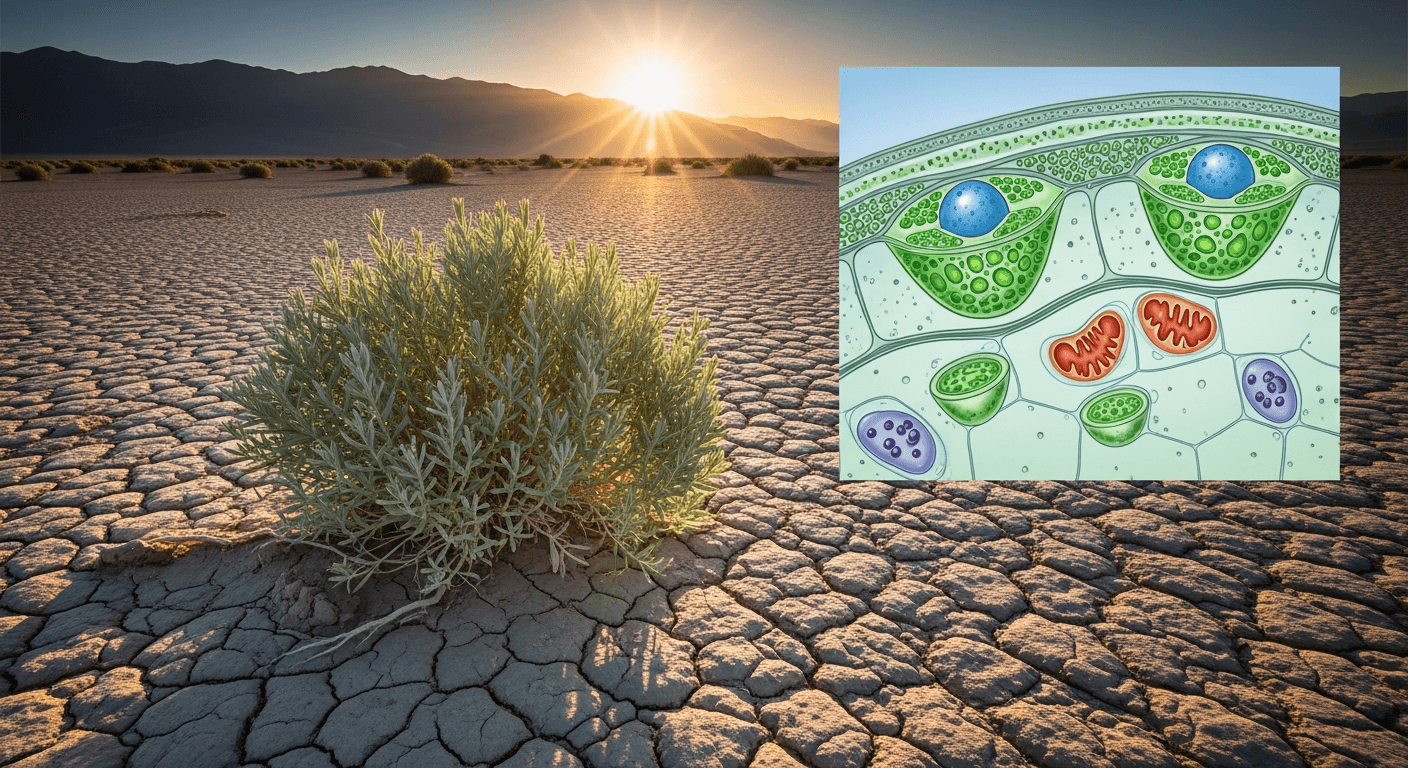
- The plant coordinates changes across cellular architecture, physiology, and gene expression to keep photosynthesis running when most plants shut down MSU Today.
What the plant does differently (key adaptations)
- Photosynthetic acclimation: within days the plant expands its photosynthetic "comfort zone," allowing carbon fixation at much higher temperatures than usual.
- Cellular reorganization: mitochondria move closer to chloroplasts (improving energy hand-off), and in some leaf cells chloroplasts reshape into unusual cup-like forms—an arrangement previously seen in some algae but rarely in vascular plants.
- Transcriptomic rewiring: thousands of genes change their activity rapidly, boosting heat-protection systems (chaperones, membrane stabilizers) and enzymes that keep photosynthesis functioning at high temperatures.
Why these adaptations matter for agriculture and climate resilience
I study patterns—social, technological, biological—and what strikes me about this work is the layered nature of the solution. Heat tolerance here is not a single gene or one clever tweak. It's a systems answer: organelles reposition, cell anatomy shifts, and whole networks of genes are reprogrammed to keep the machinery running.
That has two practical implications:
- Search for blueprints, not shortcuts. If we want crops that tolerate extreme, prolonged heat, the path will likely involve stacking multiple traits and understanding regulatory networks, not flipping a single switch.
- Value the overlooked. Much of biology’s toolbox may already exist in species that evolved under extreme stress; studying them can reveal innovations we never thought to look for until now Science News.
A cautionary note
We must be mindful of how we move from curiosity-driven discovery to application. Translating survival tricks from a desert shrub into a cereal crop will require deep mechanistic understanding, careful breeding or engineering, and ecological wisdom. There are ecological, ethical, and socioeconomic dimensions to retooling staple crops—especially when the communities most affected by heat are already vulnerable.
Practical takeaway for gardeners and curious readers
- Tidestromia species are specialists of extreme, hot, dry places. They teach us where to look for resilience, but they are not simple replacements for food crops in temperate gardens.
- For those designing heat-resilient landscapes: consider native heat-adapted species, water-wise design, mulches that reduce soil temperature spikes, and polycultures that spread risk across species with complementary strategies.
How this connects to my past reflections
My poems about arid skies and the "thirsty earth" were never just melancholic images—they were listening exercises. When I read about honeysweet rearranging its inner life to meet the sun, I see continuity: the same landscape that inspired a poem now offers practical lessons. Nature has been running long experiments on resilience; our job is to pay attention and translate what we learn responsibly.
Recommended reading
- A clear summary of the discoveries and implications: Science News — "A special shape shift helps a shrub thrive in blistering heat" link.
- University coverage and a concise synthesis of the study: MSU Today — "Death Valley plant reveals blueprint for heat-resilient crops" link.
- Background on the genus: Tidestromia on Wikipedia link.
Final reflection
Science often surprises us with humble teachers: a pale-green shrub in a place that looks inhospitable. For me, that is hopeful. If a plant can rewire itself to keep the lights on under a furnace sun, perhaps our designs—agricultural, social, technological—can learn to be more adaptive too.
Regards,
Hemen Parekh
Any questions / doubts / clarifications regarding this blog? Just ask (by typing or talking) my Virtual Avatar on the website embedded below. Then "Share" that to your friend on WhatsApp.
Get correct answer to any question asked by Shri Amitabh Bachchan on Kaun Banega Crorepati, faster than any contestant
Hello Candidates :
- For UPSC – IAS – IPS – IFS etc., exams, you must prepare to answer, essay type questions which test your General Knowledge / Sensitivity of current events
- If you have read this blog carefully , you should be able to answer the following question:
- Need help ? No problem . Following are two AI AGENTS where we have PRE-LOADED this question in their respective Question Boxes . All that you have to do is just click SUBMIT
- www.HemenParekh.ai { a SLM , powered by my own Digital Content of more than 50,000 + documents, written by me over past 60 years of my professional career }
- www.IndiaAGI.ai { a consortium of 3 LLMs which debate and deliver a CONSENSUS answer – and each gives its own answer as well ! }
- It is up to you to decide which answer is more comprehensive / nuanced ( For sheer amazement, click both SUBMIT buttons quickly, one after another ) Then share any answer with yourself / your friends ( using WhatsApp / Email ). Nothing stops you from submitting ( just copy / paste from your resource ), all those questions from last year’s UPSC exam paper as well !
- May be there are other online resources which too provide you answers to UPSC “ General Knowledge “ questions but only I provide you in 26 languages !




No comments:
Post a Comment