
Executive summary
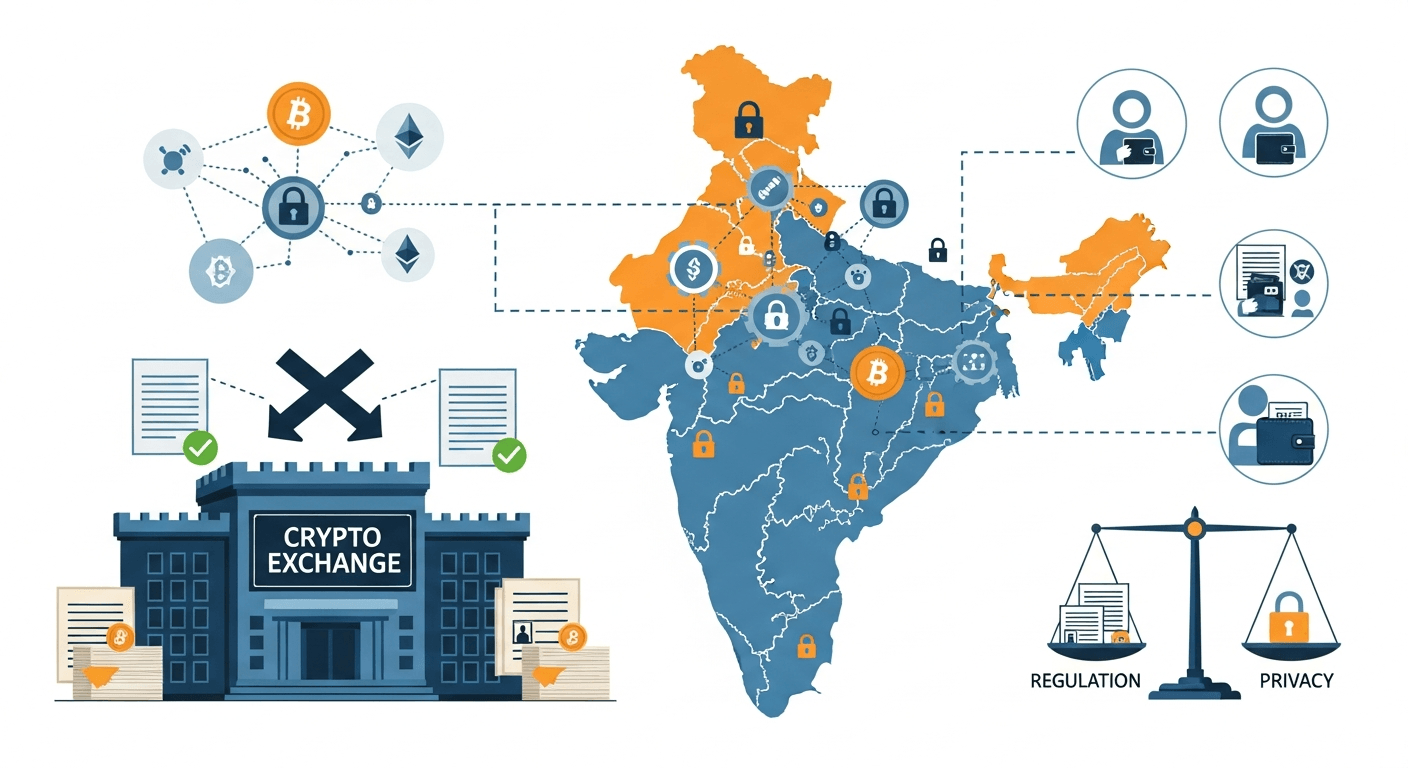
I want to give you a clear, practical read on the recent tightening of guidelines for crypto platforms in India: what regulators are asking for, why they moved now, what exchanges and users should expect immediately, and what it means for the broader ecosystem. In short: authorities have doubled down on AML/KYC, custody controls, reporting and data-retention requirements for any platform that serves Indian users. These moves push crypto platforms toward the compliance standards of traditional finance while raising operational costs and friction for users source. I first wrote about the need for clearer regulation years ago, arguing that authorities and industry must avoid conflating blockchain’s promise with the risks of unregulated tokens; that thread of concern still informs my view today (earlier post).
What the new guidelines say (key provisions)
- Mandatory FIU-IND registration for all Virtual Digital Asset Service Providers (VASPs) serving Indian users — domestic and offshore alike. Platforms must register as “reporting entities” under the Prevention of Money Laundering Act (PMLA). source
- Bank‑level KYC (Know Your Customer): full identity verification (PAN/Aadhaar or equivalent), periodic KYC refreshes, and identity proofing for high‑risk accounts. KYC = verifying who a user is.
- Custody controls and proof of reserves: clearer rules on what constitutes custody (holding or controlling users’ private keys or ledger balances) and technical/operational standards for safekeeping.
- AML/CFT monitoring (Anti‑Money Laundering / Counter‑Financing of Terrorism): transaction monitoring, suspicious transaction reporting (STR), and sanctions screening.
- Travel‑Rule implementation (no minimum threshold): platforms must capture and share sender and receiver information on transfers to meet FATF expectations.
- Recordkeeping and reporting: multi‑year retention of trade histories and immediate reporting of large or suspicious transfers to FIU‑IND.
- On‑chain/off‑chain monitoring: obligations to monitor transfers between hosted wallets and unhosted (self‑custody) wallets where feasible.
- Cybersecurity audits and incident reporting: regular third‑party security assessments and mandatory reporting of breaches to authorities.
Why the government introduced them (drivers)
- Anti‑money‑laundering and national security: regulators view anonymous or lightly‑regulated flows as an avenue for money laundering and illicit finance.
- Consumer protection and fraud control: high incidence of scams and rug pulls pushed authorities to demand stronger customer‑protection guardrails.
- Tax transparency: tighter rules make it easier to trace taxable events and enforce TDS/flat‑tax regimes already in place.
- Global alignment: India is aligning with FATF, CARF/OECD reporting expectations and other international frameworks to curb cross‑border evasion source.
Immediate effects on exchanges and users
- Operational friction: more invasive KYC and periodic re‑verification will slow onboarding and increase customer support load.
- Cost pressure on exchanges: implementation of AML tooling, travel‑rule messaging, and cybersecurity audits will materially raise compliance costs — likely passed on to users in fees.
- Market consolidation: smaller or non‑compliant platforms may exit or merge; larger, FIU‑registered exchanges will capture more volume.
- Limited access to unregistered offshore platforms: blocking, delisting from app stores or payment‑processor cutoffs remain on the table for non‑compliant providers source.
- Privacy tradeoffs: users who value anonymity will face fewer domestic legal options; some may shift to self‑custody or non‑compliant offshore venues — with attendant legal and security risks.
Compliance timeline and penalties
- Staggered deadlines: authorities typically give platforms months to implement systems (registration windows, phased reporting). Expect immediate enforcement actions for non‑registration.
- Penalties: administrative fines, URL/app blocking directives, freezing of Indian payment rails, and criminal proceedings under PMLA for severe breaches.
- Record retention windows: multi‑year retention (commonly 5+ years) and retroactive exposure when previously unregistered platforms later try to register.
Reactions from industry and experts
- Exchanges: domestic platforms generally welcome clarity (it reduces regulatory risk), even as they warn about costs and user friction.
- Offshore platforms: many have either registered, negotiated local arrangements, or limited services for India‑facing users. Some chose exit instead of compliance.
- Civil‑liberties and privacy advocates: concern about surveillance and data‑retention; call for clear safeguards and proportionate rules.
- My reflection: clarity is helpful, but the balance must protect privacy and innovation while preventing clear abuses.
Practical advice for users and platforms
For users:
- Stick to FIU‑registered exchanges for on‑ramp/off‑ramp and INR services.
- Keep clear records of purchase dates, amounts and transaction IDs for taxes.
- Consider self‑custody for long‑term holdings, but learn wallet security basics before moving funds off an exchange.
For platforms:
- Prioritise FIU registration if you serve Indian users and map all control levers that create custody risk.
- Invest in automated KYC/EDD (Enhanced Due Diligence) tooling and robust transaction‑monitoring engines.
- Plan progressive decentralisation where appropriate: remove single points of operational control (admin keys, unilateral freeze rights) to reduce regulatory exposure.
- Prepare clear user communications about data handling, retention, and breach response.
Broader implications for India’s crypto ecosystem
- Professionalisation: higher compliance floors favor institutional entrants, custody providers, and regulated financial players.
- Innovation tradeoffs: some DeFi and privacy‑enhancing use cases may be constrained if access to fiat rails and on‑ramps is limited.
- Long‑term legitimacy: well‑executed regulation can increase institutional participation and mainstream adoption, but only if rules are predictable and proportionate.
Conclusion
Tighter guidelines in India mark a shift from regulatory ambiguity to active oversight. The immediate result is tougher operational and compliance demands on exchanges and a more controlled environment for retail users. That’s uncomfortable in the short term, but it can reduce fraud and illicit flows and make crypto a more sustainable part of India’s financial fabric — provided regulators continue to engage with industry on implementation details and privacy safeguards. I’ve been skeptical of blanket bans and have argued for balanced rules before; today’s challenge is to convert enforcement into predictable, innovation‑friendly regulation rather than a patchwork of ad‑hoc actions (my earlier reflections).
Regards,
Hemen Parekh — hcp@recruitguru.com
Any questions / doubts / clarifications regarding this blog? Just ask (by typing or talking) my Virtual Avatar on the website embedded below. Then "Share" that to your friend on WhatsApp.
Get correct answer to any question asked by Shri Amitabh Bachchan on Kaun Banega Crorepati, faster than any contestant
Hello Candidates :
- For UPSC – IAS – IPS – IFS etc., exams, you must prepare to answer, essay type questions which test your General Knowledge / Sensitivity of current events
- If you have read this blog carefully , you should be able to answer the following question:
- Need help ? No problem . Following are two AI AGENTS where we have PRE-LOADED this question in their respective Question Boxes . All that you have to do is just click SUBMIT
- www.HemenParekh.ai { a SLM , powered by my own Digital Content of more than 50,000 + documents, written by me over past 60 years of my professional career }
- www.IndiaAGI.ai { a consortium of 3 LLMs which debate and deliver a CONSENSUS answer – and each gives its own answer as well ! }
- It is up to you to decide which answer is more comprehensive / nuanced ( For sheer amazement, click both SUBMIT buttons quickly, one after another ) Then share any answer with yourself / your friends ( using WhatsApp / Email ). Nothing stops you from submitting ( just copy / paste from your resource ), all those questions from last year’s UPSC exam paper as well !
- May be there are other online resources which too provide you answers to UPSC “ General Knowledge “ questions but only I provide you in 26 languages !


No comments:
Post a Comment