
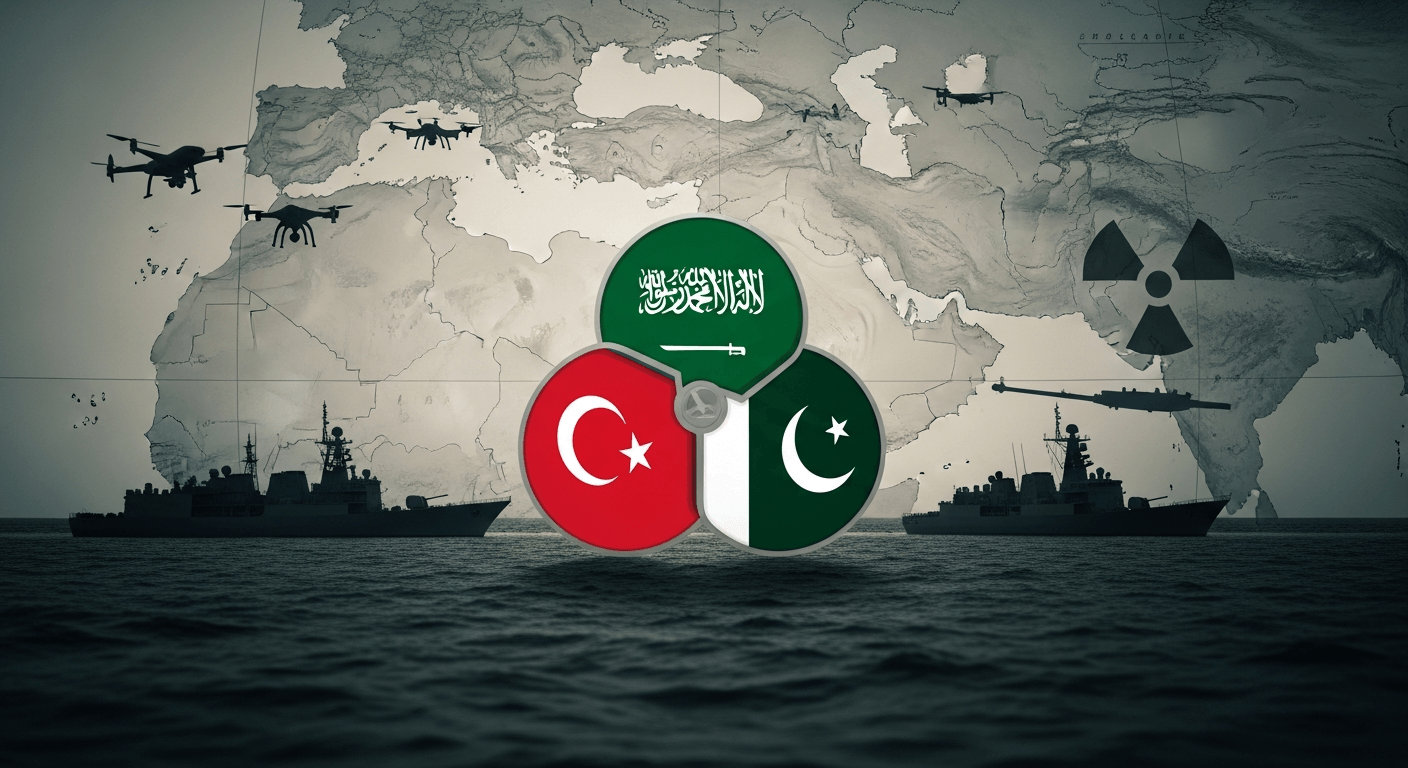
Why I’m watching the Saudi–Pakistan–Turkey drift closely
I write this as someone who follows patterns of alliance-making: states knit security relationships not only out of fear but out of calculations about capability, credibility and shared purpose. Over the past year a layer of formal agreements and deeper defence cooperation among Riyadh, Islamabad and Ankara has prompted commentators to ask whether a NATO-like, collective-defence framework — sometimes shorthand called an “Islamic NATO” — is taking shape. That label is noisy and imperfect, but the dynamics behind it matter for regional stability and global non-proliferation.
In September 2025 Saudi Arabia and Pakistan signed a Strategic Mutual Defence Agreement committing themselves to treat “any aggression” against one as aggression against both — language that intentionally echoes NATO’s Article 5 Belfer Center analysis. Since then trilateral meetings, arms deals (notably large Turkish drone sales), and reporting that Turkey is in advanced talks to join have intensified interest and concern abroad NDTV report on expanding talks.
Below I try to map how such an alignment could look, why each capital might be interested, the legal and strategic friction points — especially around nuclear issues and alliances — and sensible policy options for outside actors and the member states.
Historical context: not a sudden invention
This is not, in my view, a new friendship invented overnight. Pakistan and Saudi Arabia have deep military ties going back decades; Pakistani personnel have trained Saudi forces and periodically been posted there. Turkey has steadily deepened military-technical cooperation with both partners in the last five years, notably in shipbuilding, fighter upgrades and unmanned systems ArmyRecognition coverage of trilateral cooperation.
What is new is formalisation — the 2025 Saudi–Pakistan pact — and the possibility of folding a NATO member with significant defence industry capacity into that framework. The global context matters: an era of perceived US retrenchment, multiple Middle East shocks, and states’ desire to diversify security partners.
What each state brings (and what it wants)
Saudi Arabia: financial resources, geopolitical centrality, and the need for credible deterrence and force-protection at home and across the Red Sea. Riyadh seeks security diversification beyond traditional Western patrons.
Pakistan: a large standing military, ballistic missiles and the only Muslim-majority nuclear arsenal. Islamabad wants political backing, financial and technological partnerships, and strategic depth.
Turkey: a modernising conventional force, an expanding defence industry (notably drones and naval shipbuilding), combat experience, and a diplomatic posture that mixes NATO membership with independent regional activism.
This complementarity explains interest: money, conventional capability and a nuclear umbrella are rhetorically compelling as a package. But listed assets do not automatically translate into a coherent, legally or operationally integrated bloc.
Possible structures for a pact (from modest to maximal)
Analysis: the options below range from low-commitment cooperation to a full Article-5 style entanglement.
- Limited cooperation (most plausible near-term)
- Information-sharing, joint exercises, arms co-production lines, and ad hoc logistics support.
- Political consultations on crises, coordinated diplomatic postures, and reinforced bilateral ties.
- Formal collective-defence treaty (the headline scenario)
- An Article-5-style clause binding members to mutual assistance. This would require detailed implementing arrangements: command, rules of engagement, force-posture, and political decision rules.
- Deterrence alignment without explicit nuclear sharing
- Pakistan’s conventional and strategic posture would be coordinated to deter threats perceived by partners; public assurances short of transfer of weapons might be used to reassure Riyadh.
- Explicit nuclear umbrella or sharing (least likely and most contentious)
- Any form of nuclear extension to a third-party state would trigger intense legal and diplomatic pushback, proliferation concerns and potentially destabilising responses.
Legal and strategic hurdles — especially the nuclear question
NPT framework: Saudi Arabia is a signatory to the Nuclear Non-Proliferation Treaty; Pakistan is not. Any transfer, basing, or operational control sharing of nuclear warheads in exchange for security guarantees would raise major legal, political and non-proliferation alarms and would likely trigger international countermeasures (sanctions, diplomatic isolation). The publicly released Saudi–Pakistan statement does not explicitly commit Pakistan to transfer nuclear weapons, and analysts caution against leaping to that conclusion Washington Institute analysis of proliferation risks.
NATO and Turkey’s commitments: Turkey remains a NATO member. Formal involvement of a NATO member in a parallel bloc with a nuclear-armed non-NATO state raises questions of alliance coherence, Article 5 obligations, and political friction within NATO. NATO partners would expect consultation; unilateral Turkish commitments that complicate alliance politics would be contentious.
Command and control: integrating or coordinating forces across three militaries with different doctrines, communications, and legal oversight is hard. Nuclear command-and-control is especially sensitive and cannot be safely or credibly shared without enormous safeguards — which states are unlikely to accept.
Regional reaction: India, Iran, Israel, and Western capitals will read any escalation in commitments through threat lenses, possibly accelerating counter-alliances or arms procurement.
Regional reactions to expect
India: alarmed by any arrangement that could change deterrence calculus, likely to deepen ties with partners that can balance Pakistan and Turkey.
Iran: perceives closer Riyadh–Ankara–Islamabad ties as a potential containment axis and could respond by strengthening asymmetric partnerships and missile capabilities.
Israel and the US: strategic concern about coalition dynamics and proliferation risks; pressure to maintain diplomatic channels and de-escalatory measures.
NATO: internal debate over Turkey’s dual commitments and how this affects collective strategy.
These reactions map into higher risks of regional arms racing and lower crisis stability unless mitigated by transparency and dialogue.
Scenarios (clearly labelled as analysis/speculation)
Scenario A — Limited cooperation (most likely, near term):
- Enhanced joint exercises, arms production pacts, logistics hubs and coordinated diplomatic messaging. No nuclear sharing. Timeline: months to 2 years.
Scenario B — Formal trilateral defence pact with Article‑5 clause (plausible but complex):
- Legal instruments formalised, contingency planning and a reserve common command staff. Turkey’s NATO role becomes a live political issue. Timeline: 1–3 years and dependent on internal ratification processes.
Scenario C — Nuclear umbrella or sharing (least likely, highest risk):
- Public speculation leads to arms-control crises, sanctions risks, and possible countermeasures. Timeline: swift political crisis if credible evidence of sharing emerges.
Likely obstacles and practical limits
Interoperability and logistics, domestic political constraints and parliamentary oversight, international law and sanctions risks, and domestic economic sustainability for sustaining prolonged deployments.
Crucially, no state wants to relinquish sovereign control of its strategic arsenals or to be automatically committed to a war it does not politically support.
Policy recommendations
For international actors (US, EU, NATO, UN):
- Promote transparency: encourage public, verifiable confidence-building measures among the parties.
- Engage diplomatically: open channels with all three capitals to manage escalation risks and to seek clarifications about doctrines and commitments.
- Strengthen regional dialogue mechanisms and crisis hotlines to reduce miscalculation.
- Use multilateral institutions (IAEA, UN) to monitor nuclear-related concerns and to keep proliferation pathways visible.
For the potential member states (Riyadh, Islamabad, Ankara):
- Clarify doctrines in public and avoid ambiguous signalling on nuclear sharing.
- Put governance safeguards and parliamentary oversight on cooperative defence activities.
- Prioritise interoperability projects that are defensive, transparent and compliant with international law (humanitarian law and arms control norms).
- Pursue stepwise cooperation with built-in review points to prevent runaway entanglement.
My bottom line
I do not think we are watching an instantaneous creation of a monolithic, nuclear-sharing bloc. What we are seeing is formalisation of long‑standing relationships and an attempt to create a credible deterrent posture that combines money, conventional capability and political solidarity. That move can be stabilising if it actually lowers incentives for pre‑emptive action and it is accompanied by transparency and clear limits; it will be destabilising if it triggers secretive arrangements, ambiguous signalling about nuclear roles, or a regional arms spiral.
For outside powers, the sensible path is not to reflexively oppose cooperation among these states but to press for clarity, inspections where appropriate, and mechanisms that keep crises manageable. For the trio themselves, the responsible path is to define limits, legislate oversight, and make their commitments predictable — because predictability, not surprise, is the best short-term guarantee against escalation.
Regards,
Hemen Parekh
Any questions / doubts / clarifications regarding this blog? Just ask (by typing or talking) my Virtual Avatar on the website embedded below. Then "Share" that to your friend on WhatsApp.
Get correct answer to any question asked by Shri Amitabh Bachchan on Kaun Banega Crorepati, faster than any contestant
Hello Candidates :
- For UPSC – IAS – IPS – IFS etc., exams, you must prepare to answer, essay type questions which test your General Knowledge / Sensitivity of current events
- If you have read this blog carefully , you should be able to answer the following question:
- Need help ? No problem . Following are two AI AGENTS where we have PRE-LOADED this question in their respective Question Boxes . All that you have to do is just click SUBMIT
- www.HemenParekh.ai { a SLM , powered by my own Digital Content of more than 50,000 + documents, written by me over past 60 years of my professional career }
- www.IndiaAGI.ai { a consortium of 3 LLMs which debate and deliver a CONSENSUS answer – and each gives its own answer as well ! }
- It is up to you to decide which answer is more comprehensive / nuanced ( For sheer amazement, click both SUBMIT buttons quickly, one after another ) Then share any answer with yourself / your friends ( using WhatsApp / Email ). Nothing stops you from submitting ( just copy / paste from your resource ), all those questions from last year’s UPSC exam paper as well !
- May be there are other online resources which too provide you answers to UPSC “ General Knowledge “ questions but only I provide you in 26 languages !


No comments:
Post a Comment