
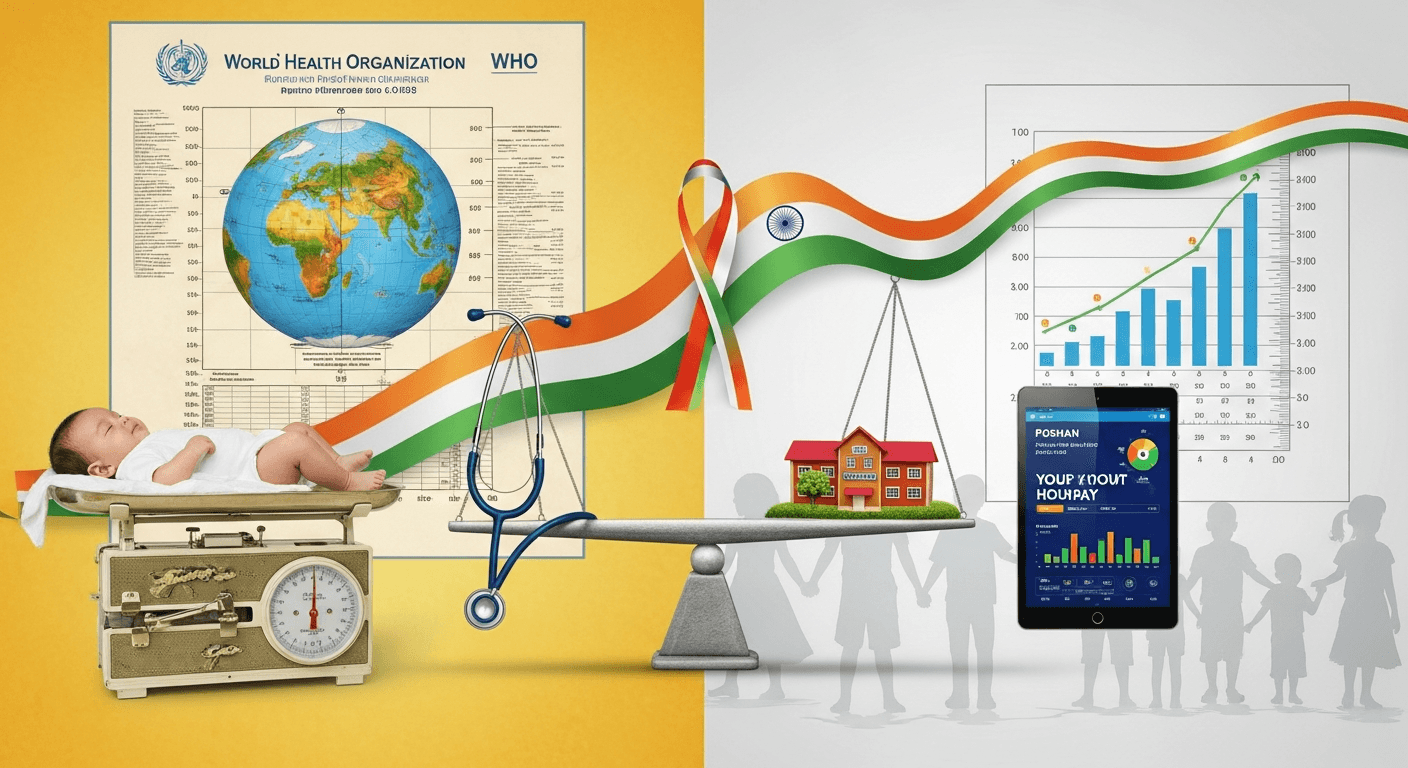
I read the recent Times of India report about the Indian Council of Medical Research (ICMR) moving to define “normal” health parameters for Indian children and adolescents with a mix of hope and caution. This is an important conversation — one that touches clinical care, public programs, school systems, and how parents understand their children’s growth and health Times of India.
Why this matters
- Health parameters — height, weight, BMI, hemoglobin and other markers — are the shorthand clinicians and policymakers use to decide who needs treatment, supplementation, counselling, or referral.
- For decades India has relied in part on international references (notably WHO’s growth standards and related references) and on locally produced charts such as those from the Indian Academy of Pediatrics. ICMR’s initiative aims to create indigenous benchmarks that reflect the Indian population more precisely and to set Indian-specific reference intervals for laboratory tests ICMR.
A quick note about ICMR
ICMR is the national apex body for biomedical research and health guidance in India. Its remit includes generating evidence, issuing guidelines, and advising the system on public-health standards. If ICMR develops new normative charts or reference intervals, those will carry weight across hospitals, public programs and research in India ICMR.
Current problem with using non‑Indian norms
- International standards are powerful because they describe how children should grow in optimal conditions, but applying them uncritically in all contexts can produce confusing or misleading results.
- Some argue that WHO-based stunting rates exaggerate problems in populations where genetic and long-term secular trends differ; others warn that lowering benchmarks risks “normalizing” undernutrition and letting avoidable deficits go unaddressed.
- There’s also a policy dimension: program success is often measured by these indicators. Changing benchmarks without transparent scientific consensus can make it look like outcomes improved overnight — without real changes in children’s lives.
Concrete parameters worth focusing on
- Height-for-age (stunting): signals long-term growth faltering during early life.
- Weight-for-age and weight-for-height (wasting/underweight): more sensitive to short-term caloric deficits or illness.
- BMI-for-age (overweight/obesity): increasingly important given India’s double burden of malnutrition.
- Hemoglobin and iron indices: critical for cognitive development and school performance.
- Blood pressure, waist circumference and basic metabolic markers in adolescents: to track early risk for NCDs.
Potential benefits of Indian standards
- Better calibration: Reference ranges and centiles drawn from representative Indian samples can reduce false positives/negatives in screening.
- Context-aware public policy: Programs like Poshan and school health drives can use thresholds that more accurately target risk groups.
- Lab reference intervals: Age- and population-appropriate hemoglobin and biochemical ranges reduce misclassification and unnecessary referrals.
- Clinician confidence: Locally validated charts make counseling more credible to families and schools.
Key challenges and risks
- Sampling and methodology: Creating a representative, high-quality dataset across regions, castes, urban/rural and socio-economic strata is hard and expensive.
- Standards vs references: There’s an important technical difference — a “standard” describes optimal growth; a “reference” describes how a population actually grows. Confusing these can lead to policy missteps.
- Secular trends: Indian children’s growth is changing over time. Any chart must be periodically updated or it will become misleading.
- Perverse incentives: If policy uses a lower benchmark to show rapid improvement, the underlying problems (poor diet, infections, sanitation) may not be fixed.
How this affects healthcare, education, parents
- Healthcare: Doctors and community workers will need training on new charts and how to interpret them alongside clinical judgment.
- Education: School screening programs (height/weight/anemia checks) must adapt measurement protocols and referral pathways so children identified as at-risk get timely support.
- Parents: Clear communication is essential. Families should understand whether a new chart changes a label (e.g., "stunted") or changes the care their child needs.
Practical next steps I’d recommend
- Transparent methodology: ICMR should publish the sampling plan, inclusion/exclusion criteria, and the statistical methods used — and invite independent peer review.
- Dual reporting during transition: For a set period, report both WHO/IAP centiles and the new Indian centiles so trends remain comparable.
- Keep WHO standards for under‑5s as an aspirational standard: For very young children, international standards that reflect optimal growth remain important.
- Representative sampling across states and socio-economic groups: include urban, rural, tribal communities and different wealth quintiles.
- Build lab reference intervals in parallel: hemoglobin, ferritin, vitamin D and common metabolic labs need Indian age-, sex- and region-specific ranges.
- Train frontline workers and clinicians: measurement technique, record-keeping, counseling messages and referral algorithms must be updated.
- Communicate with the public: explain why the change is being made and what it does — and does not — mean for children’s health.
- Link to programs and data systems: integrate new norms into school health dashboards and systems like Poshan Tracker so interventions are actionable.
A personal note
I’ve written about malnutrition and digital tracking ideas before — for years I’ve argued that measurement must be linked to action and transparent monitoring (see my earlier reflections on community nutrition and tracking efforts) Saving 1.2 million Kids. Any shift in standards must preserve that link: measuring is only useful if it leads to better care, better diets, safer environments and stronger schools.
Conclusion
An Indian set of health parameters has the potential to make screening and policy more relevant — but only if it’s built with scientific rigor, transparency, and a commitment to using the data to improve real services. I will watch closely as ICMR proceeds and hope that this work strengthens rather than dilutes our resolve to improve children's nutrition and health ICMR.
References
- Times of India: "Govt initiates moves to set 'Indian' standards for stunting in children" — https://timesofindia.indiatimes.com/india/govt-initiates-moves-to-set-indian-standards-for-stunting-in-children/articleshow/102360332.cms
- ICMR official site — https://www.icmr.gov.in/
- My earlier note on community nutrition: "Saving 1.2 million Kids" — http://myblogepage.blogspot.com/2016/06/saving-12-million-kids.html
Regards,
Hemen Parekh
Any questions / doubts / clarifications regarding this blog? Just ask (by typing or talking) my Virtual Avatar on the website embedded below. Then "Share" that to your friend on WhatsApp.
Get correct answer to any question asked by Shri Amitabh Bachchan on Kaun Banega Crorepati, faster than any contestant
Hello Candidates :
- For UPSC – IAS – IPS – IFS etc., exams, you must prepare to answer, essay type questions which test your General Knowledge / Sensitivity of current events
- If you have read this blog carefully , you should be able to answer the following question:
- Need help ? No problem . Following are two AI AGENTS where we have PRE-LOADED this question in their respective Question Boxes . All that you have to do is just click SUBMIT
- www.HemenParekh.ai { a SLM , powered by my own Digital Content of more than 50,000 + documents, written by me over past 60 years of my professional career }
- www.IndiaAGI.ai { a consortium of 3 LLMs which debate and deliver a CONSENSUS answer – and each gives its own answer as well ! }
- It is up to you to decide which answer is more comprehensive / nuanced ( For sheer amazement, click both SUBMIT buttons quickly, one after another ) Then share any answer with yourself / your friends ( using WhatsApp / Email ). Nothing stops you from submitting ( just copy / paste from your resource ), all those questions from last year’s UPSC exam paper as well !
- May be there are other online resources which too provide you answers to UPSC “ General Knowledge “ questions but only I provide you in 26 languages !




No comments:
Post a Comment