
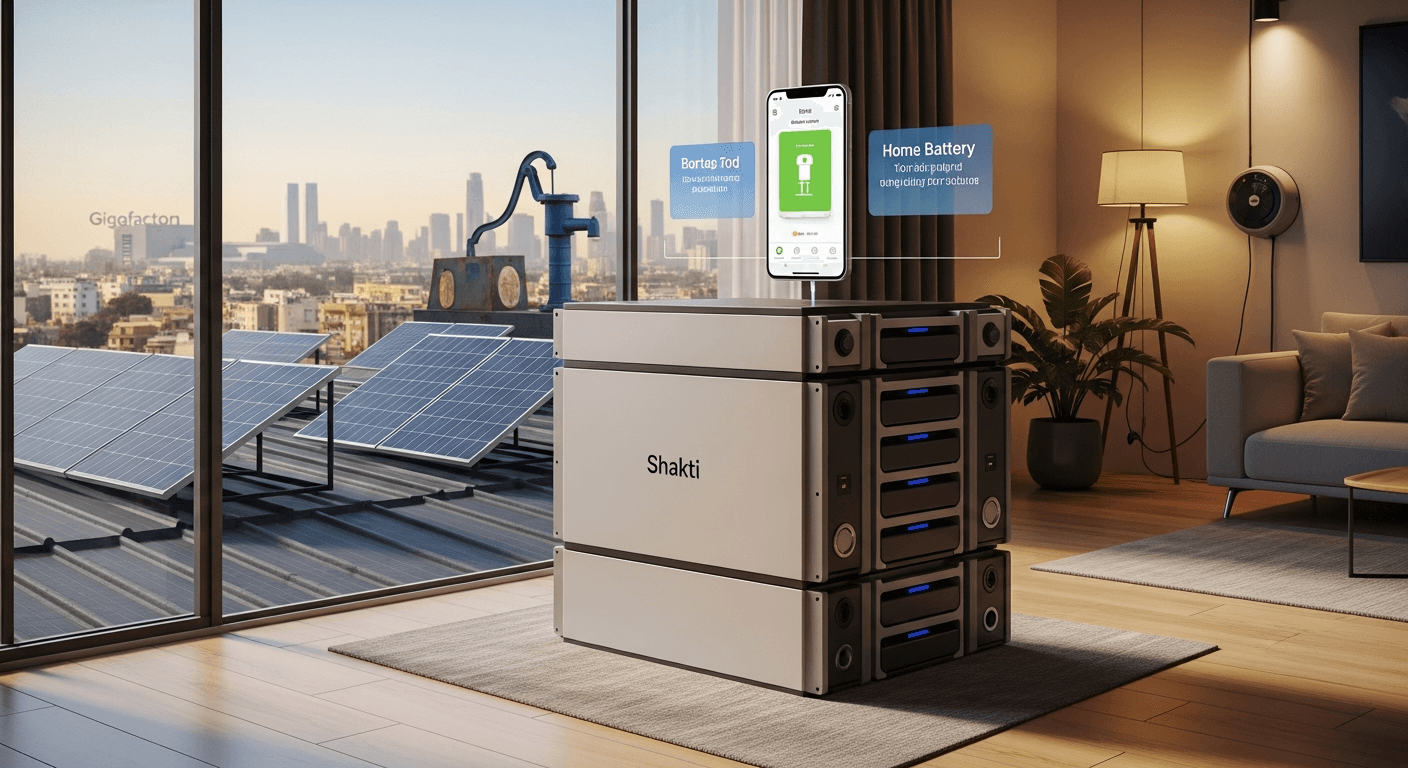
I write this as someone who has long watched how energy — its generation, storage and distribution — quietly reshapes industries and livelihoods. The launch of Ola Electric’s Ola Shakti is consequential not simply because a scooter-maker made a home battery; it is important because it signals how companies built around lithium cells can reframe themselves as energy-platform businesses.
What is Ola Shakti? A quick product tour
Ola Shakti is a modular residential Battery Energy Storage System (BESS) that the company positions for homes, farms, small businesses and other off-grid or weak-grid use cases. Key public specifications and features reported at launch include:
- Configurations: 1.5 kWh, 3 kWh, 5.2 kWh and 9.1 kWh modular units.
- Power output: Models are rated up to multi-kW output (3 kW to 6 kW in larger packs), enough to run refrigerators, pumps, induction cooktops and even air conditioners for short durations.
- Charge/discharge: Fast charge capability (reported as ~1.5–2 hours) and backup duration up to ~1.5 hours at full load (varies by model).
- Technology: Built on Ola’s 4680-format "Bharat" cells, IP67-rated enclosure, automotive-grade safety, and an app-driven energy management layer with time-of-day scheduling and OTA updates.
- Efficiency and durability: Public materials cite up to ~98% round-trip efficiency and high usable DoD (depth of discharge).
- Pricing (introductory / first tranche): reported in the range INR 29,999 to INR 159,999 across the model ladder (early-booking tokens around INR 999 and deliveries slated from Makar Sankranti 2026).
Sources: Ola’s product page and contemporary reporting from Indian business press provide these headline figures (Ola Shakti product page, reporting in Business Standard and Economic Times).
Who is the target customer?
- Urban and peri-urban homeowners who want silent, clean backup and better control over time-of-day tariffs.
- Rooftop-solar adopters seeking to store daytime solar for evening use.
- Small businesses, farm owners (for pumps) and rural/remote installations where grid reliability is an issue.
- Consumers who value integrated app control and a plug-and-play mechanical form factor rather than traditional inverter‑battery systems.
Why this diversification makes strategic sense for Ola Electric
There are clear, defensible reasons for an EV battery-maker to pivot or expand into residential BESS:
- Shared core competency: cell and pack design, thermal and safety engineering, and gigafactory capacity are directly applicable to stationary storage.
- Asset leverage: A manufacturing line and distribution network developed for EVs can supply BESS without needing wholly new factories.
- Revenue diversification: Two-wheeler markets are cyclical and competitive; residential energy systems open larger markets (analysts project multi‑billion-dollar TAMs for BESS in India by 2030).
- Strategic platform play: Owning battery-software and services at the household level positions a company to offer energy services, demand response and future V2H/V2G capabilities if regulation and products evolve.
Market context in India: why now
- Grid realities: India’s transmission bottlenecks, voltage instability in many regions and continued load growth make storage attractive for resilience and power-quality improvements.
- Rooftop solar momentum: As rooftop adoption grows, so does the need to store daytime solar for evening consumption, pushing demand for residential BESS.
- Policy tailwinds: National and state programs encouraging renewables, and growing interest in distributed energy resources, set a favourable backdrop.
- EV ecosystem synergies: As EV penetration rises, the same battery technologies and service channels (retail stores, service centers) can address both mobility and stationary markets.
I have written previously about the centrality of storage to making renewable energy reliable and useful at scale (Green Energy Storage: Preserving a Perishable). This launch fits into that pattern.
Competitive landscape
Ola enters a market where legacy utilities, large energy companies and specialised battery firms are active:
- Large incumbents and established energy companies (e.g., Tata Power and other utilities) that bundle generation, rooftop solar services and storage.
- Battery and inverter companies (including large battery makers and inverter OEMs) that have long sold residential systems and are moving from lead‑acid or conventional systems to lithium BESS.
- Automotive-tier battery groups (Amara Raja, Exide and others) with manufacturing scale and distribution reach.
- Startups and niche players focusing on modular, software-driven home energy systems.
Ola’s differentiators could be the use of 4680 cells, aggressive entry pricing, an existing retail and service footprint, and integrated software — but incumbents fight on scale, channel relationships and enterprise contracts.
Risks and challenges to watch
- Regulation and standards: Residential BESS are equipment-heavy and safety‑sensitive. BIS, local building and electrical codes, and installation certification will shape adoption. Regulatory uncertainty over grid interconnection and export rules can affect value propositions.
- Supply chain & raw materials: Cell production depends on consistent inputs and battery-chemical supply chains; fluctuations in commodity prices (cobalt, nickel, lithium) and geopolitics matter.
- Unit economics & margin pressure: Attractive consumer pricing can build volume, but sustaining margins depends on factory yield, cell costs and after‑sales economics. Competing on price invites reaction from incumbents.
- After-sales & safety: Field performance, warranties, thermal incidents and installation quality can make or break consumer trust. Scaling service networks and quality control is critical.
Implications for Ola Electric and consumers
For Ola Electric:
- Opportunity to materially enlarge addressable battery consumption and reduce per-cell costs through scale.
- A strategic move toward being an energy company rather than a pure EV OEM, opening B2B and grid-scale possibilities later.
- Execution risk is high — success depends on production discipline, channel readiness and post‑sales support.
For consumers:
- More choice and potentially lower prices for high‑quality residential storage.
- Better integration between solar, home energy management and time‑of‑use optimisation as app features mature.
- The onus will be on installers and regulators to ensure safe, standardised deployments so early optimism translates into reliable long-term value.
"Storage isn’t a luxury; it’s the missing link between renewable generation and reliable consumption."
"A product is only as strategic as the company’s ability to deliver the whole customer experience — from sale to safe operation."
Conclusion
Ola Shakti is a logical and potentially disruptive step. It leverages cell-level expertise and retail reach to address a pressing need in India’s energy transition: affordable, scalable residential storage. The product’s specs and aggressive introductory pricing make it immediately relevant to rooftop-solar households and those facing unreliable grids. Yet the outcome will hinge less on specs and more on execution — quality production, safe installations, supply-chain resilience, and the regulatory environment.
If Ola executes well, the move could accelerate household adoption of clean energy, deepen Ola’s role in the energy ecosystem, and nudge competitors to innovate faster. If it stumbles on service or safety, it will be a sobering lesson in how hardware-led platform expansions require operational rigour as much as engineering flair.
Regards,
Hemen Parekh
Any questions / doubts / clarifications regarding this blog? Just ask (by typing or talking) my Virtual Avatar on the website embedded below. Then "Share" that to your friend on WhatsApp.
Get correct answer to any question asked by Shri Amitabh Bachchan on Kaun Banega Crorepati, faster than any contestant
Hello Candidates :
- For UPSC – IAS – IPS – IFS etc., exams, you must prepare to answer, essay type questions which test your General Knowledge / Sensitivity of current events
- If you have read this blog carefully , you should be able to answer the following question:
- Need help ? No problem . Following are two AI AGENTS where we have PRE-LOADED this question in their respective Question Boxes . All that you have to do is just click SUBMIT
- www.HemenParekh.ai { a SLM , powered by my own Digital Content of more than 50,000 + documents, written by me over past 60 years of my professional career }
- www.IndiaAGI.ai { a consortium of 3 LLMs which debate and deliver a CONSENSUS answer – and each gives its own answer as well ! }
- It is up to you to decide which answer is more comprehensive / nuanced ( For sheer amazement, click both SUBMIT buttons quickly, one after another ) Then share any answer with yourself / your friends ( using WhatsApp / Email ). Nothing stops you from submitting ( just copy / paste from your resource ), all those questions from last year’s UPSC exam paper as well !
- May be there are other online resources which too provide you answers to UPSC “ General Knowledge “ questions but only I provide you in 26 languages !





No comments:
Post a Comment