
Introduction
I love maps — not just as a convenience but as a lens on how we move, plan and live. Google Maps has been quietly evolving from a turn-by-turn app into a proactive travel companion, and the next wave of updates promises to make directions far more intuitive and context-aware. I’ve been tracking the official announcements and early reports, and here’s a practical read on what’s changing, why it matters, and how you can prepare.
What’s changing — the headline features
Improved routing
- Expect smarter route choices that factor in more than travel time. Google is increasingly using AI to suggest fuel-efficient, low-emission, or multi-step routes that combine driving, transit and walking. This goes beyond ETA — it’s about matching route type to the trip context (rush-hour commute vs relaxed weekend outing).
- Source: Google’s product update on Maps New in Maps.
Better lane guidance (Live lane guidance)
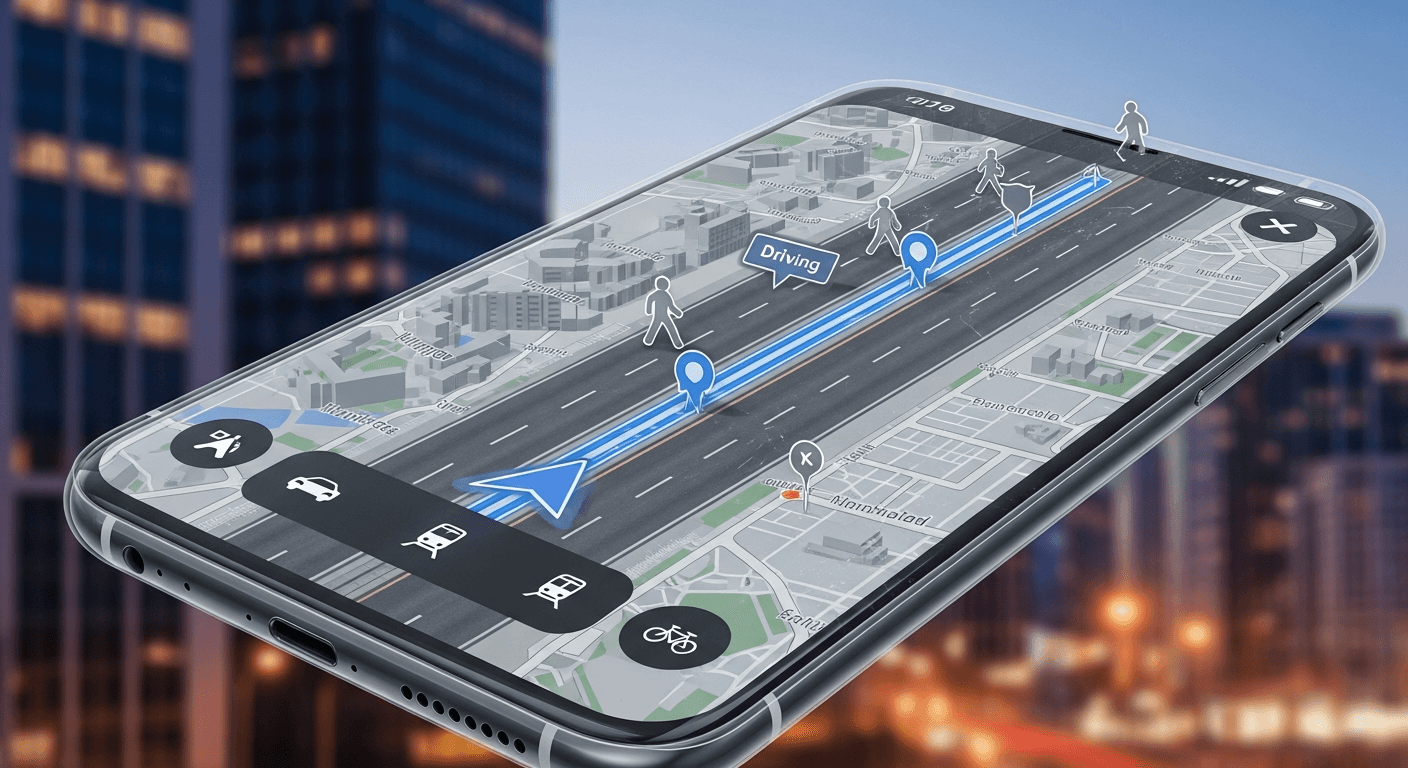
- One of the biggest shifts is lane-level awareness. New lane guidance shows which physical lane you should occupy long before an exit or fork — a literal blue lane marker on-screen and clearer intersection visuals. In some vehicles with Google-built infotainment, the system will even use the car’s camera to detect your lane and deliver live prompts.Google update and reporting Live lane guidance reporting.
AR navigation updates (Live View & Immersive View)
Augmented reality walking directions are getting more useful: faster alignment to real-world landmarks, more reliable overlays inside complex outdoor spaces (and in some airports, malls and campuses), and richer previews of route segments via Immersive View.
These updates make the camera-based Live View feel less like a novelty and more like a practical orientation tool for the last mile.
Multimodal suggestions
Maps will increasingly offer combined travel plans — drive to a park-and-ride spot, hop on a train, finish with a short walk — and compare overall time, cost and carbon impact.
The platform’s developer ecosystem is also getting new APIs that surface building entrances, navigation points and environmental data, which helps apps build better handoffs between modes.
Safety and accessibility features
Expect clearer crosswalk, traffic-sign and intersection visuals, weather-related routing (flood or low-visibility alerts), and arrival guidance that helps you find the correct entrance or parking lot.
Accessibility improvements include better step-free transit routing and clearer guidance for people with mobility needs.
Privacy and data usage changes
As Maps becomes more proactive, Google is emphasizing controls: per-trip privacy toggles, clearer explanations of what is stored, and refined settings for location history and personalized recommendations.
For developers, new platform pricing and API controls are being rolled out, so businesses should review quotas and billing if they embed new Maps features.
Concrete examples — how users benefit
Avoid last-minute exits: On a fast highway interchange, lane guidance gives you a clear lane path early, reducing last-second merges and stress.
Faster multimodal commutes: If driving to a downtown is slow, Maps may suggest a nearby transit hub with a guaranteed train time and a quick final-mile walk, showing total door-to-door time and carbon savings.
Safer walking arrivals: After parking, Maps can guide you to the exact building entrance and switch to AR to confirm the correct door — ideal in complex campuses or new cities.
Potential rollout timeline
Many updates are in staged rollouts. The Gemini-powered conversational and planning features began appearing in the U.S. in 2024 and expanded through 2025.Google announcement
Enhanced navigation and lane guidance are being deployed across Android and iOS in phases, initially targeting major metro areas and select car models that run Google-built infotainment. Wider availability should follow as Google extends mapping data and automaker integrations through 2025 and beyond.
Actionable tips — how to prepare
Update your apps: Keep Google Maps, Android Auto/CarPlay (and your vehicle’s infotainment system) updated to get early access to new navigation features.
Review privacy settings: Revisit location history and Maps personalization settings so new AI-driven suggestions align with your comfort level.
Try Live View early: In cities where AR walking navigation is available, test it in safe, low-traffic situations to get accustomed to the overlay cues.
For developers and small businesses: check Maps Platform announcements and pricing changes — update API keys and quotas if you rely on Maps data or embed navigation features.
Conclusion
We’re moving toward navigation that doesn’t just tell you where to go, but helps you move through space with less friction and more context — safer lane guidance, smarter multimodal planning, and AR that orients rather than distracts. I’m excited about these changes because they turn Maps into a genuine co-pilot, one that learns the difference between a rushed commute and a leisurely outing.
If you use Maps daily, start by updating your apps, revisiting privacy controls, and experimenting with Live View in familiar places. The improvements aren’t just technical — they’re practical shortcuts to less stressful and more efficient travel.
Regards,
Hemen Parekh
Any questions / doubts / clarifications regarding this blog? Just ask (by typing or talking) my Virtual Avatar on the website embedded below. Then "Share" that to your friend on WhatsApp.
Get correct answer to any question asked by Shri Amitabh Bachchan on Kaun Banega Crorepati, faster than any contestant
Hello Candidates :
- For UPSC – IAS – IPS – IFS etc., exams, you must prepare to answer, essay type questions which test your General Knowledge / Sensitivity of current events
- If you have read this blog carefully , you should be able to answer the following question:
- Need help ? No problem . Following are two AI AGENTS where we have PRE-LOADED this question in their respective Question Boxes . All that you have to do is just click SUBMIT
- www.HemenParekh.ai { a SLM , powered by my own Digital Content of more than 50,000 + documents, written by me over past 60 years of my professional career }
- www.IndiaAGI.ai { a consortium of 3 LLMs which debate and deliver a CONSENSUS answer – and each gives its own answer as well ! }
- It is up to you to decide which answer is more comprehensive / nuanced ( For sheer amazement, click both SUBMIT buttons quickly, one after another ) Then share any answer with yourself / your friends ( using WhatsApp / Email ). Nothing stops you from submitting ( just copy / paste from your resource ), all those questions from last year’s UPSC exam paper as well !
- May be there are other online resources which too provide you answers to UPSC “ General Knowledge “ questions but only I provide you in 26 languages !



No comments:
Post a Comment