
Why India Rejects CPEC
I write this as someone who watches geopolitics with the same curiosity I bring to markets and supply-chains: with a desire to understand incentives, narratives, and the everyday consequences for people on the ground. The recent reiteration from New Delhi that it "does not recognise" the China–Pakistan Economic Corridor (CPEC) is not a rhetorical flourish — it is the crystallisation of five persistent anxieties that any serious observer must unpack.
What India objects to — in plain terms
Territorial integrity: CPEC projects run through areas administered by Pakistan (Gilgit–Baltistan and Pakistan-occupied Kashmir) that India claims as part of its own territory. For New Delhi this is not a technicality; it is a matter of sovereignty and principle. India has repeatedly made this position clear in public briefings and parliamentary replies NDTV.
Internationalisation of a bilateral dispute: India fears that large-scale infrastructure and third-party participation in CPEC risks converting a bilateral Kashmir dispute into a multilateral economic reality on the ground, thereby altering facts that New Delhi has long insisted must be resolved bilaterally.
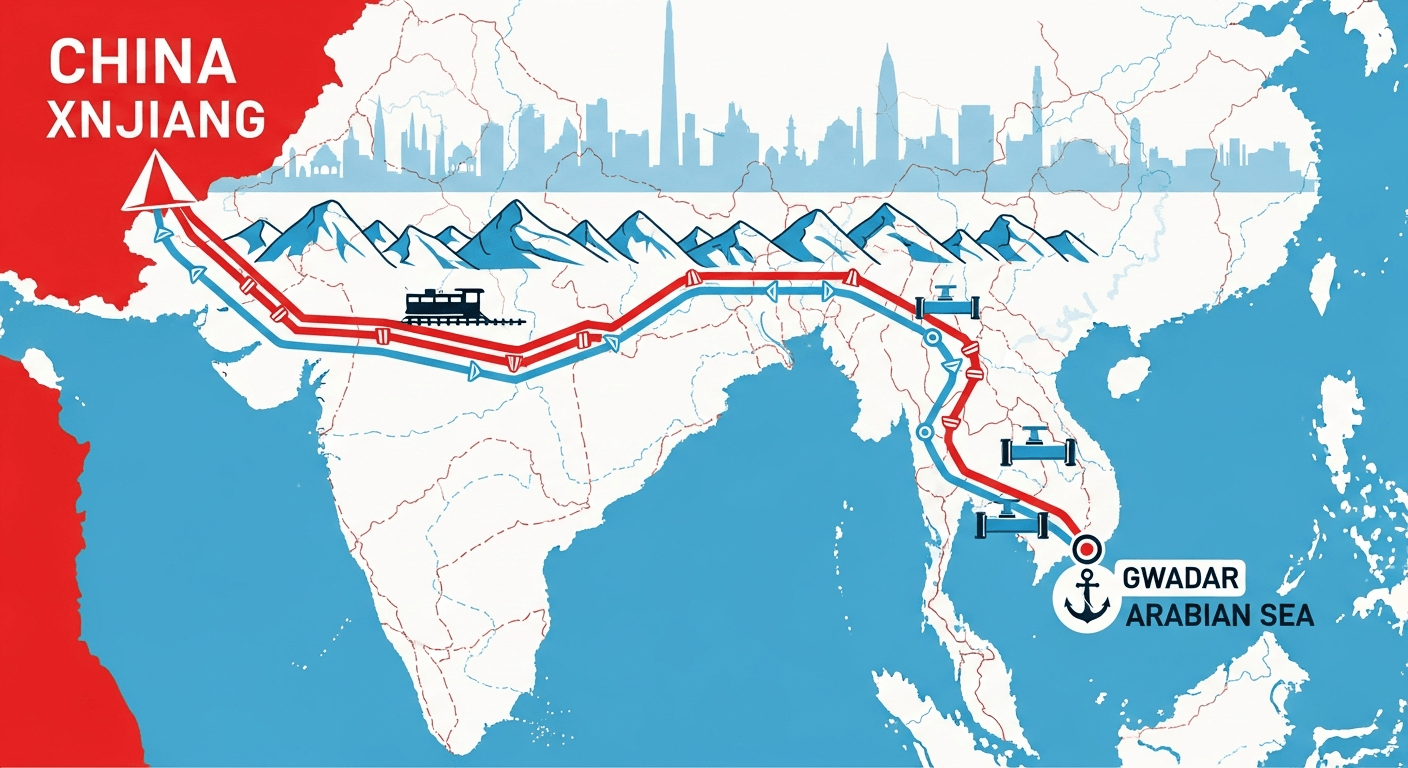
Strategic footprint: Beyond ports and railways, corridors are strategic assets. A land-sea connection from western China to Gwadar can shift regional transit geometry and, in India’s view, may be leveraged for geostrategic advantage.
Precedent and principle: Accepting projects that pass through disputed territory sets a diplomatic precedent New Delhi finds unacceptable — one that could be cited elsewhere to justify altering disputed boundaries through development projects.
Domestic and regional optics: Any visible progress on CPEC gives Islamabad and Beijing a narrative of connectivity and development, which complicates India’s diplomatic and domestic messaging on the Kashmir dispute.
The counter-arguments I hear — and why they matter
From Islamabad and Beijing the message is different: CPEC is framed as development-first, mutually beneficial, and a win for Pakistan’s connectivity and energy deficits. Economists and analysts point out that corridor projects can and do deliver real infrastructure gains. The corridor is also part of a larger Belt and Road Initiative whose economic logic is persuasive to recipient governments and businesses Wikipedia — CPEC.
What complicates the debate is that both truth and grievance can coexist: infrastructure can bring jobs and power, and yet its placement through disputed territory creates an irremovable political reality.
My reflection: an economic lens on a political problem
I have written before about how trade and investment create interdependencies that make political disputes both harder and more complex to resolve. In earlier posts I tried to shine a light on the contradictions of boycotts, supply-chain dependence, and the realities of a globalised economy — themes that are relevant here too (Hypocrisy to Nth Degree, The Chinese are coming!).
My point then — and which I return to now — is simple: strategic disagreements do not get solved by ignoring economics, and economics cannot be divorced from politics. The practical question for India is how to preserve its core redlines (sovereignty, bilateral dispute resolution) while not ceding all regional economic narratives to others.
What might be a sensible path forward? (a few modest suggestions)
Clear redlines, clearer engagement: India can keep its principled objection while engaging selectively on multilateral norms for cross-border projects — insisting on transparency, environmental safeguards, and local consent.
Alternative connectivity: Invest in and accelerate India-led regional connectivity projects (including Chabahar and other ports/rail links) that offer viable economic options to neighbours and reduce the narrative monopoly.
Multilateral norms and standards: Push for international standards for projects that pass through disputed areas — auditability, public disclosure of contracts, and safeguards for local populations.
Soft power and local development: Use development diplomacy to strengthen ties with communities in the neighbourhood that feel excluded from big corridors.
These are not quick fixes. They are, however, realistic ways to combine principle with pragmatism.
Closing thought
Geography does not change overnight. But narratives do. CPEC is as much a story about connectivity and investment as it is about politics and claims. India’s refusal to recognise the corridor is a predictable defence of territorial principle. The real test will be whether India complements that defence with positive alternatives that offer the region better choices.
I have returned to these themes across my writing — because I believe the future will be written at the intersection of power, infrastructure, and everyday economics. We can choose to react to projects that reshape maps, or we can craft parallel projects that rewrite incentives.
Regards,
Hemen Parekh
Any questions / doubts / clarifications regarding this blog? Just ask (by typing or talking) my Virtual Avatar on the website embedded below. Then "Share" that to your friend on WhatsApp.
Get correct answer to any question asked by Shri Amitabh Bachchan on Kaun Banega Crorepati, faster than any contestant
Hello Candidates :
- For UPSC – IAS – IPS – IFS etc., exams, you must prepare to answer, essay type questions which test your General Knowledge / Sensitivity of current events
- If you have read this blog carefully , you should be able to answer the following question:
- Need help ? No problem . Following are two AI AGENTS where we have PRE-LOADED this question in their respective Question Boxes . All that you have to do is just click SUBMIT
- www.HemenParekh.ai { a SLM , powered by my own Digital Content of more than 50,000 + documents, written by me over past 60 years of my professional career }
- www.IndiaAGI.ai { a consortium of 3 LLMs which debate and deliver a CONSENSUS answer – and each gives its own answer as well ! }
- It is up to you to decide which answer is more comprehensive / nuanced ( For sheer amazement, click both SUBMIT buttons quickly, one after another ) Then share any answer with yourself / your friends ( using WhatsApp / Email ). Nothing stops you from submitting ( just copy / paste from your resource ), all those questions from last year’s UPSC exam paper as well !
- May be there are other online resources which too provide you answers to UPSC “ General Knowledge “ questions but only I provide you in 26 languages !




No comments:
Post a Comment