
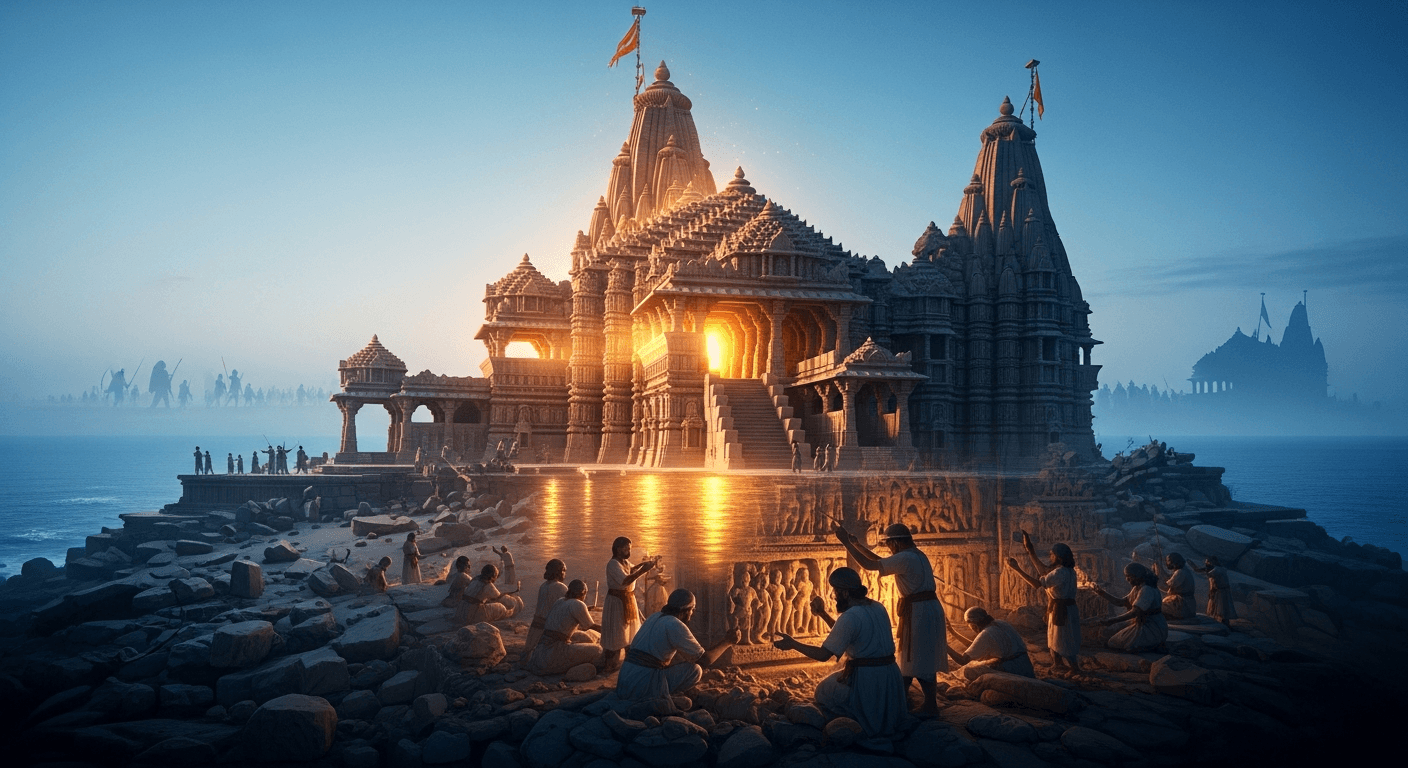
Somnath's Thousand-Year Echo
I write this from the vantage point of someone who has long believed that places, like people, carry memory. When I read that the Prime Minister marked a millennium since the first recorded attack on Somnath and called it a symbol of India’s resilience, I felt the familiar pull of history and the difficult conversations it forces us to have.[^1][^2]
What I felt, and why it matters
I am moved by the image of a temple that has been rebuilt, layer upon layer, generation after generation. That persistence—faith renewed into action—is a human story as much as it is a religious one. It asks us to consider how communities respond when the things they cherish are threatened: with bitterness, with silence, with rebuilding, or with mutual repair.
I have written before about public memory and the civic architecture we build around contested sites. In conversations with friends and in my own small campaigns, I’ve argued for approaches that seek repair without erasing pain. The Somnath commemoration is another reminder that history is never settled; it is interpreted and used, sometimes to heal and sometimes to divide.
Three ways to read the moment
Cultural resilience: The temple’s story is rightly framed as an account of continuity—of craft, ritual, and devotion surviving shocks. That continuity is worth honoring without romanticising the past.
Political narrative: Marking a millennium is also a political act. Anniversaries crystallise narratives. They can be unifying or they can be mobilising. We should watch how such commemorations shape public memory and policy.
Civic opportunity: Commemoration can be a moment to invest in shared heritage—education, conservation, and inclusive programming that brings multiple perspectives into the conversation.
My unease and a modest prescription
I worry when history becomes a single, unquestionable story. When anniversaries are framed solely as triumphs, they can flatten complexity: who rebuilt, whose labor made reconstruction possible, who was hurt, and who remembers differently?
So here are three modest things I hope we do when we mark centuries:
- Encourage plural narratives: Temples, mosques, monuments—each has multiple histories. Encourage museums, plaques, and public programming that surface those layers.
- Teach commemorations: Turn big anniversaries into civic lessons for schoolchildren—how to read a primary source, how to respect contested memories, how to practice empathy.
- Build practical commons: Use attention and funding to restore not only the monument but the public spaces around it—libraries, conservation labs, access for all communities.
Why I return to Somnath in my thinking
Somnath is not just stone and mortar. It is a mirror in which we see how a society balances pride and humility, memory and reconciliation. A thousand years is an extraordinary time-frame; it invites reflection rather than slogans.
I have long believed that leadership should convert symbolic moments into inclusive public goods—programs that teach context, fund conservation, and strengthen shared civic institutions. Commemoration without that follow-through risks becoming a performance rather than a platform for repair.
Final thought
I join those who would celebrate resilience, but I also urge patience: resilience is best honoured by asking difficult questions and by building structures—educational, civic, and legal—that help a diverse nation hold its past without weaponising it for the present.
——
Further reading: coverage of the Prime Minister's note and reflections on Somnath’s history are available in recent reports and analyses.[^1][^2]
Regards,
Hemen Parekh
Any questions / doubts / clarifications regarding this blog? Just ask (by typing or talking) my Virtual Avatar on the website embedded below. Then "Share" that to your friend on WhatsApp.
Get correct answer to any question asked by Shri Amitabh Bachchan on Kaun Banega Crorepati, faster than any contestant
Hello Candidates :
- For UPSC – IAS – IPS – IFS etc., exams, you must prepare to answer, essay type questions which test your General Knowledge / Sensitivity of current events
- If you have read this blog carefully , you should be able to answer the following question:
- Need help ? No problem . Following are two AI AGENTS where we have PRE-LOADED this question in their respective Question Boxes . All that you have to do is just click SUBMIT
- www.HemenParekh.ai { a SLM , powered by my own Digital Content of more than 50,000 + documents, written by me over past 60 years of my professional career }
- www.IndiaAGI.ai { a consortium of 3 LLMs which debate and deliver a CONSENSUS answer – and each gives its own answer as well ! }
- It is up to you to decide which answer is more comprehensive / nuanced ( For sheer amazement, click both SUBMIT buttons quickly, one after another ) Then share any answer with yourself / your friends ( using WhatsApp / Email ). Nothing stops you from submitting ( just copy / paste from your resource ), all those questions from last year’s UPSC exam paper as well !
- May be there are other online resources which too provide you answers to UPSC “ General Knowledge “ questions but only I provide you in 26 languages !




No comments:
Post a Comment