
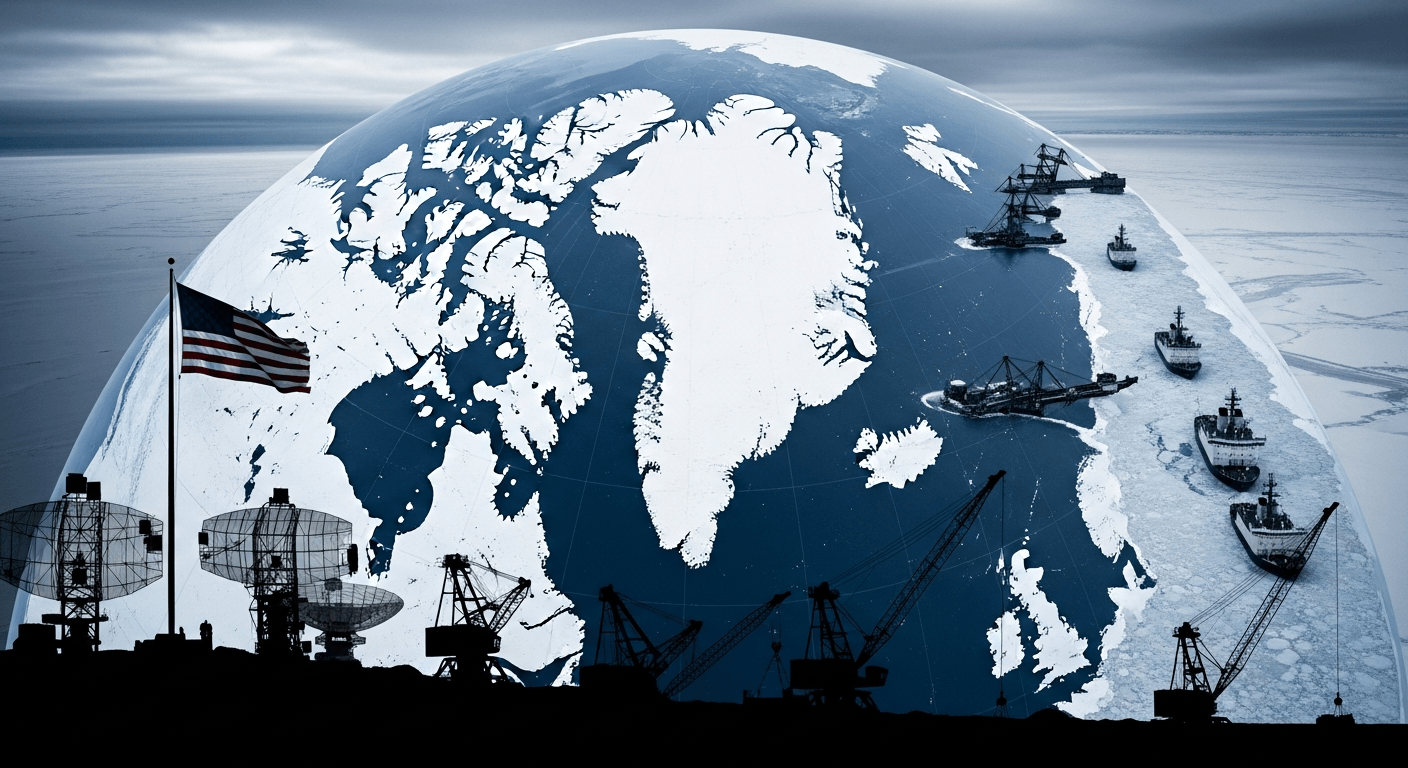
Why 'the hard way' — and what it means
I watched the latest round of rhetoric — a renewed insistence from the U.S. president that the country “needs” Greenland and that the administration would "go as far as we have to go" to secure it — and felt the familiar mix of alarm and curiosity that geostrategic posturing usually produces. That phrase — the suggestion of taking the issue the “hard way” — is worth a careful, calm unpacking rather than a reflexive outrage or easy dismissal.
A short primer: Greenland's status and strategic value
Greenland is an autonomous territory within the Kingdom of Denmark with a long, complex history: centuries of colonisation, a transition from colony to integral part of Denmark in the mid-20th century, and increasing self-rule after the 2009 Self-Government Act. Its population is small, its landmass vast, and its location sits astride some of the most important polar approaches between North America, Europe and the Arctic Ocean.
Why great powers pay attention:
- Military geography: Greenland hosts long-established U.S. facilities (the Thule/Pituffik area has been a linchpin for early-warning, missile-tracking and space-related operations) and sits astride the GIUK (Greenland–Iceland–UK) gap, a classic maritime chokepoint.
- Resources and economics: thawing ice has exposed prospects — from hydrocarbons to uranium and rare-earth minerals — that matter to industrial and defence supply chains.
- New routes and the Arctic race: melting sea ice opens seasonal shipping lanes and shortens polar approaches; control or strong partnerships in Greenland change logistics and influence in the High North.
The rhetoric: what was actually said
Reporters quoted the president saying things like, “We need Greenland… we’ll go as far as we have to go,” and he has previously described the idea of buying the island as "something we talked about… it's not number one on the burner." Those two lines—one more flippant, the other more forceful—capture the ambiguity in the message: is this a negotiation gambit, campaign theatre, or a serious strategic shift?[1][2]
Denmark’s response was brisk and consistent: the Danish prime minister told audiences plainly that "Greenland is not for sale." That short sentence carried the weight of alliance politics, legal history and respect for self-determination.[3]
Reading the line about the “hard way”
When a sitting leader suggests doing something “the hard way,” three readings are plausible and not mutually exclusive:
- Signalling to rivals: blunt language can warn competitors (notably Russia and China) that the U.S. considers the island part of its vital strategic perimeter. It is about deterrence by rhetoric.
- Domestic audience and campaign dynamics: dramatic phrases mobilise attention, simplify complex policy into a memorable slogan, and let a leader look decisive on national-security questions.
- Negotiation posture: public pressure can be intended to extract concessions — to force partners to offer greater access, investment, or basing rights without a formal transfer of sovereignty.
Those motives explain the language more than a literal intent to apply force. Still, the phrasing matters: public threats risk undermining alliances and give adversaries reasons to exploit divisions.
Legal and diplomatic realities
You cannot simply seize Greenland. The UN Charter, NATO commitments, and long-standing norms of sovereignty rule out annexation by force. Greenland’s internal legal path to full independence is defined by the Self-Government Act — it is the people of Greenland who would determine their future, not a third country unilaterally.
Historically, territorial transfers have precedents (the 1867 Alaska purchase is the oft-cited U.S. example), but today those mechanisms require consent, complex negotiations, and democratic legitimacy. Practical obstacles are many: local opposition, Danish political costs, NATO cohesion, and logistical governance across an island of ice and sparse infrastructure.
Possible motivations behind the push
- Security: securing early-warning, missile-tracking, and space assets; safeguarding northern approaches.
- Resources: rare earths, critical minerals and potential hydrocarbons that matter for both civilian industries and defence supply chains.
- Geopolitical competition: making it harder for rivals to deepen ties with the island; signalling to allies that the U.S. intends to retain influence in the Arctic.
- Political theatre: dramatic posture that ties into broader themes of strength, control and legacy.
Why Greenlandic voices and local politics matter
Any change that affects Greenland must account for Greenlanders’ perspectives. Over recent years Greenlandic leaders and representatives have repeatedly insisted that Greenlanders decide their future — and many have emphasised partnership over purchase or coercion. The island’s long path toward greater autonomy underscores a fundamental truth: external offers — however generous — interact with a colonial history and domestic politics in ways that simple deals can’t fix.
Implications and what to watch next
- Arctic geopolitics will intensify: expect more diplomacy, clearer Arctic strategies among NATO members, and competitive offers of investment to Nuuk.
- Alliance management: Washington will need to repair or re-state trust with Copenhagen if it hopes to expand cooperation without destabilising ties.
- Greenlandic agency: local debates on independence, investment and resource development will accelerate — external interest can empower local demands for clearer paths and better terms.
- Legal and normative guardrails: any talk of coercion will push allies and international institutions to reassert norms against acquisition by force.
I’ve written before about how geopolitical postures intersect with climate and technology; this episode is another reminder that the Arctic is no longer a marginal theatre. Political rhetoric may be loud — but real policy has to navigate law, local legitimacy, alliance politics and the hard work of governance.
If you care about the future of the Arctic, watch how Washington frames its next moves: are they offers of partnership and investment, or escalatory statements that erode trust with friends and the very multilateral order that keeps such regions stable?[1][3]
Regards,
Hemen Parekh
Any questions / doubts / clarifications regarding this blog? Just ask (by typing or talking) my Virtual Avatar on the website embedded below. Then "Share" that to your friend on WhatsApp.
[1] ABC News, “Trump says US will 'go as far as we have to' to get control of Greenland” — https://abcnews.go.com/International/trump-us-control-greenland/story?id=120208823
[2] The Guardian / video transcript from Aug 2019 (on the president’s earlier comments): https://www.theguardian.com/world/2019/aug/18/trump-considering-buying-greenland
[3] New York Times, “'Greenland Is Not for Sale': Trump’s Talk of a Purchase Draws Derision” — https://web.archive.org/web/20190822015552/https:/www.nytimes.com/2019/08/16/world/europe/trump-greenland.html
I have discussed related themes before in my blog posts about geopolitics, climate and creative responses to shifting borders (see earlier reflections collected here: http://myblogepage.blogspot.com/2017/02/not-so-farfetched-after-all.html).
Get correct answer to any question asked by Shri Amitabh Bachchan on Kaun Banega Crorepati, faster than any contestant
Hello Candidates :
- For UPSC – IAS – IPS – IFS etc., exams, you must prepare to answer, essay type questions which test your General Knowledge / Sensitivity of current events
- If you have read this blog carefully , you should be able to answer the following question:
- Need help ? No problem . Following are two AI AGENTS where we have PRE-LOADED this question in their respective Question Boxes . All that you have to do is just click SUBMIT
- www.HemenParekh.ai { a SLM , powered by my own Digital Content of more than 50,000 + documents, written by me over past 60 years of my professional career }
- www.IndiaAGI.ai { a consortium of 3 LLMs which debate and deliver a CONSENSUS answer – and each gives its own answer as well ! }
- It is up to you to decide which answer is more comprehensive / nuanced ( For sheer amazement, click both SUBMIT buttons quickly, one after another ) Then share any answer with yourself / your friends ( using WhatsApp / Email ). Nothing stops you from submitting ( just copy / paste from your resource ), all those questions from last year’s UPSC exam paper as well !
- May be there are other online resources which too provide you answers to UPSC “ General Knowledge “ questions but only I provide you in 26 languages !



No comments:
Post a Comment