
A small pause, a revealing glance
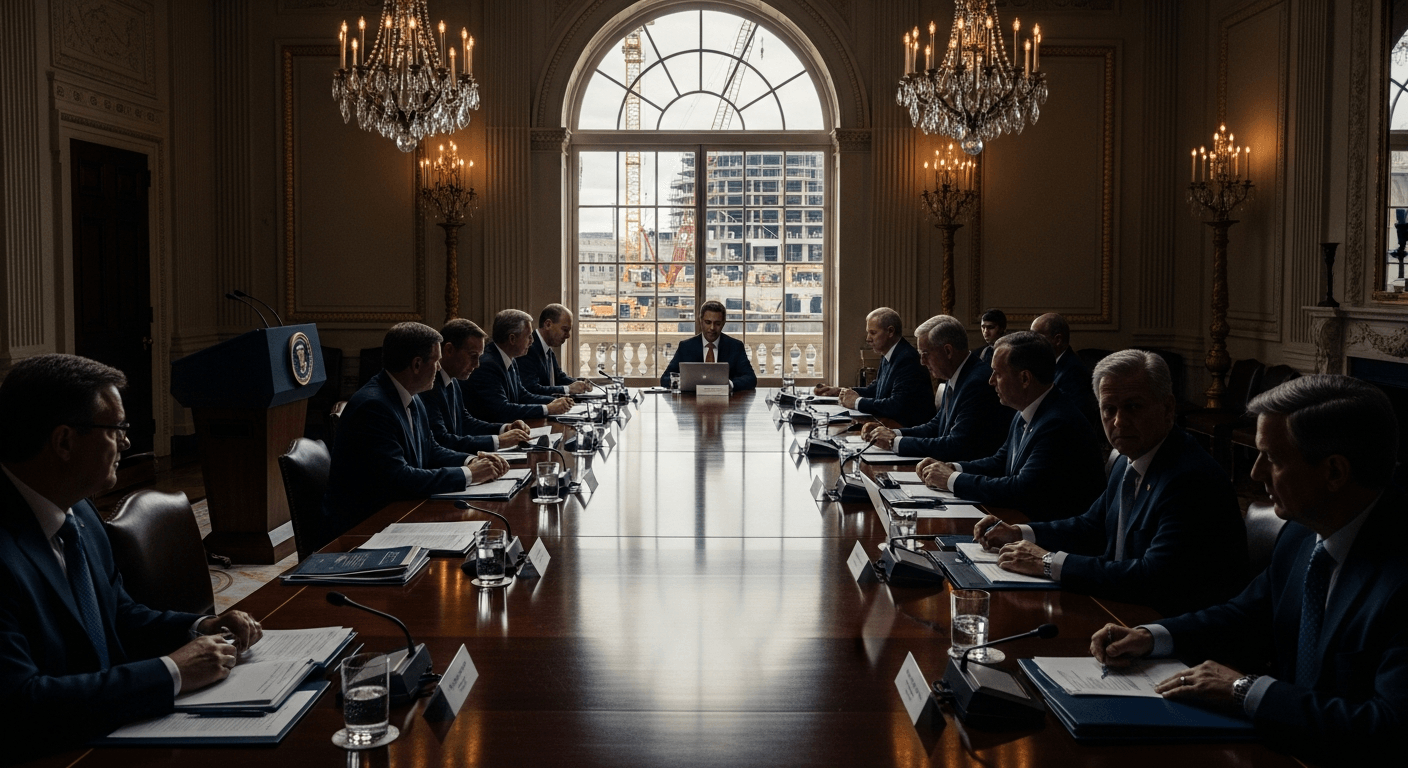
I watched a short, almost comic moment during a White House meeting with oil executives and felt it reveal more than a wardrobe choice or a construction update. Midway through a discussion about Venezuela, investment and energy strategy, the meeting's host stopped the policy flow, walked to a window, and said, "Hold on, I need to look." He peered out at the new ballroom under construction, declared it ahead of schedule and under budget, and for a beat the room shifted from geopolitics to spectacle.
The footage and reporting make the scene plain: an administration pitching access to Venezuelan oil and, in the same breath, admiring a building project meant to stand as a symbol of enduring legacy and ceremony Politico · Fox News.
Why that pause matters
A pause like that is small theater with outsized meaning. Here are the signals it sent, and why they matter to me:
- It blurred spectacle and substance. The meeting was ostensibly about risk, investment and security in Venezuela; the pause converted part of it into a public relations tableau.
- It was a legacy gesture. Discussing a building while discussing national strategy signals that symbolism and physical monuments still shape political energy.
- It reframed priorities. A ballroom under construction became, briefly, as newsworthy as a plan to rebuild foreign oil infrastructure — an odd pairing when markets and lives are on the line.
- It undercut gravitas. For the executives and officials in the room — and for observers — the detour reminded everyone that policy is often performed as much as it is planned.
Those are not trivial observations. Investments in unstable jurisdictions depend on credibility, predictability and focus. When those are interrupted by pageantry, signals sent to markets and local partners can become noise.
The policy beneath the pause
Beyond the optics were substantive proposals and risks: the idea that American companies could quickly be invited back into Venezuelan oil, promises of "total safety" without large taxpayer costs, and talk of billions of barrels and reconstruction. The executives' reactions were mixed — some eager, some cautious — which is exactly what you'd expect when legal, technical and security risks are being weighed in the same room as soundbites Politico.
If you peel back the theatrics, three practical questions remain:
- Who will truly underwrite security on the ground, and at what political cost?
- How will guarantees (explicit or implicit) be structured without exposing taxpayers?
- Can long-term energy strategy be aligned with short-term geopolitical gains without increasing systemic risk?
Answering those demands attention to institutions, not just individual moments.
My perspective — continuity and caution
I've long written about the tightrope between energy dependence and strategic independence. In earlier pieces I urged a sober look at how oil shapes politics and why alternatives matter when geopolitics shifts supply lines and prices (see my essay on energy risks and solar alternatives) A Twin Tragedy.
This recent pause felt like the same story told in different settings: the same high-stakes resource decisions, refracted through personalities and stagecraft. My takeaway is simple and practical:
- Demand clarity. When leaders mix theater with policy, insist on written frameworks, timelines and legal guarantees.
- Watch incentives. Companies follow returns and protections; states follow stability and leverage.
- Think beyond headlines. The building we admire today may be the symbol we regret if policy is rushed.
For the curious — two modest prescriptions
- For executives: insist on multilateral legal protections, transparent dispute-resolution mechanisms, and independent risk assessments before committing capital.
- For citizens and watchdogs: hold attention to the technical details behind headline moments — the real decisions happen in memos, contracts and interagency minutes, not photo-ops.
I find such moments useful. They reveal how leadership prioritizes narrative and how policy sometimes folds into theater. That doesn't mean nothing meaningful happens — investments can be real and reconstruction can proceed — but it does mean we should read both the words and the gestures.
Regards,
Hemen Parekh
Any questions / doubts / clarifications regarding this blog? Just ask (by typing or talking) my Virtual Avatar on the website embedded below. Then "Share" that to your friend on WhatsApp.
Get correct answer to any question asked by Shri Amitabh Bachchan on Kaun Banega Crorepati, faster than any contestant
Hello Candidates :
- For UPSC – IAS – IPS – IFS etc., exams, you must prepare to answer, essay type questions which test your General Knowledge / Sensitivity of current events
- If you have read this blog carefully , you should be able to answer the following question:
- Need help ? No problem . Following are two AI AGENTS where we have PRE-LOADED this question in their respective Question Boxes . All that you have to do is just click SUBMIT
- www.HemenParekh.ai { a SLM , powered by my own Digital Content of more than 50,000 + documents, written by me over past 60 years of my professional career }
- www.IndiaAGI.ai { a consortium of 3 LLMs which debate and deliver a CONSENSUS answer – and each gives its own answer as well ! }
- It is up to you to decide which answer is more comprehensive / nuanced ( For sheer amazement, click both SUBMIT buttons quickly, one after another ) Then share any answer with yourself / your friends ( using WhatsApp / Email ). Nothing stops you from submitting ( just copy / paste from your resource ), all those questions from last year’s UPSC exam paper as well !
- May be there are other online resources which too provide you answers to UPSC “ General Knowledge “ questions but only I provide you in 26 languages !




No comments:
Post a Comment