
Lead
I remember writing about the idea of an "Internet of Vehicles" years ago — cars acting like networked computers sharing situational awareness. Today that vision is leaping off research papers and pilot sites and into policy discussions: the Centre is actively pushing vehicle-to-vehicle (V2V) safety technology for phased roll‑out. As someone who has followed connected mobility for more than a decade, I want to explain what V2V is, why the government is accelerating it now, what evidence supports the safety case, and the real-world obstacles that must be solved for it to work on our roads.
What is V2V?
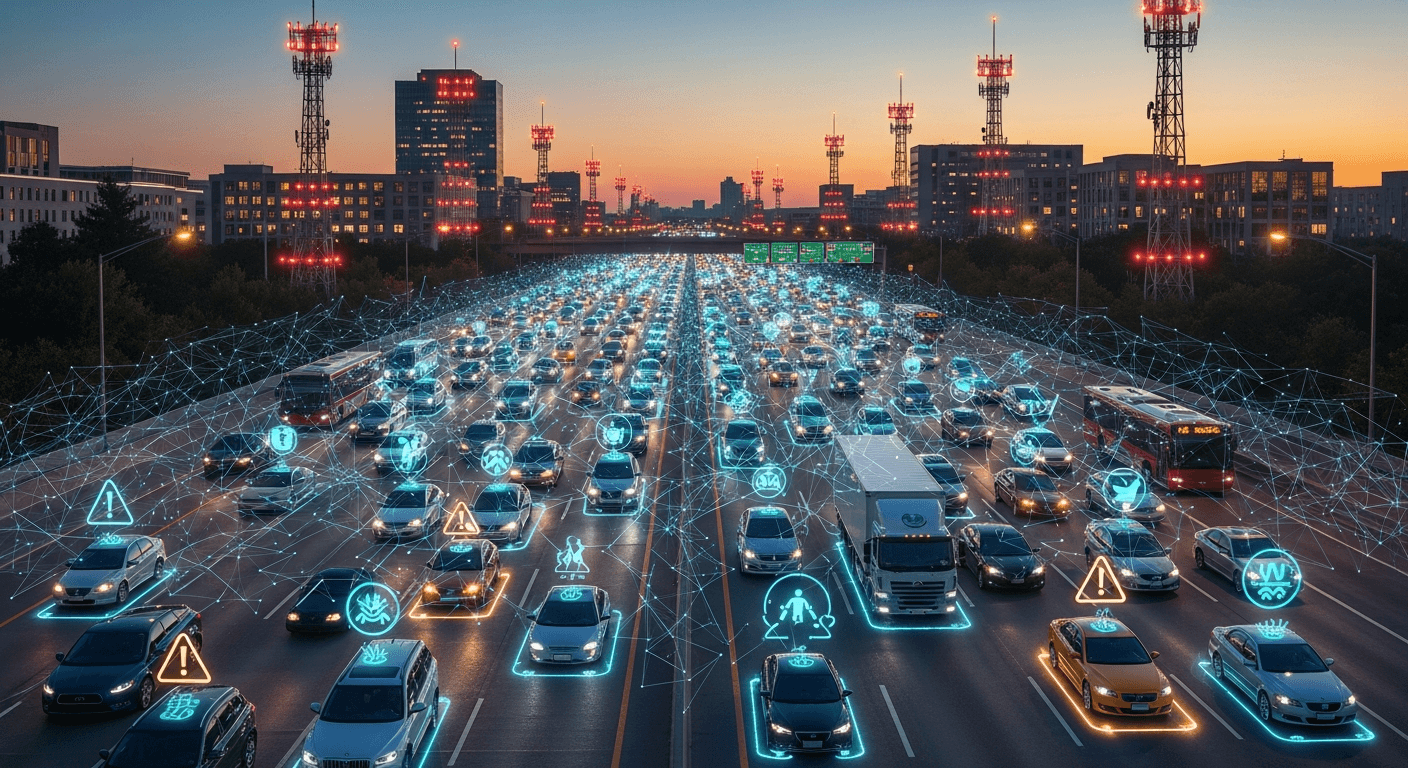
V2V is a subset of V2X (vehicle-to-everything) communication: cars exchange short, standardized messages about their position, speed, heading and braking so nearby vehicles can warn drivers — or automated systems — about hazards beyond line of sight. These messages can be exchanged directly between vehicles over a short-range wireless channel (sometimes called DSRC or ITS‑G5) or via cellular-based variants (C‑V2X) depending on the technology path chosen.
Unlike radar or cameras that perceive the local environment, V2V shares intent and state (for example: an abrupt brake event or a vehicle entering a blind curve) so others receive an early alert even if the obstacle is hidden. V2V is designed as a complement to — not a replacement for — onboard sensors and driver vigilance.
Why is the Centre pushing it now?
There are practical and political reasons. Road safety remains a major public health issue, and governments are looking for scalable, technology-driven interventions that reduce collisions, especially chain‑reaction pileups and low‑visibility rear‑end crashes. V2V promises earlier warnings and better situational awareness across diverse road conditions.
Technically, the ecosystem is more mature than it was a few years ago: field trials, interoperable message standards, and increasing industry interest mean the costs and deployment risks are better understood. At the same time, spectrum authorities and transport agencies in several countries have clarified radio resources for ITS, making national roll‑outs more feasible.
Finally, V2V policy connects to broader aims: improving fleet safety, integrating with advanced driver assistance systems (ADAS), and preparing the road environment for higher levels of automation. A phased mandate for new vehicles is one way regulators seek to overcome the classic adoption problem: safety benefits accrue only when a significant share of the fleet can communicate.
Safety benefits and evidence
Large field experiments and pilot programs provide the clearest evidence so far. The U.S. Safety Pilot Model Deployment in Ann Arbor (2012–2013) equipped thousands of vehicles and infrastructure elements to test direct V2V and V2I applications in everyday traffic. Independent evaluations found that V2V safety applications issued valid alerts in many real-world conflict scenarios and provided valuable driver response data, while identifying areas where nuisance warnings needed refinement.
In Europe, a coordinated series of pilots — including the Cooperative ITS Corridor and the C‑Roads platform, plus national projects such as SCOOP@F and NordicWay — tested day‑1 safety services (roadworks warnings, emergency vehicle alerts, signal‑phase information) across borders and different communication technologies. These projects showed measurable improvements in warning lead time, interoperability across vendors and countries, and valuable lessons for deployment models.
Japan offers another concrete example: ITS Spot and later ITS Connect deployments demonstrated that V2X concepts can be integrated with tolling, traffic information and targeted safety messages on expressways and urban intersections. Together, these international examples show that V2V/V2X can work in real traffic and that many safety use cases are technically achievable today.
Challenges and concerns
No technology is risk‑free. Privacy is a primary concern: even short safety messages can carry location and motion data, and policymakers must ensure that personal data is protected and that message systems do not enable tracking of individual drivers.
Cybersecurity is an equally serious risk. Vehicles that accept external messages must be resilient to spoofing, replay or denial‑of‑service attacks. Secure message frameworks, certificate management and robust public‑key infrastructures are prerequisites for safe operation.
Spectrum management matters because V2V requires reliable radio channels. Competition for the 5.9 GHz band (and regional spectrum differences) means regulators must balance ITS needs against other wireless uses and decide on harmonized allocations to avoid fragmentation.
Interoperability is the final piece: benefits scale only when devices, vehicles and roadside units speak the same protocols and follow common message semantics. Lessons from EU and international pilots show that common profiles, cross‑testing and coordinated certification reduce fragmentation and accelerate useful roll‑out.
What drivers and manufacturers should expect
Drivers should expect gradual, phased changes. Initially new vehicles will ship with on‑board units capable of sending and receiving basic safety messages; aftermarket or retrofit options will likely follow for fleets and public vehicles. Human‑machine interfaces will be tuned to minimize distraction — many pilot studies emphasized avoiding nuisance alerts.
Manufacturers will need to align hardware, software and message stacks with national standards and security frameworks. They should prepare to integrate V2V alerts with ADAS and offer clear user controls and privacy settings. Road operators and telecom partners will also play a role in hybrid deployments where cellular networks augment direct V2V messages.
Practical tip for drivers
Keep your vehicle software updated and follow manufacturer guidance on in‑vehicle safety alerts; treat V2V warnings as an early cue but continue to drive defensively.
Conclusion
V2V is not a silver bullet, but it is a meaningful, evidence‑backed tool that can reduce certain classes of crashes when rolled out thoughtfully. The Centre’s push aligns with international pilots and the technical progress seen in the U.S., Europe and Japan. Success will depend on careful attention to privacy, cybersecurity, spectrum policy and interoperability — and on steadily building trust among drivers, manufacturers and road managers.
I have written about connected vehicles and the Internet of Vehicles in earlier blogs, and today’s policy momentum feels like the next phase of that long arc: moving from concept and pilots into regulated deployment. If implemented with transparency and technical rigor, V2V can move our roads a step closer to preventing harm before it happens.
Regards,
Hemen Parekh
Any questions / doubts / clarifications regarding this blog? Just ask (by typing or talking) my Virtual Avatar on the website embedded below. Then "Share" that to your friend on WhatsApp.
Get correct answer to any question asked by Shri Amitabh Bachchan on Kaun Banega Crorepati, faster than any contestant
Hello Candidates :
- For UPSC – IAS – IPS – IFS etc., exams, you must prepare to answer, essay type questions which test your General Knowledge / Sensitivity of current events
- If you have read this blog carefully , you should be able to answer the following question:
- Need help ? No problem . Following are two AI AGENTS where we have PRE-LOADED this question in their respective Question Boxes . All that you have to do is just click SUBMIT
- www.HemenParekh.ai { a SLM , powered by my own Digital Content of more than 50,000 + documents, written by me over past 60 years of my professional career }
- www.IndiaAGI.ai { a consortium of 3 LLMs which debate and deliver a CONSENSUS answer – and each gives its own answer as well ! }
- It is up to you to decide which answer is more comprehensive / nuanced ( For sheer amazement, click both SUBMIT buttons quickly, one after another ) Then share any answer with yourself / your friends ( using WhatsApp / Email ). Nothing stops you from submitting ( just copy / paste from your resource ), all those questions from last year’s UPSC exam paper as well !
- May be there are other online resources which too provide you answers to UPSC “ General Knowledge “ questions but only I provide you in 26 languages !





No comments:
Post a Comment