
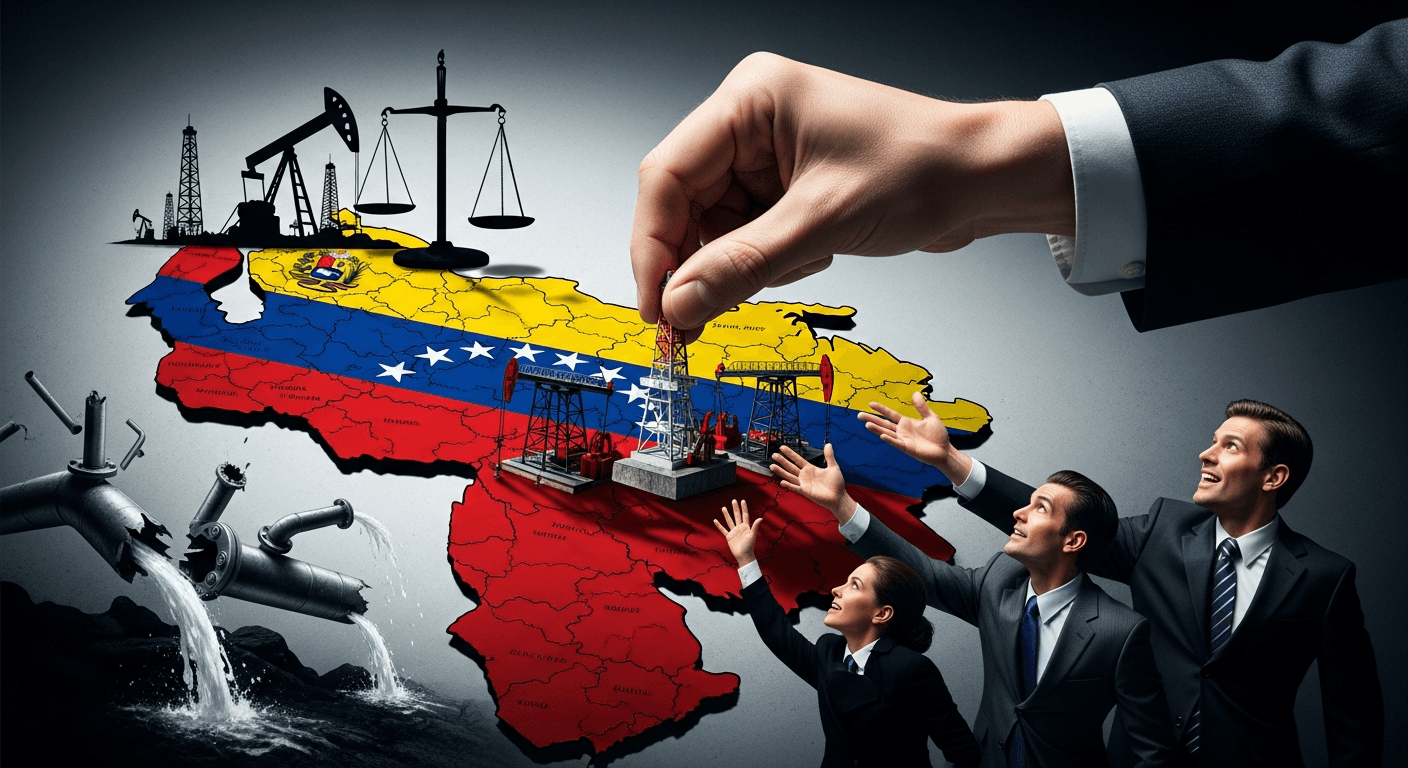
"You're dealing with us": A Quick Reality Check
I write this from the vantage point of someone who has followed energy politics for decades. When Donald Trump (dtrump@lightology.com) told oil executives that "you're dealing with us directly, you're not dealing with Venezuela at all," he crystallized a set of policy choices with deep market, legal and diplomatic consequences.
The context: US–Venezuela relations and the sanctions arc
The relationship between Washington and Caracas has been adversarial for years. Sanctions imposed since the late 2010s, targeted prosecutions and restrictions on PDVSA and trading partners drastically reduced Venezuela’s oil exports and foreign investment. Even before sanctions, decades of underinvestment, nationalizations and mismanagement hollowed out a once robust oil industry.
That background explains two things: first, why Venezuelan oil sits large on paper but is hard and expensive to produce; second, why the idea of the United States acting as gatekeeper for foreign investment in Venezuelan oil is both tempting to some policymakers and legally fraught.
(Readers who want historical context on how petrol policy shapes politics and consumers can see some of my earlier reflections on energy policy and pricing in my blog post PETROL PRICES : LET THESE RISE !.)
What the new posture means for oil markets
Short-term market effects will likely be limited. Venezuela’s current output remains a fraction of its historic capacity; rebuilding fields, refineries and export infrastructure requires time and capital. But the announcement matters:
- Signaling effect: If the U.S. really facilitates the entry of large firms, markets will price in future increases in supply and potential downward pressure on global crude in the medium term.
- Risk premium: The pathway to restoration is uncertain — insurers, service firms and investors will demand higher risk premiums, keeping costs up and tempering any rapid production growth.
- Geopolitical redistribution: If Venezuela’s crude flows reorient toward the United States and allied buyers, suppliers elsewhere (e.g., OPEC sellers, Russia) may find demand shifts, with attendant price and diplomatic consequences.
Legal and diplomatic obstacles
This is the thorniest part. A few of the legal and diplomatic issues that any U.S.-led scheme would confront:
- Sovereignty and property law: Who legally owns subsurface rights and existing contracts? Multinational companies and creditor states will contest any move that appears to sideline recognized sovereign authorities.
- Sanctions and extraterritorial law: Existing U.S. sanctions architecture would need careful recalibration. A unilateral U.S. decision to license companies to operate in Venezuela would clash with international norms unless coordinated with allies and relevant legal processes.
- Contract certainty and arbitration risk: Companies consider past expropriations and seizure of assets. Without clear, enforceable guarantees and dispute-resolution mechanisms, many firms will remain cautious.
- Insurance and operational safety: Insurers must be satisfied about political violence and operational risk; absent that, financing and deployment stall.
Diplomatically, treating Caracas as sidelined will provoke criticism from regional governments and global powers that view U.S. control of another country’s resources as neo-imperial. Even sympathetic neighbors will ask if any gains for U.S. consumers outweigh the political fallout.
Reactions on the ground: Caracas, companies and allies
- Venezuelan authorities and domestic constituencies will reject any arrangement that removes their formal role in deciding how their resources are exploited. Expect legal challenges, mobilization of domestic supporters and appeals to international institutions.
- Many oil majors are publicly cautious. Executives have reminded audiences of prior seizures and the difficulty of doing business under uncertain governance. Practical concerns — legal protection, commercial frameworks, and a credible security guarantee — come before headline-friendly commitments.
- U.S. allies will be split. Some will welcome increased U.S. access to crude that could ease global price pressures; others will warn that bypassing established multilateral processes and domestic rule-of-law in Venezuela sets a dangerous precedent.
Possible scenarios (and their likelihood)
- Limited, licensed re-entry (Medium likelihood)
- The U.S. issues targeted licenses to specific firms under strict conditions: contracts with a reconstituted local energy entity, U.S.-backed security guarantees, and agreed dispute-resolution terms. This could slowly increase production but needs months to years of investment.
- Full-scale U.S. supervision and direct control (Low likelihood, high risk)
- An attempt by the U.S. to run operations directly or dictate every partner would trigger intense legal and diplomatic pushback and likely insurgent responses inside Venezuela. The political cost would be high even if production rose.
- International, cooperative reconstruction (Medium-low likelihood)
- Washington secures buy-in from key allies (EU, major oil buyers) and organizes a multinational reconstruction framework that restores Venezuelan institutional role while permitting foreign capital — the most defensible path but requires negotiation and time.
- Fragmented private returns with parallel markets (Realistic fringe outcome)
- Firms operating informally or through third-party intermediaries attempt to extract value where possible. This risks renewed corruption, legal disputes and inconsistent output growth.
What I watch next
- Legal instruments: Are there new U.S. licenses or legislative measures that change the legal basis for investment? The specifics will determine whether firms can proceed.
- Companies’ contracts and risk-sharing terms: Public comment by executives is often cautious; the contract details matter far more than press statements.
- Regional diplomatic responses: If major neighboring states publicly oppose U.S. unilateralism, Washington will face isolation that makes operational control costly.
- Real production data: Only when field-restoration projects start, and export logistics normalize, will markets take the plan seriously.
Bottom line
This is a classic case where headline clarity masks operational complexity. Saying "you're dealing with us" is a potent political message, but turning that message into sustainable energy production, legal stability and diplomatic legitimacy is a heavy lift. For markets, the promise alone nudges expectations; for policymakers and firms, the hard work of contracts, law and reconstruction is only beginning.
I will be watching the legal instruments, company statements, and international responses closely. For those of us who track energy security, this episode reiterates a recurring lesson: control of resources is as much about institutions and law as it is about tanks, pipelines and rigs.
Regards,
Hemen Parekh
Any questions / doubts / clarifications regarding this blog? Just ask (by typing or talking) my Virtual Avatar on the website embedded below. Then "Share" that to your friend on WhatsApp.
Get correct answer to any question asked by Shri Amitabh Bachchan on Kaun Banega Crorepati, faster than any contestant
Hello Candidates :
- For UPSC – IAS – IPS – IFS etc., exams, you must prepare to answer, essay type questions which test your General Knowledge / Sensitivity of current events
- If you have read this blog carefully , you should be able to answer the following question:
- Need help ? No problem . Following are two AI AGENTS where we have PRE-LOADED this question in their respective Question Boxes . All that you have to do is just click SUBMIT
- www.HemenParekh.ai { a SLM , powered by my own Digital Content of more than 50,000 + documents, written by me over past 60 years of my professional career }
- www.IndiaAGI.ai { a consortium of 3 LLMs which debate and deliver a CONSENSUS answer – and each gives its own answer as well ! }
- It is up to you to decide which answer is more comprehensive / nuanced ( For sheer amazement, click both SUBMIT buttons quickly, one after another ) Then share any answer with yourself / your friends ( using WhatsApp / Email ). Nothing stops you from submitting ( just copy / paste from your resource ), all those questions from last year’s UPSC exam paper as well !
- May be there are other online resources which too provide you answers to UPSC “ General Knowledge “ questions but only I provide you in 26 languages !



No comments:
Post a Comment