
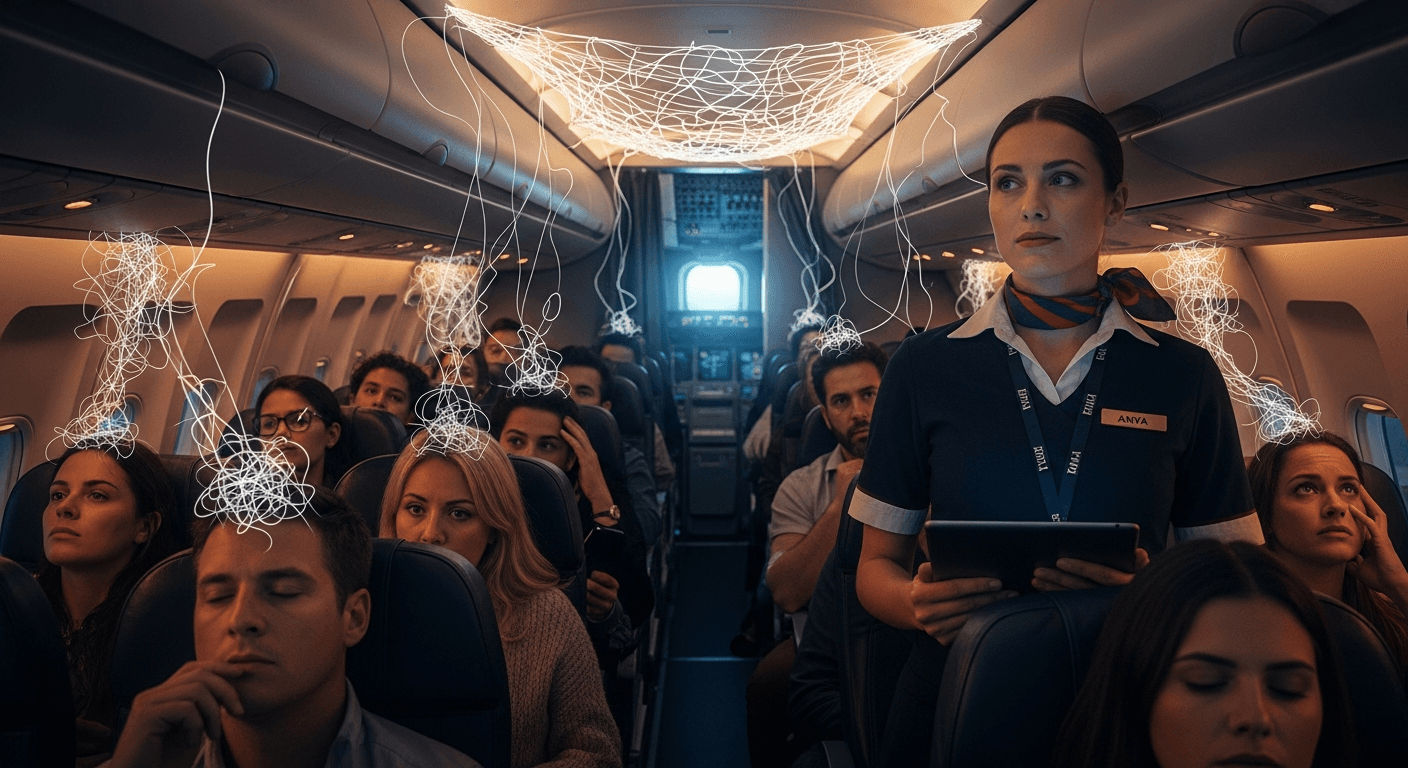
The scene that stayed with me
I watched the clips from the Mumbai–Krabi flight with a sinking recognition. Passengers stuck for nearly nine hours — shouting, demanding answers, one man even kicking at the cockpit door — and two travellers ultimately deboarded by security. The images were raw and relentless: exhaustion, anger, and a breakdown in trust between people and the systems that move them.[^news9]
I do not write this to sensationalise. I write this because these episodes are mirrors — they reflect operational gaps, human fragility, and a failure of communication that too often turns inconvenience into confrontation.
What happened is both simple and complicated
At the surface this is an airline delay: a late incoming aircraft, air-traffic congestion and crew duty-time limits were cited. Yet beneath that sequence lie predictable pressures:
- tightly packed schedules with little slack;
- regulators enforcing safety-related duty-time limits (which are non-negotiable from a safety point of view);
- passengers with urgent commitments, children, medical needs and limited tolerance for uncertainty;
- frontline staff who are trained to keep calm but rarely given the tools or authority to restore trust fast.
Those structural pressures transform a mechanical delay into a human crisis.[^news9][^toi]
Why communication is a public good during delays
I have written before about accountability in transport — about treating passengers as stakeholders, not inconveniences — and the idea of a Service Liability framework for public carriers.[^hemen2019] The Mumbai–Krabi episode underlines why: when people feel ignored, their default response is to reclaim agency. Sometimes that looks like shouting; sometimes worse.
Good crisis communication has four simple rules, yet they are rarely followed under operational stress:
- Be honest about what you know and what you don’t.
- Give a realistic timeline and update it even if the estimate worsens.
- Share the reasons briefly (so frustration has a narrative it can digest).
- Provide tangible relief (water, food, comfortable space, options to deplane) and explain why a particular option is or isn’t available.
When any of these fail, resentment grows. I’ve seen videos where passengers complain of being left on board with minimal refreshments and poor updates — a recipe for escalation.[^ndtv][^indianexpress]
Empathy for the staff — and the invisible failure modes
It’s easy to vilify an airline in a five-minute clip. But there’s another troubling set of stories: ground staff and contract workers facing abuse, even physical assault, while trying to manage chaos. In the December disruptions that shook multiple hubs, frontline teams were overwhelmed, under-protected, and left to absorb the anger of thousands.[^toi]
That does not absolve passengers who cross the line. It does demand better systems: protective protocols for staff, rapid escalation channels, and pre-planned contingency support (meals, rebooking hubs, temporary accommodation) triggered automatically when delays pass certain thresholds.
Systems need slack — not just optimisation
Modern airlines optimise relentlessly: more flights, higher aircraft utilisation, thinner turnarounds. That efficiency is profitable — until one small disruption ripples across thousands of itineraries. The structural lesson is old but worth repeating: designs that prioritize efficiency over resilience will fail spectacularly when stress arrives.
Regulation that enforces duty-time limits exists to keep people safe. But regulators, airlines and airports must collaborate on operational resilience: shared spare aircraft pools, mutualised crew resources, and transparent rules for when passengers must be deplaned and cared for.
What I keep coming back to
I believe in three practical shifts that could reduce these violent flashpoints:
- a Service Liability approach that clarifies responsibilities and minimum remedies for long delays (so passengers aren’t left inventing their own justice);
- automated contingency triggers (meals, clear reassignment options, hotel support) once a delay passes pre-set thresholds;
- investment in crisis-communication training and legal protections for frontline staff so they can de-escalate safely.
These are not utopian fixes. They are, in many cases, policy choices and operational investments.
A final, personal note
Travel will always be an intimate test of modern systems. A delayed flight reveals how we negotiate scarcity — of time, of seats, of answers. I feel for the families and workers caught in those long hours, and I am impatient with systems that let small technical or rostering problems metastasise into human crises.
We should demand safety, yes. But we should also insist on dignity: for passengers who deserve clear information and relief, and for staff who deserve protection and support. The tools to build that middle ground already exist; what’s missing is the will to use them before the next viral clip arrives.
We should demand safety, yes. But we should also insist on dignity: for passengers who deserve clear information and relief, and for staff who deserve protection and support. The tools to build that middle ground already exist; what’s missing is the will to use them before the next viral clip arrives.
Regards,
Hemen Parekh
Any questions / doubts / clarifications regarding this blog? Just ask (by typing or talking) my Virtual Avatar on the website embedded below. Then "Share" that to your friend on WhatsApp.
[^news9]: News footage and reporting on the Mumbai–Krabi delay and onboard unrest (example coverage): News9 Live video report.
[^ndtv]: Reporting on in-flight chaos and lack of updates from passengers' perspective: NDTV article describing delayed flights and onboard confusion.
[^indianexpress]: Coverage of passengers criticising crew behaviour during past long delays (context on communication failures): Indian Express.
[^toi]: Accounts of frontline staff facing abuse and the strain during mass cancellations and delays: Times of India reporting on ground-staff incidents.
[^hemen2019]: My earlier writing on service accountability and passengers' rights: "Passengers to get payout if 'private train' is late" (my post on service liability and transport accountability).
Get correct answer to any question asked by Shri Amitabh Bachchan on Kaun Banega Crorepati, faster than any contestant
Hello Candidates :
- For UPSC – IAS – IPS – IFS etc., exams, you must prepare to answer, essay type questions which test your General Knowledge / Sensitivity of current events
- If you have read this blog carefully , you should be able to answer the following question:
- Need help ? No problem . Following are two AI AGENTS where we have PRE-LOADED this question in their respective Question Boxes . All that you have to do is just click SUBMIT
- www.HemenParekh.ai { a SLM , powered by my own Digital Content of more than 50,000 + documents, written by me over past 60 years of my professional career }
- www.IndiaAGI.ai { a consortium of 3 LLMs which debate and deliver a CONSENSUS answer – and each gives its own answer as well ! }
- It is up to you to decide which answer is more comprehensive / nuanced ( For sheer amazement, click both SUBMIT buttons quickly, one after another ) Then share any answer with yourself / your friends ( using WhatsApp / Email ). Nothing stops you from submitting ( just copy / paste from your resource ), all those questions from last year’s UPSC exam paper as well !
- May be there are other online resources which too provide you answers to UPSC “ General Knowledge “ questions but only I provide you in 26 languages !




No comments:
Post a Comment