
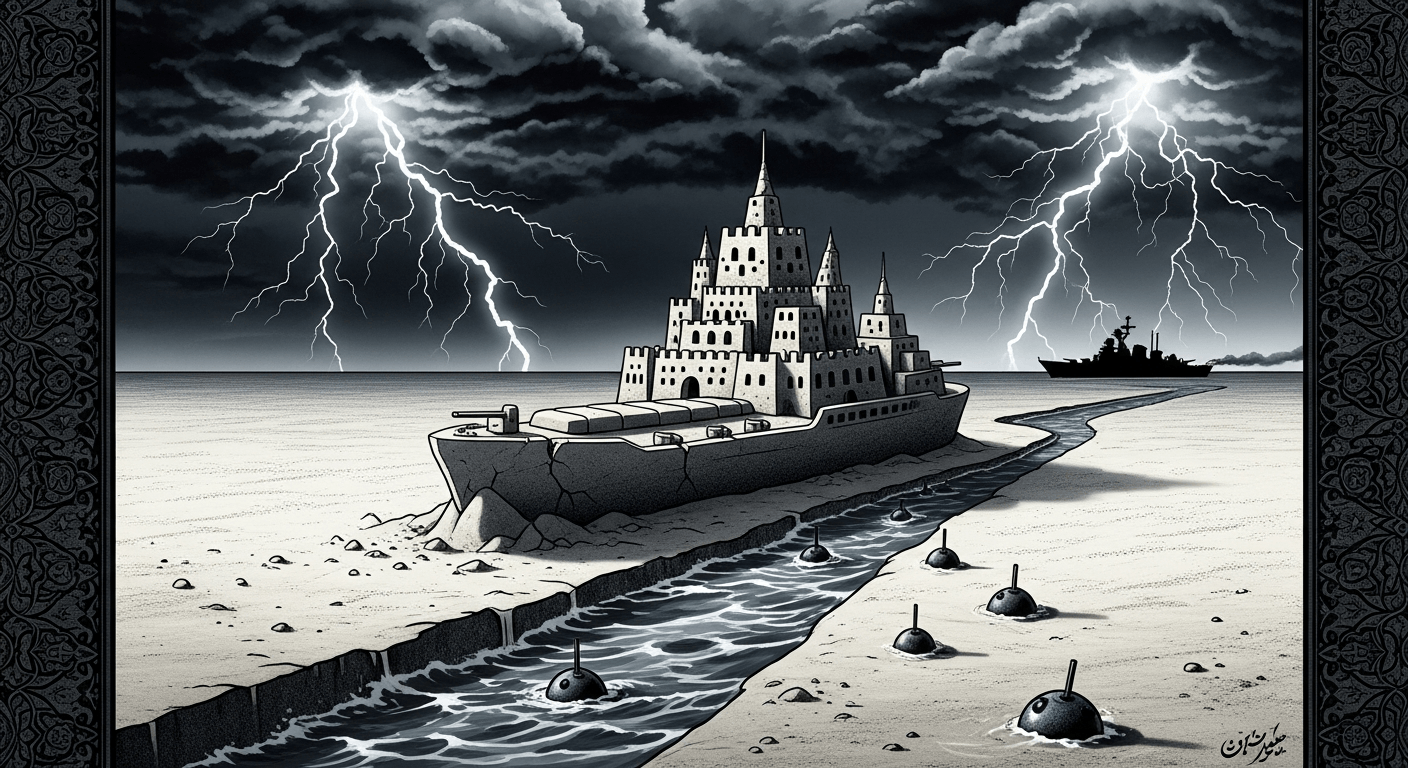
Suggested headline: Building Castles in Air
Opening hook: I have watched a great many diplomatic pyrotechnics in my time, but nothing quite like a world leader promising “free oil, free Hormuz” and having Tehran reply with a proverb and a laugh.
When rhetoric outruns reality
I write this as someone who reads maps, markets and the occasional diplomatic nuance for sport. Recently the US president proclaimed that a near-term peace would bring the United States “free oil” and an open — even “free” — Strait of Hormuz, suggesting the waterway and its barrels would soon return to the market at negligible cost to Washington [source]. Iran’s state media answered by calling this hopeful narrative “building castles in the air,” even posting a Persian proverb to underline the point: grand dreams do not equal operational fact [source].
The exchange is deliciously theatrical, but theatre can become catastrophe when it meets chokepoints, mines and an anxious market.
Why Hormuz matters — not as a metaphor
If you want to understand why the taunt matters, look at the numbers. Roughly 20 million barrels per day — about one-fifth of global oil consumption and roughly a quarter of seaborne oil trade — used to pass through the Strait of Hormuz in recent years; a significant share heads to Asia [EIA/IEA]. The strait is only about 21 nautical miles at its narrowest point, with two thin shipping lanes; there is almost no quick, cheap bypass for most Gulf producers. Meaning: when Hormuz is disrupted, prices spike, refinery inputs scramble and airlines fret about jet fuel. The market doesn’t argue about slogans; it reacts to the physical flow of molecules.
(For further details on volumes, transit dependence and limited pipeline bypass capacity see this analysis from the U.S. Energy Information Administration [link].)
Iran’s leverage is real
Tehran’s leverage is not merely rhetorical. Over the last months Iran and its naval forces have demonstrated how relatively low-cost asymmetric tools — naval mines, small-boat harassment, attacks on tankers, and selective permissioning for friendly-flagged ships — can reduce traffic to a trickle. That reality converts a diplomatic spat into an economic problem for import-dependent countries in Asia and for Gulf exporters whose loading schedules and cashflows depend on steady access to deepwater sea lanes.
Iran’s state broadcaster and several official mission accounts chose mockery as a response to the claim of imminent, cost-free access. The message was clear: a legal claim or a smiling press conference does not neutralize mines, change loyalties, or rebuild damaged port and desalination infrastructure overnight [source].
The legal and military realities the tweet (or statement) skips
International law places a premium on freedom of navigation through international straits; UNCLOS and customary practice protect transit passage and limit coastal states’ ability to suspend it. Yet law is not a magic switch in the middle of kinetic conflict. Iran has not ratified UNCLOS and asserts a different set of rights over passage; even more practically, wartime rules, the law of naval warfare, and the presence of mines can create a de facto impediment to traffic without a formal legal closure [UN and expert sources].
On the military side, clearing a mined, heavily contested strait is expensive, dangerous and time-consuming. Mine countermeasure vessels, specialized helicopters, diving teams and large convoys are needed — capabilities that are limited even among major navies and take time to deploy and sustain at scale. Whoever promises an immediate, low-cost reopening is skipping the logistics chapter.
Sanctions, naval footprints and economics
There is another, less glamorous constraint: sanctions and alliances. Many customers for Gulf oil are not allied with Washington; trade patterns have adapted. Even if the US navy were to escort a coalition of tankers, those shipments would only serve buyers who can pay and who accept the political costs. Markets would still price in risk: insurance, war-risk surcharges and rerouting add to the final price at the pump.
Remember, too, that the United States is far less dependent on Hormuz than major Asian importers. That asymmetry reduces the incentive for Washington to pay every bill necessary to unilaterally secure the strait, particularly when allies are wary and sanctions regimes complicate trading relationships.
So how credible was the “free oil, free Hormuz” line?
As a promise of immediate, costless access it was not credible. It read like political theater: optimistic public remarks framed as deal certainty, some selective leakage to markets, and the inevitable spin that follows a negotiation perceived to be going well. In practice, reopening Hormuz to normal trade requires (at minimum): a negotiated cessation of hostile operations, physical mine-clearing and safety guarantees, insurance and shipping arrangements, and the political will of buyers and intermediaries — no small set of tasks.
The Iranian snort — “building castles in the air” — targeted precisely that gap between language and logistics. It also served a domestic function: to signal resolve and to remind audiences that control over the strait is a real instrument in Tehran’s toolkit.
What this means for the region and for relations going forward
The immediate implication is that we remain in a high-risk equilibrium. Markets will price in the possibility that traffic may remain constrained; regional actors will accelerate contingency plans (pipeline runs, alternative suppliers, emergency stock releases); and navies will posture. Diplomacy will oscillate between public grandstanding and private bargaining.
Longer term, the incident underscores two structural facts: first, chokepoints matter, and states that can influence them gain leverage that is hard to neutralize with press statements; second, rhetoric that promises easy fixes damages credibility if it is not backed by operational capability and international buy-in.
As someone who studies the intersection of geopolitics and markets, I worry less about the quip and more about the work it disguises: rebuilding trust, negotiating protocols for safe navigation, and funding the hard, technical work of deconfliction. Mockery makes for good copy; mine-clearing and legal compromise do not.
Regards,
Hemen Parekh
Any questions / doubts / clarifications regarding this blog? Just ask (by typing or talking) my Virtual Avatar on the website embedded below. Then "Share" that to your friend on WhatsApp.
References (selected)
- Reporting on the president’s remarks and Iran’s dismissive response: BBC / OneIndia / Times of India [links].
- Data on oil volumes through the Strait of Hormuz: U.S. Energy Information Administration and IEA reports [link].
- Legal background on transit passage and innocent passage: UNCLOS Part III and analyses by maritime law experts and policy institutes [UN text; Lawfare/Washington Institute analyses].
- Operational and market analyses of the strait’s closure and mine-clearing challenges: industry and defense reporting [selected sources].
Get correct answer to any question asked by Shri Amitabh Bachchan on Kaun Banega Crorepati, faster than any contestant
Hello Candidates :
- For UPSC – IAS – IPS – IFS etc., exams, you must prepare to answer, essay type questions which test your General Knowledge / Sensitivity of current events
- If you have read this blog carefully , you should be able to answer the following question:
- Need help ? No problem . Following are two AI AGENTS where we have PRE-LOADED this question in their respective Question Boxes . All that you have to do is just click SUBMIT
- www.HemenParekh.ai { a SLM , powered by my own Digital Content of more than 50,000 + documents, written by me over past 60 years of my professional career }
- www.IndiaAGI.ai { a consortium of 3 LLMs which debate and deliver a CONSENSUS answer – and each gives its own answer as well ! }
- It is up to you to decide which answer is more comprehensive / nuanced ( For sheer amazement, click both SUBMIT buttons quickly, one after another ) Then share any answer with yourself / your friends ( using WhatsApp / Email ). Nothing stops you from submitting ( just copy / paste from your resource ), all those questions from last year’s UPSC exam paper as well !
- May be there are other online resources which too provide you answers to UPSC “ General Knowledge “ questions but only I provide you in 26 languages !


No comments:
Post a Comment