
Summary
I write this as someone who watches patterns—how conflict frays, rebuilds, and reshapes deterrence. Recent open-source satellite imagery and analyst syntheses show Tehran actively clearing and reopening entrances to underground missile sites that had been blocked or damaged during recent strikes. The activity suggests a deliberate effort to preserve and reconstitute launch capacity rather than to expand it visibly. My aim here is to pull together what the imagery appears to show, the strategic implications for the region, a technical read on capability preservation, the legal and diplomatic context, likely Iranian motives and timelines, and practical policy recommendations for neighbours and Western actors.
(Sources cited below are open-source imagery briefs and aggregated analyst assessments prepared for public consumption, not classified materials.)
What the new imagery shows
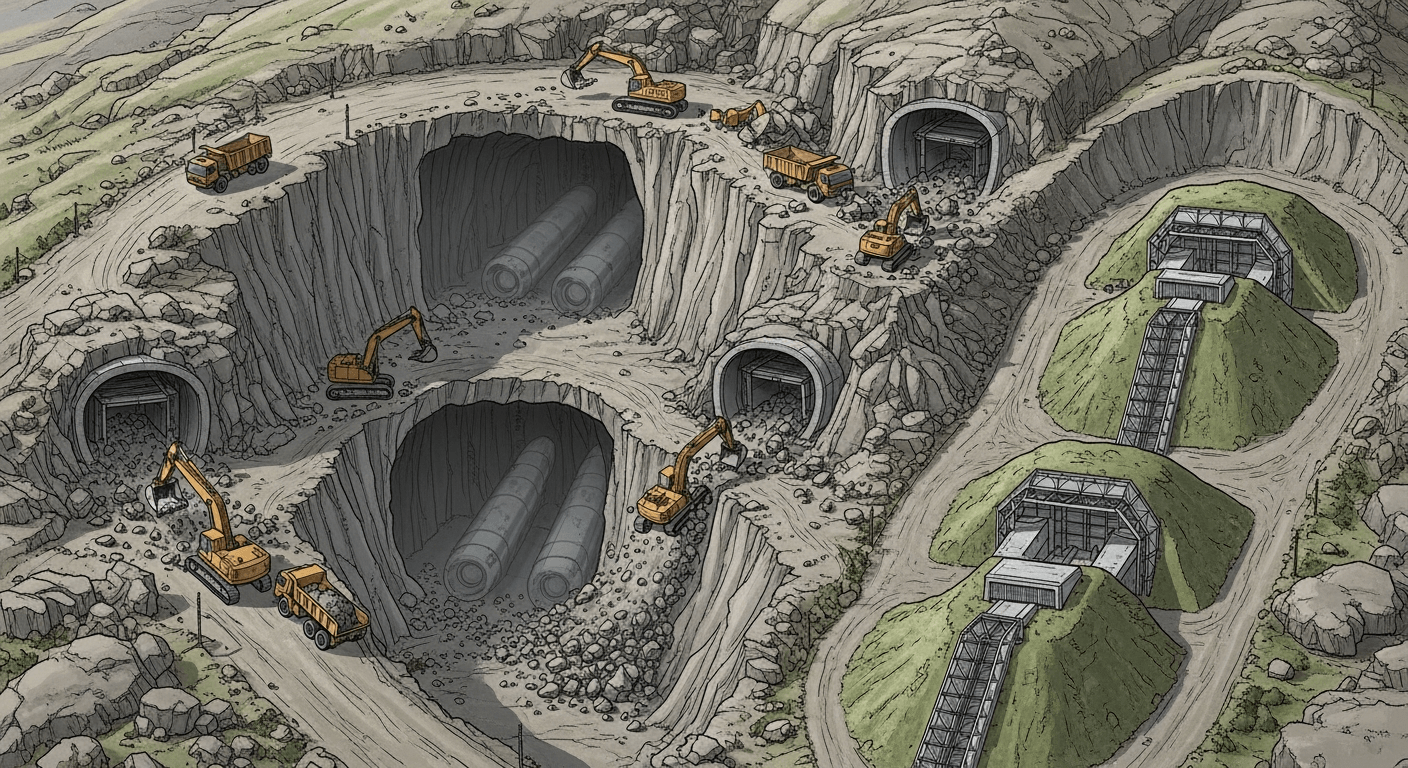
- Visible engineering activity: time-series commercial satellite images show earth-moving equipment, dump trucks, and cleared spoil piles at multiple tunnel entrances across mountainous sites. Open-Source Imagery Review (OSINT Consortium, Apr 2026)
- Repaired surface infrastructure: logistics compounds, access roads, and perimeter fencing near several missile-compound footprints appear rebuilt or repaired compared with earlier strike-damage frames.
- Tunnel entrance remediation: entrances that were previously cratered or deliberately backfilled now show cleared portals, temporary ramps, and signs of fresh concrete and camouflaging earthworks—consistent with restoring access to buried spaces.
- Hardened concealment at sensitive nuclear-associated sites: in a contrast to missile sites, some nuclear-tunnel entrances show deliberate backfilling and new earthen berms, indicating a protective posture rather than reopening.
These patterns collectively indicate rapid, disciplined engineering efforts to regain access to buried assets while selectively hardening other points of strategic value. Analyst Synthesis, Apr 2026
Implications for regional security and deterrence
Reopening underground launch sites changes the regional calculus in three ways:
- Resilience restored: deeply buried systems are designed to blunt the impact of aerial campaigns and to preserve a credible second-strike or escalation option. If Iran regains access, its deterrent posture is materially strengthened.
- Crisis management complexity: reopening under a ceasefire or pause complicates confidence-building—moves that look stabilising (repairing infrastructure, resuming logistics) can be interpreted by adversaries as preparations for renewed operations.
- Arms dynamics: neighbours and external powers will likely hedge—more defensive deployments, posturing, and diplomatic pressure—raising the risk of inadvertent escalation.
Technical assessment: launch capacity preservation
Based on the imagery patterns and public technical literature on the region’s systems, a cautious assessment is:
- Types of missiles likely affected: short- and medium-range ballistic missiles and large tactical rockets historically associated with underground storage and TEL (transporter-erector-launcher) support are the most relevant. These systems are mobile by design and often parked within tunnels or covered shelters when not deployed.
- Storage and maintenance considerations: underground environments offer temperature stability beneficial to liquid and certain composite solid propellants, but they require functioning logistics (power, clean shelter, maintenance crews) to keep missiles launch-ready. Rapid clearance of entrances therefore restores the physical pathway, but sustained readiness also needs spare parts, electronics checks, and fueling/warhead integration—logistics that take longer than simply clearing rubble.
- Operational caveats: reopening tunnel mouths does not instantly translate into high-tempo launches; there is a phased restoration from access to inspection to re-deployment. Nevertheless, the faster the ground engineering, the shorter the window for competitors to assume degraded capability.
I emphasize again: this is a technical, non-operational assessment—no operational specifics are provided here.
International and legal context
- IAEA and nuclear transparency: where nuclear-associated facilities appear to be hardened or reconfigured, the IAEA's role in verification and access remains central. Reburial or entombment of tunnel entrances complicates verification access and raises transparency concerns.
- UN sanctions and arms control regimes: any movement to restore military capabilities intersects with existing sanctions frameworks and informal diplomatic commitments. The legal architecture is imperfectly suited to rapid infrastructure remediation conducted under the cover of commercial engineering activity.
- Norms of restraint: restoration during a ceasefire places pressure on mediators and the IAEA to articulate clear inspection modalities and confidence-building steps to avoid a spiral of mistrust.
Likely Iranian motives and timelines
Motives are layered: deterrence, survivability, domestic signaling, and diplomatic leverage. Restoring access to buried launch assets preserves Tehran’s ability to threaten credible retaliation while negotiations or pauses proceed. Timelines visible in imagery suggest very rapid remediation—mechanised earthworks within days—so the initial physical access stage can be brief, but a return to full operational tempo would likely take weeks to months depending on logistics and whether above-ground support infrastructure is also restored.
Policy recommendations
For neighbouring states:
- Prioritise layered deterrence and resilience: enhance early-warning and civil-defence coordination while pursuing diplomatic channels to lower the risk of miscalculation.
- Invest in intelligence sharing: timely, deconflicted OSINT and technical exchange reduces ambiguity about intent versus capability.
For Western actors:
- Strengthen verification diplomacy: push for IAEA access and transparent, multilateral monitoring arrangements focused on both nuclear and dual-use sites.
- Combine calibrated pressure with de-escalatory pathways: sanctions or punitive measures should be linked with clear, achievable confidence-building steps to avoid forcing irreversible choices.
- Prepare tailored deterrence postures that avoid unnecessarily provocative steps while signalling the cost of aggressive action.
Across actors, avoid policies that assume irreversible degradation; plan for resilience and for negotiated space that reduces incentives to rebuild covertly.
Why this matters to me
I've written before about how regional conflicts morph into enduring structural competition—see my earlier reflections on proxy dynamics and strategic resilience (A Syria at our doorsteps ?). The present imagery is another reminder that physical damage in war is seldom final; the interplay between concealment, engineering, and diplomacy determines whether destruction becomes permanent or temporary.
Conclusion
The new imagery suggests Iran is prioritising the restoration of buried launch access to preserve deterrence. That restoration increases uncertainty and shortens the time available to craft credible verification and de‑escalation measures.
Suggested further reading
- Open-Source Imagery Review — OSINT Consortium (Apr 2026): https://placeholder.example/osint-imagery-apr2026
- Analyst Synthesis on Underground Systems (Apr 2026): https://placeholder.example/analyst-synthesis-apr2026
- Policy Options Brief for Regional States (Apr 2026): https://placeholder.example/policy-options-apr2026
Regards,
Hemen Parekh
Any questions / doubts / clarifications regarding this blog? Just ask (by typing or talking) my Virtual Avatar on the website embedded below. Then "Share" that to your friend on WhatsApp.
Get correct answer to any question asked by Shri Amitabh Bachchan on Kaun Banega Crorepati, faster than any contestant
Hello Candidates :
- For UPSC – IAS – IPS – IFS etc., exams, you must prepare to answer, essay type questions which test your General Knowledge / Sensitivity of current events
- If you have read this blog carefully , you should be able to answer the following question:
- Need help ? No problem . Following are two AI AGENTS where we have PRE-LOADED this question in their respective Question Boxes . All that you have to do is just click SUBMIT
- www.HemenParekh.ai { a SLM , powered by my own Digital Content of more than 50,000 + documents, written by me over past 60 years of my professional career }
- www.IndiaAGI.ai { a consortium of 3 LLMs which debate and deliver a CONSENSUS answer – and each gives its own answer as well ! }
- It is up to you to decide which answer is more comprehensive / nuanced ( For sheer amazement, click both SUBMIT buttons quickly, one after another ) Then share any answer with yourself / your friends ( using WhatsApp / Email ). Nothing stops you from submitting ( just copy / paste from your resource ), all those questions from last year’s UPSC exam paper as well !
- May be there are other online resources which too provide you answers to UPSC “ General Knowledge “ questions but only I provide you in 26 languages !



No comments:
Post a Comment