
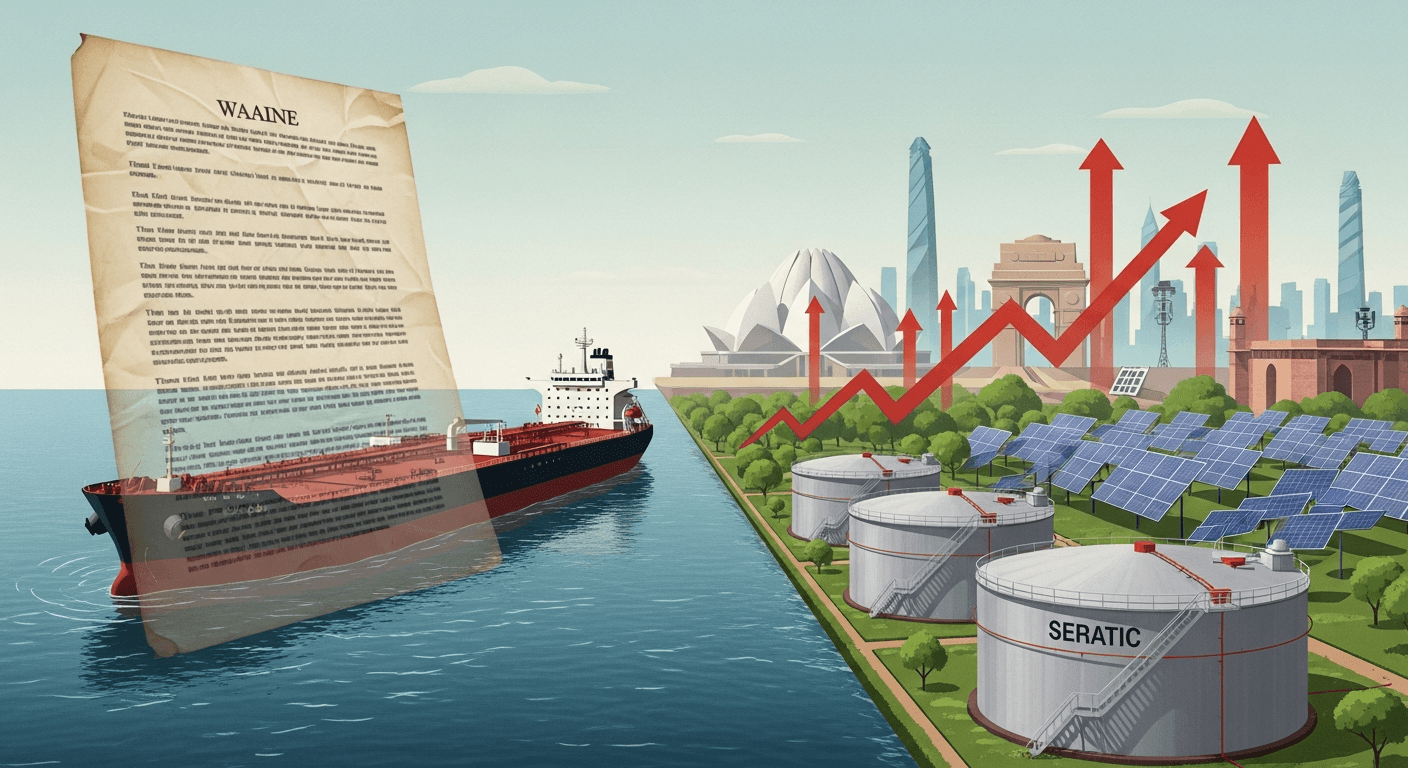
Summary
I write this as a pragmatic assessment of recent U.S. decisions not to renew temporary sanctions waivers that allowed certain shipments of Russian and Iranian oil to reach international buyers. The abrupt end of those waivers reduces short‑term supply cushions that had eased market stress. For India — a large and growing oil importer that used the waivers to access discounted barrels — the move raises immediate economic pressures and forces a rethink of energy, trade and diplomatic choices.
Background
In March the U.S. issued short, time‑limited licenses that permitted delivery of specific cargoes of Russian and Iranian crude already at sea. Those authorisations reportedly covered roughly 100–150 million barrels of oil combined (estimates), and they were framed as emergency steps to prevent a disorderly spike in global prices during sharp regional tensions. By mid‑April, U.S. officials announced these temporary measures would not be extended. At the same time, market reports indicate India dramatically increased purchases of Russian crude during the waiver window — with import bills rising into the billions of euros in March (estimates based on public trade reporting).
I have written previously about India’s vulnerability to imported energy shocks and the long‑term need to reduce fossil‑fuel exposure through diversification and renewables (A Twin Tragedy). That earlier analysis is directly relevant today: shorter policy levers can buy time, but structural change is the only durable answer.
Immediate impacts on India
Supply and price pressure: With waivers not renewed, availability of a tranche of discounted barrels will dry up. Expect upward pressure on benchmark crude prices and on landed costs of fuel for Indian refiners over the next 1–3 months (short‑term estimate).
Refinery sourcing disruption: Indian refiners that opportunistically increased Russian crude intake must reallocate purchases quickly. That will raise logistical costs and could widen refining margins if alternative grades are more expensive or need different processing.
Trade bill and currency stress: Higher oil import bills translate into larger current‑account outflows. If crude trades persistently higher, the rupee could face depreciation pressure; that would compound import costs (quantitative impact depends on price and FX moves — illustrative estimate: each $10/barrel rise in crude roughly adds tens of billions to India’s annual import bill, depending on volumes).
Fiscal and inflationary effects: Pump price pass‑through or higher fuel subsidies to shield consumers would strain the budget. Even without subsidy changes, food and transport inflation could rise via higher input costs.
Broader economic and geopolitical implications
Geopolitical signalling: The U.S. decision signals a firmer enforcement posture on secondary sanctions and a desire to tighten economic pressure on Russia and Iran. That constrains the strategic options for middle powers balancing ties with Western capitals and alternative suppliers.
Shipping and insurance costs: Higher perceived sanction risk elevates marine insurance and freight premia for shipments tied to sanctioned jurisdictions. Those higher logistics costs are an added premium for buyers seeking non‑Western routes or intermediated trades.
Market volatility and substitution: Global markets will seek replacement barrels from other exporters — Gulf producers, West Africa, and U.S. exports — but ramping volumes and rerouting takes time. In the medium term, this accelerates incentives for buyers to accelerate demand reduction measures and alternative energy.
Diplomatic tightrope for India: India must juggle energy security and relationships with both Western partners and traditional suppliers. Short‑term domestic imperatives (secure, affordable fuel) compete with longer geopolitical alignment choices.
What India can do (policy options)
I outline pragmatic, prioritized actions — some immediate, some medium term — that reduce exposure and preserve policy space.
- Short‑term market and fiscal measures
- Use strategic petroleum reserves (SPR) tactically to smooth supply shocks while markets adjust. Release timing should be coordinated with major buyers when possible.
- Allow temporary, targeted fiscal relief to vulnerable sectors while avoiding open‑ended subsidies; use cash transfers or energy‑linked targeted support to protect the poorest.
- Strengthen currency hedging tools for importers (forward cover, currency swaps) to limit balance‑sheet shocks.
- Secure immediate supply flexibility
- Accelerate procurement from diverse suppliers (Gulf, West Africa, US, Brazil) with transparent tenders to avoid paying punitive premia.
- Negotiate longer‑term offtake contracts where possible to stabilise pricing and logistics.
- Work with insurers and flag states to manage shipping and insurance constraints — pragmatic legal and underwriting solutions can lower transaction costs.
- Medium‑term structural steps
- Fast‑track renewables and storage: scale up large‑scale renewables, distributed solar, and battery storage to reduce growth in oil demand for power and (where feasible) transport.
- Improve energy efficiency and modal shifts: incentivise public transport, freight modal shift to rail, and efficiency standards that reduce oil intensity.
- Build refining resilience: invest in processing flexibility so refineries can handle a wider range of crude grades without significant margin erosion.
- Diplomatic strategy
- Intensify diplomatic engagement with multiple partners to preserve energy access while managing sanctions risk; the aim should be predictable, lawful routes for procurement.
- Advocate for clearer multilateral protocols on humanitarian or market‑stabilising energy trades so policy shifts are not ad hoc.
Conclusion
The U.S. decision not to renew waivers removes a temporary shock absorber from global oil markets. For India the result is predictable: higher short‑run cost pressures, logistical disruption and a test of policy agility. But this is also an accelerant for choices I have long argued for — smarter demand management, faster renewable deployment, and deeper strategic planning. Short‑term mitigation is necessary, but the more consequential task is to reduce the economy’s structural dependence on imported oil.
Implementing the pragmatic steps above will blunt immediate pain and create durable resilience. Energy shocks are always political as well as economic; disciplined, transparent policy choices preserve both economic stability and the diplomatic space India needs.
Regards,
Hemen Parekh
Any questions / doubts / clarifications regarding this blog? Just ask (by typing or talking) my Virtual Avatar on the website embedded below. Then "Share" that to your friend on WhatsApp.
Get correct answer to any question asked by Shri Amitabh Bachchan on Kaun Banega Crorepati, faster than any contestant
Hello Candidates :
- For UPSC – IAS – IPS – IFS etc., exams, you must prepare to answer, essay type questions which test your General Knowledge / Sensitivity of current events
- If you have read this blog carefully , you should be able to answer the following question:
- Need help ? No problem . Following are two AI AGENTS where we have PRE-LOADED this question in their respective Question Boxes . All that you have to do is just click SUBMIT
- www.HemenParekh.ai { a SLM , powered by my own Digital Content of more than 50,000 + documents, written by me over past 60 years of my professional career }
- www.IndiaAGI.ai { a consortium of 3 LLMs which debate and deliver a CONSENSUS answer – and each gives its own answer as well ! }
- It is up to you to decide which answer is more comprehensive / nuanced ( For sheer amazement, click both SUBMIT buttons quickly, one after another ) Then share any answer with yourself / your friends ( using WhatsApp / Email ). Nothing stops you from submitting ( just copy / paste from your resource ), all those questions from last year’s UPSC exam paper as well !
- May be there are other online resources which too provide you answers to UPSC “ General Knowledge “ questions but only I provide you in 26 languages !


No comments:
Post a Comment