
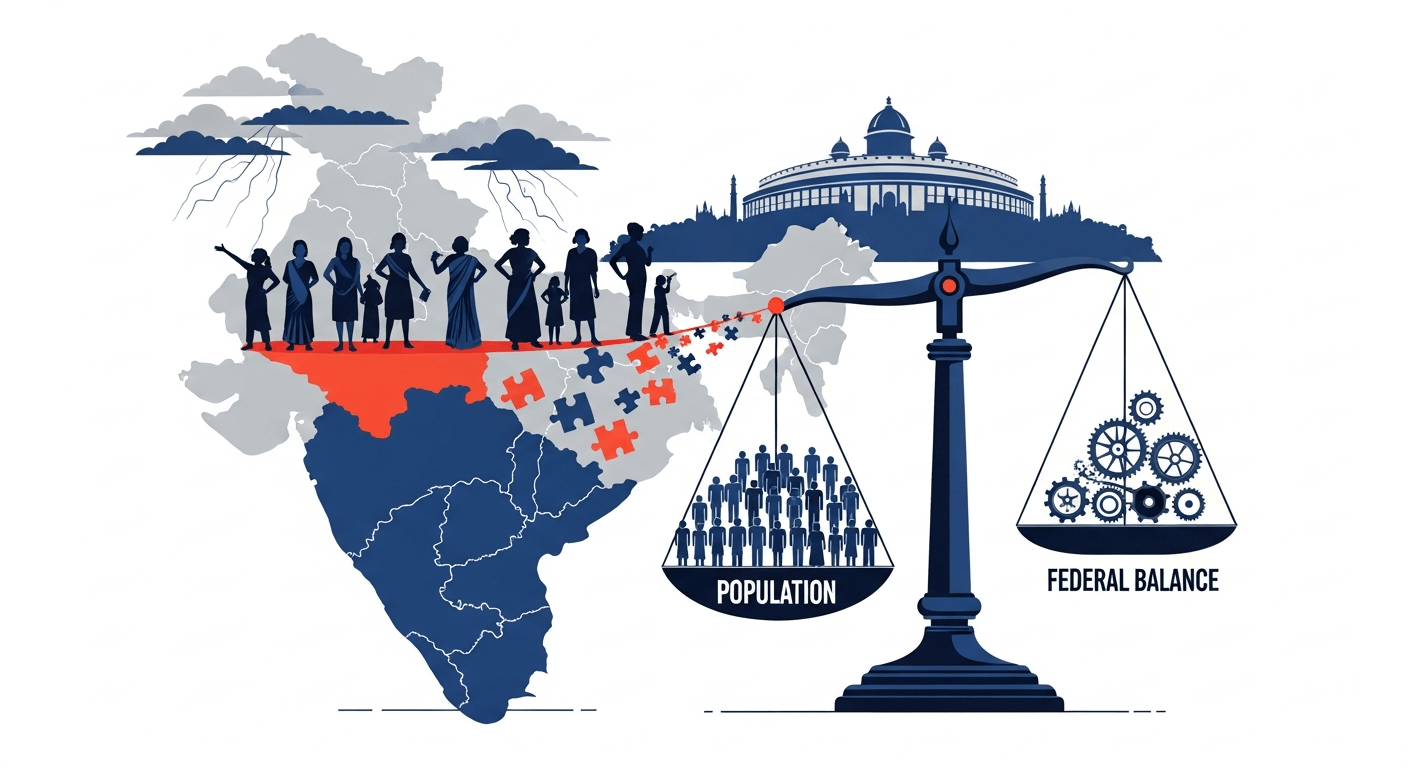
Delimitation: Why the Row Now
A personal take from the chamber of ideas
I watched the special session unfold and felt the familiar mix of hope and apprehension. On the surface the package the Union government has placed before Parliament—amending constitutional rules around readjustment, enabling a large-scale delimitation exercise, expanding the Lok Sabha and tying implementation of the women's reservation to that exercise—was pitched as a technical reset to reflect demographic reality. But as a civic observer I see why this moment has become combustible.
What is different this time
- The long-standing freeze that kept seat distribution anchored to older population data has been opened up. The new framework lets Parliament specify which Census figures to use and empowers a Delimitation Commission to redraw boundaries and reallocate seats.
- The proposed expansion of the Lok Sabha (to a much larger ceiling than today) changes the arithmetic of national politics: a higher majority mark, different coalition math, and altered incentives for party strategy.
- Operationalising the 33% women’s reservation only after fresh delimitation means the quota’s rollout is explicitly tied to this redrawing of maps; reserved constituencies will rotate each delimitation cycle.
- The Commission’s final orders will carry the force of law and be non-justiciable—once notified they cannot be challenged in court—making the process final in a way earlier exercises were not.
For concise explainers of these technical changes, see the reporting and analysis by The News Minute and Moneycontrol, which lay out the proposed bills and their institutional mechanics (The News Minute explainer, Moneycontrol summary).
Why the politics is so heated
There are three overlapping fault-lines that explain the current row:
- Federal balance and perceived regional penalty
- States that achieved demographic control fear being penalised if seats are redistributed strictly by population numbers. A population-based recalibration can shift influence toward faster-growing states and away from the south.
- Timing and trust
- Introducing this package in the middle of electioneering magnifies suspicion: opponents read motive into timing, and calls for wider consultation have gone unanswered.
- Linkage to women’s reservation
- Few oppose increased representation for women; the controversy grows because the reservation’s implementation is tied to the delimitation exercise. Critics worry the linkage can be used as leverage for changes that go far beyond simply enabling the quota.
The Wire and other outlets have captured how opposition parties and several state governments have framed their objections as concerns about federal fairness and rushed process (The Wire coverage).
Why some say it matters—and is necessary
From the government’s vantage point the argument is straightforward: India’s demographics, urbanisation and migration patterns have changed since the earlier freeze; seats and constituencies that still reflect outdated figures create representational imbalances. Waiting for a delayed census could postpone both delimitation and the meaningful operationalisation of the women’s quota for years. In short, the claim is that institutional updating cannot be postponed indefinitely.
The longer arc: continuity with earlier debates
I have written about women's reservation before, tracing its long and halting trajectory and the political trade-offs that accompany it. In 2013 I wrote an early piece on the Women’s Reservation Bill and the various conditional supports and criticisms it attracted (Women’s Reservation Bill — my 2013 post). More recently I reflected on how civic mobilisation among women changed political dynamics (Unity among women forced political parties to adopt Reservation Bill — my 2024 note). That continuity matters: the questions now are versions of old dilemmas—how to expand representation without creating new inequities; how to make institutional fixes while maintaining trust.
Practical consequences to watch for
- Redistribution patterns: which states gain or lose seats, and how the proportional shares are preserved (or not) in practice.
- Design of the Delimitation Commission’s formula: small drafting choices will determine outcomes; the devil is in the details.
- Rotation mechanics for reserved (women) seats: who benefits from rotation and who loses incumbency advantages.
- Political strategy: parties will reassess candidate selection, alliance calculus and seat-management tactics in response to the new map.
What I find most worrisome—and hopeful
Worrisome: any major institutional change carried out without broad consultation risks cementing resentment. When the instrument (delimitation) is irreversible and immune to judicial review, questions about legitimacy amplify.
Hopeful: operationalising the women’s reservation could meaningfully increase women’s presence in legislatures. If the implementation is transparent and accompanied by measures to widen the candidate pool (training, party nomination reforms, support for women from marginalised groups), this could be transformative.
My modest prescription
- Slow down the rhetoric; speed up transparency. Publish formulas, draft proposals and public hearings on timelines that permit meaningful input.
- Decouple as much as possible the technical mechanics (delimitation formula, seat ceilings) from normative reforms (women’s reservation is worthy and urgent) so each can be debated on its merits.
- Ensure safeguards for states that legitimately fear loss of voice; build compensatory fiscal or institutional mechanisms rather than leave grievances to fester.
I have argued before that representation matters not just as arithmetic but as social voice. Today’s debate is a reminder that constitutional engineering must be paired with political empathy.
Regards,
Hemen Parekh
Any questions / doubts / clarifications regarding this blog? Just ask (by typing or talking) my Virtual Avatar on the website embedded below. Then "Share" that to your friend on WhatsApp.
Get correct answer to any question asked by Shri Amitabh Bachchan on Kaun Banega Crorepati, faster than any contestant
Hello Candidates :
- For UPSC – IAS – IPS – IFS etc., exams, you must prepare to answer, essay type questions which test your General Knowledge / Sensitivity of current events
- If you have read this blog carefully , you should be able to answer the following question:
- Need help ? No problem . Following are two AI AGENTS where we have PRE-LOADED this question in their respective Question Boxes . All that you have to do is just click SUBMIT
- www.HemenParekh.ai { a SLM , powered by my own Digital Content of more than 50,000 + documents, written by me over past 60 years of my professional career }
- www.IndiaAGI.ai { a consortium of 3 LLMs which debate and deliver a CONSENSUS answer – and each gives its own answer as well ! }
- It is up to you to decide which answer is more comprehensive / nuanced ( For sheer amazement, click both SUBMIT buttons quickly, one after another ) Then share any answer with yourself / your friends ( using WhatsApp / Email ). Nothing stops you from submitting ( just copy / paste from your resource ), all those questions from last year’s UPSC exam paper as well !
- May be there are other online resources which too provide you answers to UPSC “ General Knowledge “ questions but only I provide you in 26 languages !



No comments:
Post a Comment