
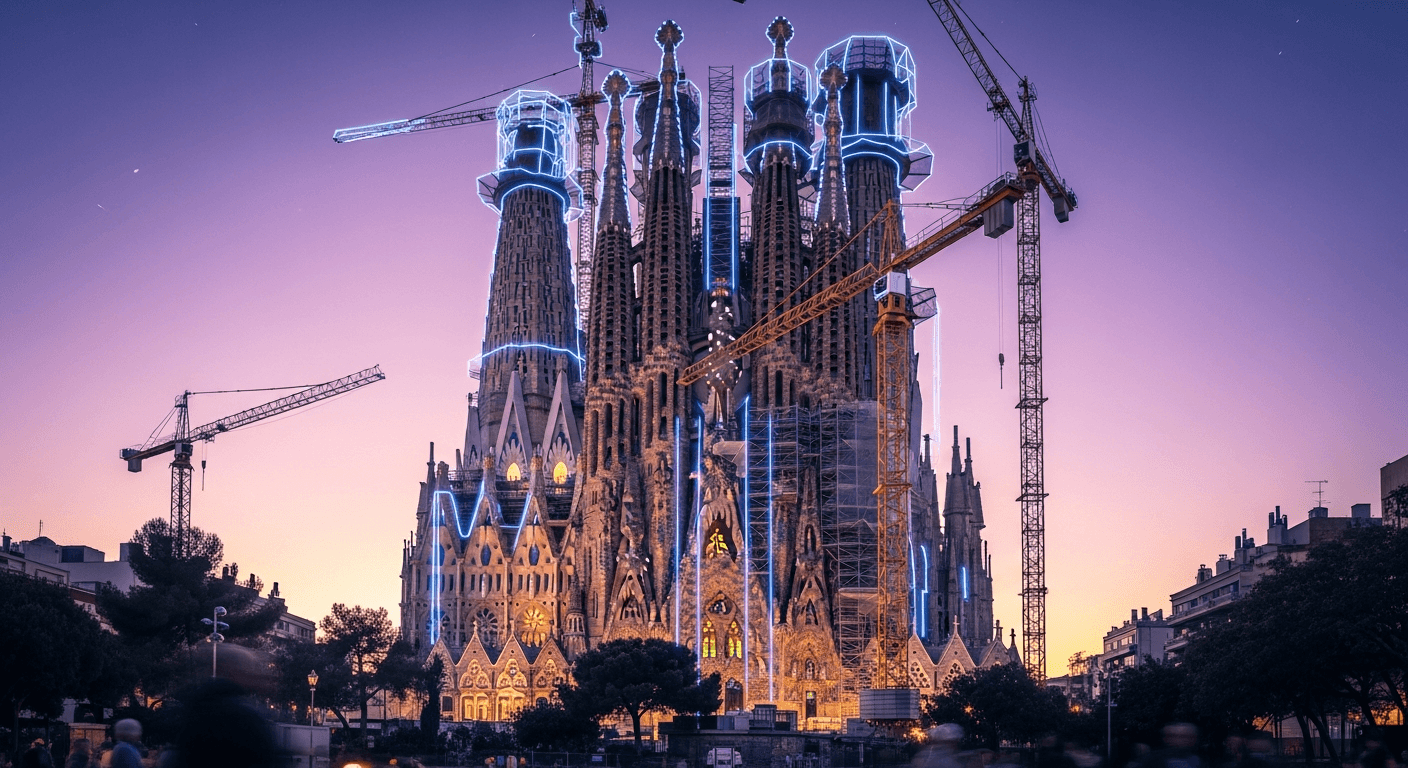
I remember the first time I stood beneath those soaring stone trees and felt the light change as it filtered through the stained‑glass like a tide. The Sagrada Família has always felt like a living thing to me — more organism than monument — and the news that this 144‑year project is finally approaching its finish line has that old wonder returning, mingled with questions about heritage, technology, and the cost of completion.
Historical background
The Sagrada Família began as a local, devotional project in Barcelona in the late 19th century. What started with modest ambitions quickly became an ambitious public work, reinvented early on by an architect who turned away from conventional Gothic revival toward a language of organic geometry, symbolism, and light. Over the decades the building grew — and stalled — through a patchwork of funding cycles, wars, and cultural shifts.
Construction was profoundly disrupted by political upheaval in the 20th century. At one key moment, much of the original workshop and its detailed models were destroyed, forcing later generations to piece together intentions from photographs, fragments and recollections. For long stretches the basilica relied on donations and the revenue from visitors; for others, it sat as a civic argument about what to preserve and how to proceed.
The architect’s vision
The original architect reimagined the cathedral as a kind of geological cathedral: towers like stalagmites, façades that read as sequenced narratives (birth, suffering, glory), and an interior forest of branching columns. The completed concept called for 18 towers — apostles, evangelists, the Virgin and the central spire representing Christ — and three grand façades that would unfold the Christian story in stone.
Crucially, the vision accepted time as a collaborator. It was conceived as a project to outlast a single human career, an approach that both freed future makers and complicated the question of fidelity. The master plan combined intense symbolic programing with structural inventions inspired by nature: helicoids, ruled surfaces, hyperboloids and parabolic arches that resolve loads in unexpected ways and create interiors that feel both monumental and intimate.
Construction challenges
Any narrative of the Sagrada Família’s long life must contend with interruptions and losses. The destruction of early models during civil strife left an incomplete archive. Funding was intermittent for decades; construction slowed in times of economic stress and accelerated when tourist revenues rose.
Technically, many of the original forms were extraordinarily difficult to calculate and build with 19th‑ and early 20th‑century methods. The design’s complex geometries were well ahead of the craft techniques of the time, so the project alternated between daring innovation and painstaking trial‑and‑error.
Recent global crises also left their mark: a pandemic pause in 2020 halted work and threatened timelines, even as advancing technology began to offer solutions that earlier generations could only imagine.
Modern techniques and the race to finish
The acceleration toward completion in recent decades has been made possible by technology. Computer‑aided design and 3D modelling let teams reconstruct lost intentions from fragments. CNC milling and prefabrication allow stone panels and sculptural elements to be manufactured with a precision that would have been impossible a century ago, and then assembled on site.
Engineering consultancies and modern structural analysis have lightened elements where earlier builders relied on mass. Parametric workflows translate visionary geometries into buildable parts, and digital archives preserve iterations for future hands. The result is a productive tension: the original spirit of experimentation married to contemporary systems that can actually deliver the forms that once existed only in plaster and imagination.
Timeline to the finish line
- 1882 — Foundation stone laid; early neo‑Gothic plans give way to a new direction.
- Early 20th century — Design transformed into an organic, symbolic scheme; the architect devotes decades to the work.
- 1920s–1930s — Construction interrupted and records partially destroyed during civil conflict.
- Late 20th century — Steady progress resumes with renewed funding and public interest.
- 2010 — Significant portions of the interior completed and the building consecrated for liturgical use.
- 2020 — Pandemic pause slows work again.
- Mid‑2020s — Prefabrication, CAD/CAM workflows and targeted engineering accelerate progress; the central spire and key façades near completion.
- 2026 (symbolic date) — The central spire and critical elements are expected to be finished, marking a major milestone in the basilica’s long life. Decorative and ancillary work will continue into the following decade.
Cultural significance
The Sagrada Família has become much more than an architectural project for Barcelona: it is a global symbol, a municipal engine of tourism, and a contested piece of urban identity. Millions visit every year to experience its paradox — a completed interior exposed through scaffolding and cranes — and the building has woven itself into the city’s modern economy and image.
At the same time, the basilica has been a catalyst for debates about authenticity, stewardship and the commodification of heritage. Its status as a UNESCO‑recognized site for parts of the work underlines its cultural value, even as its very incompletion has been part of what made it iconic.
Controversies and civic tensions
Completion is not just a technical challenge; it is a civic and ethical one. Plans to realize a grand approach and final stairway have run into resistance from residents whose blocks would have to be reshaped or relocated. Litigation and protests reflect real human costs: displacement, rising rents, and the pressure of tourism on ordinary neighbourhood life.
Architectural purists have argued that later hands cannot faithfully reproduce the original spirit; others counter that completion is itself an interpretation and that leaving the work permanently unfinished would betray the project’s generational intent. The question is practical as well as philosophical: how do you finish something that was deliberately conceived to be a conversation across time?
Architectural significance
Viewed architecturally, the Sagrada Família remains one of the most radical experiments in cathedral design since the Middle Ages. It defies easy categorization, blending Gothic verticality with Art Nouveau’s fluid lines and an almost biomorphic structural logic. Inside, columns split like tree trunks, vaults form complex shells, and light becomes an active participant in the spatial drama.
When the final tower rises to the planned height — greater than many historic cathedrals — it will not only rewrite skylines but also complete an argument about how sacred architecture might speak to a modern city: complex, layered, and never purely historical.
Closing reflection
There is something quietly human about a building that asks many generations to finish it. The Sagrada Família has been an experiment in patience and faith, a place where craft, devotion and technology meet. Watching the last stones and panels find their place, I feel both the weight of what’s been lost and the joy of what is still possible. Completion will not close the conversation; it will start a new chapter in which care, interpretation and use will determine how this remarkable structure lives in the world.
Regards,
Hemen Parekh
Any questions / doubts / clarifications regarding this blog? Just ask (by typing or talking) my Virtual Avatar on the website embedded below. Then "Share" that to your friend on WhatsApp.
Get correct answer to any question asked by Shri Amitabh Bachchan on Kaun Banega Crorepati, faster than any contestant
Hello Candidates :
- For UPSC – IAS – IPS – IFS etc., exams, you must prepare to answer, essay type questions which test your General Knowledge / Sensitivity of current events
- If you have read this blog carefully , you should be able to answer the following question:
- Need help ? No problem . Following are two AI AGENTS where we have PRE-LOADED this question in their respective Question Boxes . All that you have to do is just click SUBMIT
- www.HemenParekh.ai { a SLM , powered by my own Digital Content of more than 50,000 + documents, written by me over past 60 years of my professional career }
- www.IndiaAGI.ai { a consortium of 3 LLMs which debate and deliver a CONSENSUS answer – and each gives its own answer as well ! }
- It is up to you to decide which answer is more comprehensive / nuanced ( For sheer amazement, click both SUBMIT buttons quickly, one after another ) Then share any answer with yourself / your friends ( using WhatsApp / Email ). Nothing stops you from submitting ( just copy / paste from your resource ), all those questions from last year’s UPSC exam paper as well !
- May be there are other online resources which too provide you answers to UPSC “ General Knowledge “ questions but only I provide you in 26 languages !



No comments:
Post a Comment