
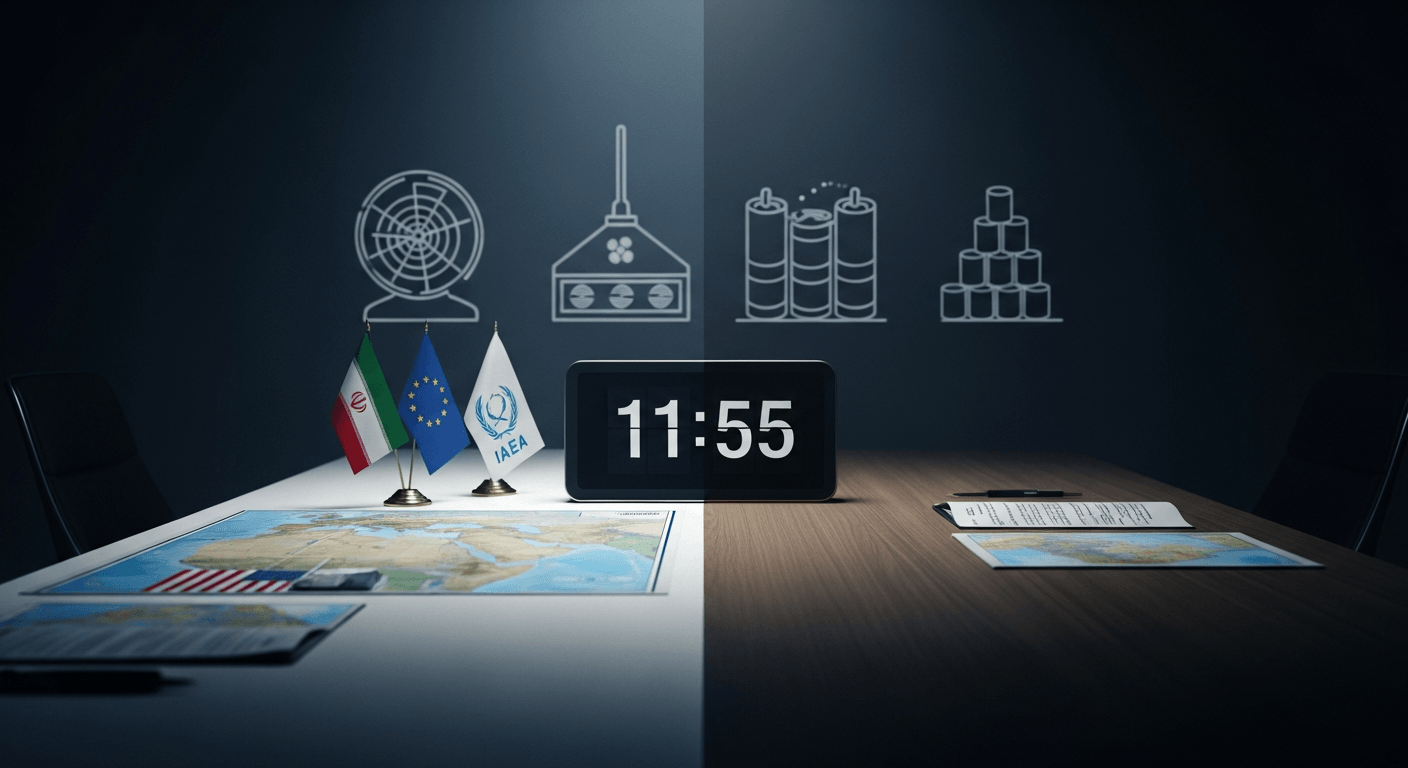
How a 20-year pause became a line in the sand
I have watched these cycles of negotiation long enough to see a familiar pattern: a fragile pause, a technical bargain, and then the slow unraveling when politics and mistrust enter the room. The reference to a “20‑year pause” in Iran’s enrichment activities points back to the early 2000s when Tehran agreed—temporarily and voluntarily—to suspend enrichment as a confidence-building measure while it negotiated with European powers. That suspension signaled a narrow window in which inspectors could rebuild confidence and diplomacy might reset longer-term limits on Iran’s fuel-cycle activity.
What the pause meant in practical terms was simple: fewer centrifuges running, a smaller stockpile of enriched uranium, and wider access for the International Atomic Energy Agency (IAEA) to verify those constraints. For negotiators, it bought time and created a baseline around which a broader bargain—the 2015 deal—could be written.
(Enrichment: the process of increasing the proportion of the fissile isotope uranium‑235 in uranium; it is used for both civilian power and, at higher levels, weapons.)
The arc of talks and how we reached the ‘last mile’
The diplomatic timeline that led to the recent negotiations is well known: the 2015 comprehensive agreement froze key components of Iran’s program in exchange for sanctions relief; a unilateral U.S. withdrawal later reopened the field of contestation; Tehran responded with stepped-up enrichment and reduced cooperation with the IAEA; and intermittent negotiations—centered on restoring compliance in exchange for rollback of sanctions—proceeded in fits and starts.
Over the last few years, talks repeatedly advanced to the final, hardest questions: how to verify Iranian rollback when Tehran had expanded capacity and stockpiles; how to sequence sanctions relief and nuclear commitments so neither side felt vulnerable; and how to guard against rapid reversals if either party backslid.
(‘Breakout time’: the estimated time it would take a country to produce enough weapons-grade fissile material for a single nuclear device, given existing stockpiles and enrichment capacity.)
The core sticking points
Verification and continuity of monitoring. The IAEA’s access and access to historical questions about undeclared facilities remained an unresolved sore point. Reconstructing a decades‑long record requires continuous, credible access—something ruined when cameras were removed and inspectors were limited.
Sanctions relief versus sequencing. Tehran wanted immediate, tangible relief from sanctions that had squeezed its economy; Washington and partners feared lifting measures before demonstrable, verifiable steps by Tehran, creating a sequencing dilemma.
Regional security assurances. Gulf states and Israel demanded stronger guarantees that a revived deal would not embolden Tehran’s regional policies—concerns that external parties pressed into the negotiation calculus.
The snapback mechanism. Many negotiators worried about preserving a credible enforcement tool that could re-impose UN sanctions quickly if violations occurred. (Snapback: a provision that allows UN sanctions to be reactivated automatically or rapidly if parties are judged to have violated agreed limits.)
Advanced centrifuges and stockpiles. Iran’s installation of more efficient IR‑6‑class machines and expansion of its enriched-uranium stockpile shortened estimated breakout times and made verification more complicated.
Tehran’s countermeasures
Faced with sanctions and the absence of a reliable U.S. partner in the earlier years, Iran pursued a deliberate modernization and expansion of its fuel‑cycle capabilities: higher enrichment levels at underground facilities, accumulation of larger stockpiles of enriched uranium, and installation of advanced centrifuges that raise throughput. Diplomatically, Tehran also sought to diversify support with political and economic engagement from other major powers and regional partners to blunt pressure.
These moves were calibrated: provocative enough to strengthen negotiating leverage, but often framed in domestic law and rhetoric as reversible if sanctions were lifted.
The U.S. position and domestic politics
U.S. negotiators attempted to balance demands for verifiable rollback with political constraints back home. Any deal required congressional patience and an administration willing to accept political heat for lifting sanctions—no simple task in a polarized environment. Skeptics insisted on guarantees and slow, conditioned relief; pragmatists argued that re‑engagement reduced near‑term proliferation risk.
The role of other actors
- EU3 (European mediators) pushed for a pragmatic sequence that preserved verification while delivering relief.
- Russia and China acted as counterweights, often favoring de‑escalation and transactional trade concessions.
- The IAEA was the technical arbiter whose reports and inspections shaped credibility.
- Regional Gulf states and Israel amplified security concerns and urged tougher terms or parallel measures on missile, proxy, and regional behavior.
These actors complicated and sometimes stabilized negotiations—each brought external leverage and red lines.
What happened at the ‘last mile’?
The breakdown was not a single dramatic event but a cluster of last‑mile fractures:
Insistence on sequencing. When one side demanded immediate, visible sanctions relief before Iran completed agreed verification steps, negotiators hit an impasse.
Unresolved IAEA probes. Tehran pressed for closure of historical questions about undeclared material; others demanded answers before meaningful relief—both positions had domestic and technical logic.
Mutual mistrust magnified by technological realities. Iran’s advanced centrifuges meant that any rollback would have to be deep and credible; for partners, that raised the cost of verification. For Iran, accepting such constraints without full relief felt like submission.
External pressures. Regional actors’ threats of unilateral measures and domestic political constraints in the United States made compromise politically costly for negotiators.
In short, the last mile collapsed under the weight of sequencing disputes, verification gaps, and the political environment that penalized visible concessions.
Miscalculations and mutual distrust
Both sides misread incentives. Tehran overestimated the economic relief it would secure quickly and underestimated Western insistence on extended verification. Western capitals underestimated how much Iran’s program had advanced and how quickly domestic politics would turn against concessions. The result was a classic game‑theory impasse where neither trusted the other to honor commitments once the immediate pressure eased.
(That is the pattern I flagged years ago when I wrote about nuclear diplomacy and strategic equilibria—see my earlier reflections on negotiation dynamics.) Precariously Perched at the Cliff Edge
Short- and medium-term consequences
- Increased risk of military escalation, whether through covert sabotage, strikes, or escalatory incidents at sea.
- Reduced breakout time, which compresses crisis decision windows and raises pressure for preventive measures by adversaries.
- Tighter sanctions and deeper economic isolation, prompting Tehran to further entrench or to seek alternate partners.
- A regional arms‑race dynamic as neighbors and adversaries hedge.
Possible paths forward
Policymakers should consider calibrated, reversible confidence‑building measures rather than all‑or‑nothing bargains:
- Step‑by‑step reciprocal sequencing: small, verifiable Iranian rollbacks matched to targeted, demonstrable sanctions relief.
- Strengthening IAEA access and continuity of monitoring as the precondition for broader trust—possibly with multi‑party guarantors.
- Multilateral frameworks that decouple regional security concerns (missiles, proxies) into parallel tracks so the nuclear track is not overloaded.
- Third‑party assurances or a transitional escrow mechanism for sanctions relief to reduce the political cost of compromise.
Assessment and recommendations
Realistically, the collapse at the last mile was avoidable but not surprising. Nuclear talks are political theater as much as technical exercises. To make diplomacy durable, negotiators must accept incrementalism, preserve continuous verification, and create immediate, tangible benefits for compliance. That will mean creativity: escrow accounts, phased delisting of sanctions tied to observable steps, and more durable multilateral guarantees.
Two‑sentence summary: The talks collapsed because sequencing, verification gaps, and domestic politics turned negotiable technicalities into existential litmus tests. If diplomacy is to restart, it must begin with small, verifiable steps that rebuild trust before larger bargains are attempted.
Regards,
Hemen Parekh
Any questions / doubts / clarifications regarding this blog? Just ask (by typing or talking) my Virtual Avatar on the website embedded below. Then "Share" that to your friend on WhatsApp.
Get correct answer to any question asked by Shri Amitabh Bachchan on Kaun Banega Crorepati, faster than any contestant
Hello Candidates :
- For UPSC – IAS – IPS – IFS etc., exams, you must prepare to answer, essay type questions which test your General Knowledge / Sensitivity of current events
- If you have read this blog carefully , you should be able to answer the following question:
- Need help ? No problem . Following are two AI AGENTS where we have PRE-LOADED this question in their respective Question Boxes . All that you have to do is just click SUBMIT
- www.HemenParekh.ai { a SLM , powered by my own Digital Content of more than 50,000 + documents, written by me over past 60 years of my professional career }
- www.IndiaAGI.ai { a consortium of 3 LLMs which debate and deliver a CONSENSUS answer – and each gives its own answer as well ! }
- It is up to you to decide which answer is more comprehensive / nuanced ( For sheer amazement, click both SUBMIT buttons quickly, one after another ) Then share any answer with yourself / your friends ( using WhatsApp / Email ). Nothing stops you from submitting ( just copy / paste from your resource ), all those questions from last year’s UPSC exam paper as well !
- May be there are other online resources which too provide you answers to UPSC “ General Knowledge “ questions but only I provide you in 26 languages !



No comments:
Post a Comment