
Introduction
A recent push by the Prime Minister to fast-track amendments to the Nari Shakti Vandan Adhiniyam — commonly called the Women’s Reservation Act — has re-opened a long-running debate about how quickly India should move to guarantee one-third of legislative seats to women. The Prime Minister urged MPs and citizens to support the measure, warning that further delay would be "a gross injustice" to the women of India and asking that implementation be timed so that the 2029 Lok Sabha elections and upcoming Assembly polls reflect this reform (PMO India, Apr 9, 2026; Times of India, Apr 14, 2026).
In this piece I explain what the bill proposes, why the centre wants to accelerate implementation, the main arguments on both sides, and practical compromises that could help translate a long-promised idea into meaningful representation.
What the women's reservation bill proposes — the basics
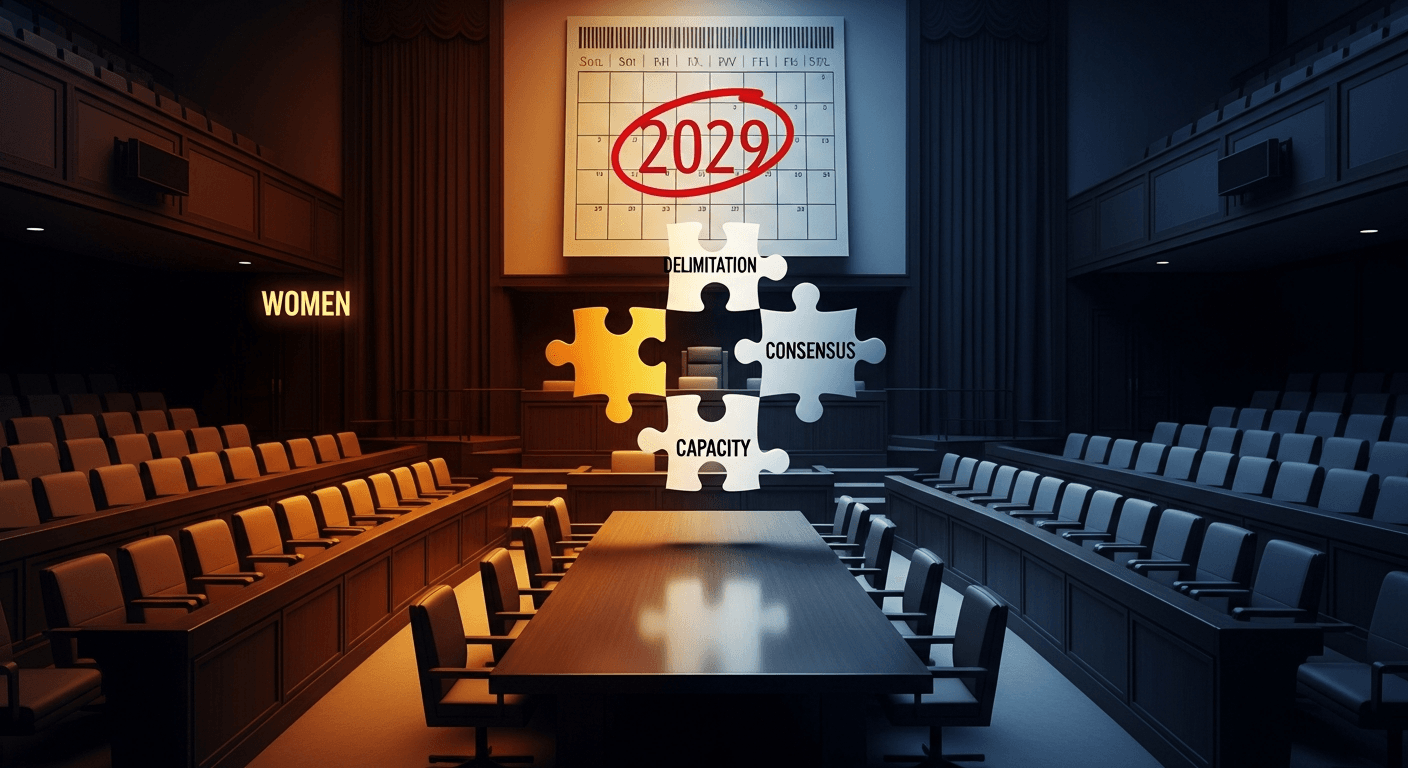
- The 2023 constitutional amendment enshrined 33% reservation for women in the Lok Sabha and state assemblies, but tied implementation to a delimitation exercise based on a future census. Under that linkage, the earliest practical implementation could slip to the mid-2030s.
- The government's current proposal would delink implementation from the later census-based delimitation and instead base necessary seat adjustments on the 2011 Census, increasing Lok Sabha strength from 543 to 816 and reserving roughly one-third (about 273 seats) for women, applied vertically including SC/ST reserved seats (New Indian Express, Apr 9, 2026; NDTV, Apr 9, 2026).
Short history and prior attempts
- The idea of reserving seats for women in legislatures has a legislative pedigree stretching back decades, with multiple private member bills and conversations in Parliament. The 2023 Nari Shakti Vandan Adhiniyam represented a rare consensus step by amending the Constitution to create the framework for 33% reservation, but practical implementation rules were left to subsequent legislation and delimitation.
- Attempts in earlier decades repeatedly stalled over technical and political issues: how to define reserved constituencies, whether reservations should be rotational, and how to reconcile reservation with existing SC/ST seat protections.
The Prime Minister's intervention: when, where and what he said
In early April the Prime Minister published an op-ed and posted messages urging immediate action and asking citizens—especially women—to write to their MPs seeking passage of the implementing amendment during a special Parliament sitting scheduled for April 16–18 (PMO India, Apr 9, 2026). The core assertion was that delaying implementation would deny women the political voice the nation has already promised, an outcome the Prime Minister described as "unfortunate" and a potential "gross injustice" if postponed (Times of India, Apr 14, 2026).
"Any further delay will be unfortunate and a gross injustice to the women of India." (PMO India, Apr 9, 2026)
Perspectives: supporters and opponents
Supporters
- Many ruling-party spokespeople and pro‑quota civil society voices see the amendment as corrective and overdue. They argue that numerical representation is a necessary step toward gender-equitable policymaking and that structural barriers — time constraints, election math, party gatekeeping — will only be addressed when women have guaranteed seats (NDTV, Apr 9, 2026).
- Women's organisations and networks that have long campaigned for political representation view legal certainty and a clear implementation timeline as essential to sustaining momentum built since the 2023 constitutional change.
Opponents and skeptics
- Several opposition parties and regional formations have pushed back, not necessarily against the principle but against the timing and method. Concerns include lack of pre-legislative consultation, suddenness of proposals during an extended Budget Session, and the technical question of delimitation and its political consequences (The Hindu, Apr 12, 2026).
- Critics also warn that rapid expansion of seats and redrawing boundaries could alter state-level power balances and invite litigation or claims of political engineering.
Potential implications if passed
Political
- Short term: a sizeable redrafting of constituencies and an increase in Lok Sabha strength could reshape party calculations, candidate selection strategies, and coalition math ahead of the 2029 general election.
- Medium term: guaranteed seats for women may accelerate recruitment of women leaders within parties, change issue agendas, and influence policy priorities.
Social and representational
- More women in legislatures could improve policy attention to health, education, child-care, gender-based violence, and social welfare issues — areas where research shows female legislators often prioritize different portfolios or perspectives.
Legislative process and timeline
- Passage requires a constitutional amendment and parliamentary consensus; if implemented via the proposed delinking and re-delimitation on the 2011 Census, the government argues the schedule could allow the 2029 polls to run with quotas in place (New Indian Express, Apr 9, 2026).
Why proponents call urgency justified — the "gross injustice" argument
- Principle of promise and delivery: The 2023 amendment signaled a national consensus. Delaying implementation undermines credibility and perpetuates the representation gap for millions of women.
- Practical opportunity cost: Each election without reservation is an election that effectively excludes a guaranteed share of women from seats they could occupy, prolonging structural exclusion.
- Momentum and morale: After years of campaigning, a visible, timely implementation sustains civic faith that democratic promises can translate into institutional change.
Counterarguments and concerns
- Reservation limits and federal balance: Critics worry about altering the size of the House and whether a permanent increase in seats is the right method. Regional parties fear shifts in representation could dilute state-specific weights.
- Merit and candidate quality: Some opponents argue reservations could be misused for tokenism or that selection pressures could favor proxies; proponents counter that structural access is a precondition for equal opportunity and that parties must invest in candidate development.
- Procedural fairness: The absence of detailed, pre-legislative consultations with opposition parties and stakeholders has fed distrust; opponents call for all-party talks and clearer technical plans for delimitation (The Hindu, Apr 12, 2026).
Possible compromises to ease passage
- Time-bound implementation: A phased rollout with clear milestones (for example, pilot implementation in a subset of states or a staged increase) might reduce political resistance.
- Independent delimitation commission: Agreeing to a transparent, time-limited independent body to redraw constituencies using published criteria could address trust deficits.
- Capacity commitments: Parties could jointly pledge funding and training for women candidates, and civil society actors could partner for leadership pipelines to reduce tokenism concerns.
- Sunset and review clauses: Embedding periodic reviews to assess social impact, seat distribution fairness, and avenues for judicial clarity could reassure skeptics.
My closing view and call to civic engagement
I have written about the need for women’s stronger voice in politics before, and I see this moment as a test of whether constitutional promises become lived reality (Hemen Parekh, MyBlogEPage, 2011/2022). I believe the principle of representation is clear: when roughly half the population lacks proportionate voice in law-making, democracy is still incomplete. That said, technical and federal concerns are real and deserve transparent answers.
If you care about this issue, engage: read the texts that Parliament will consider, ask your MP for clarity on implementation timelines, join local civic groups pushing for substantive candidate development, and demand procedural transparency about delimitation. Reform without trust will not endure; trust without clarity will not convince. The democracy we want requires both urgency and care.
Regards,
Hemen Parekh
Any questions / doubts / clarifications regarding this blog? Just ask (by typing or talking) my Virtual Avatar on the website embedded below. Then "Share" that to your friend on WhatsApp.
Get correct answer to any question asked by Shri Amitabh Bachchan on Kaun Banega Crorepati, faster than any contestant
Hello Candidates :
- For UPSC – IAS – IPS – IFS etc., exams, you must prepare to answer, essay type questions which test your General Knowledge / Sensitivity of current events
- If you have read this blog carefully , you should be able to answer the following question:
- Need help ? No problem . Following are two AI AGENTS where we have PRE-LOADED this question in their respective Question Boxes . All that you have to do is just click SUBMIT
- www.HemenParekh.ai { a SLM , powered by my own Digital Content of more than 50,000 + documents, written by me over past 60 years of my professional career }
- www.IndiaAGI.ai { a consortium of 3 LLMs which debate and deliver a CONSENSUS answer – and each gives its own answer as well ! }
- It is up to you to decide which answer is more comprehensive / nuanced ( For sheer amazement, click both SUBMIT buttons quickly, one after another ) Then share any answer with yourself / your friends ( using WhatsApp / Email ). Nothing stops you from submitting ( just copy / paste from your resource ), all those questions from last year’s UPSC exam paper as well !
- May be there are other online resources which too provide you answers to UPSC “ General Knowledge “ questions but only I provide you in 26 languages !


No comments:
Post a Comment