
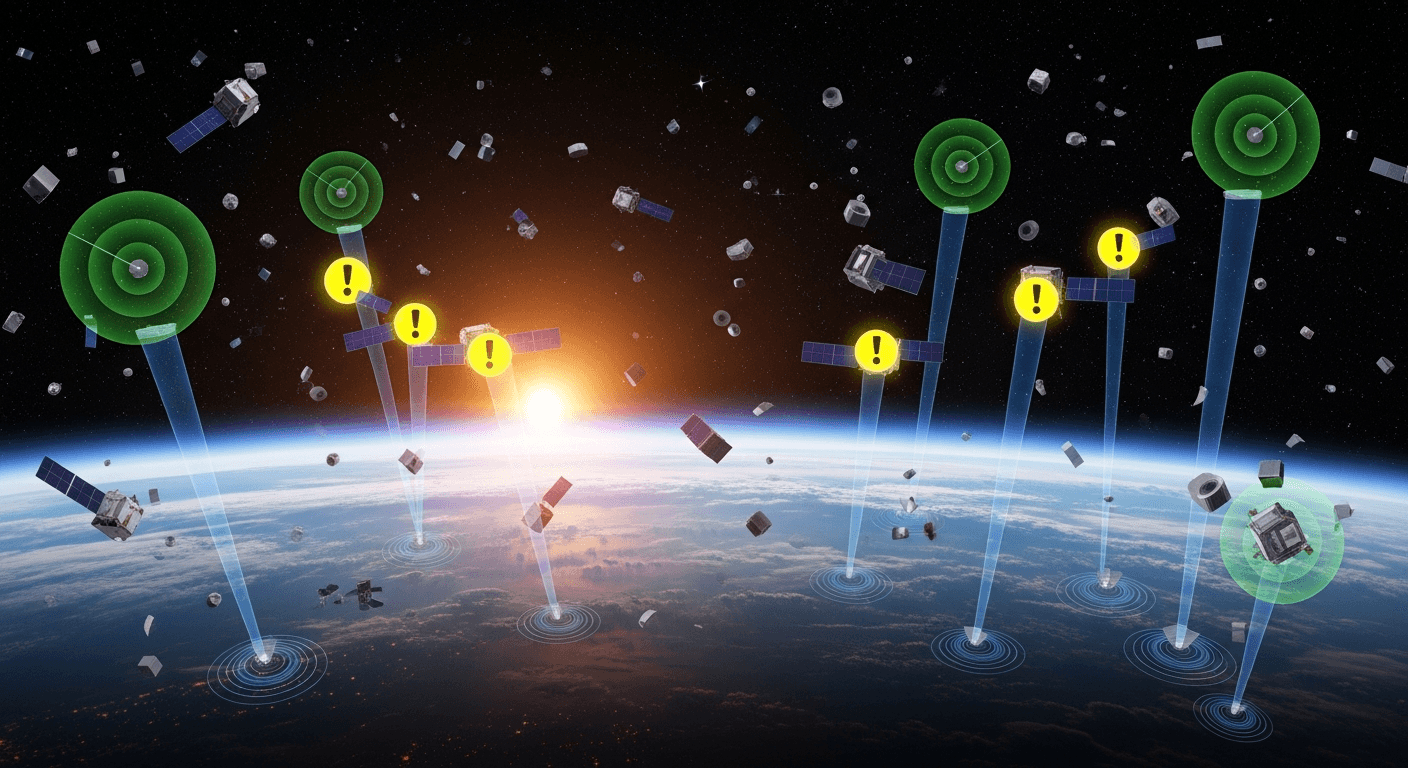
Opening: a sky that feels smaller
Last year I found myself staring at a graph of near‑miss alerts and thinking: we are treating low Earth orbit like a busy roundabout with no traffic lights. The headline figure — about 1.5 lakh (150,000) collision or conjunction alerts issued for Indian satellites in 2025 — jolted me the same way. It’s not a doomsday number so much as a practical alarm: our orbital neighbourhood is busier, messier and harder to manage than most of us realise.
In this piece I want to explain what those alerts mean, why the count spiked, what satellite operators and services face, and what this all means for you and me.
What is a conjunction / collision alert?
A conjunction alert (sometimes called a close‑approach alert) is a warning that two objects in orbit — an operational satellite, a spent rocket body, or a fragment of debris — may pass very close to one another. Think of it like an ATC warning in the sky: the prediction says “there is a risk, please check and respond.”
Key details in an alert:
- predicted closest approach distance (often measured in metres to kilometres)
- time of closest approach (UTC)
- probability estimate of collision (from vanishingly small to alarmingly high)
- confidence level, based on tracking quality
Not every alert becomes a manoeuvre. Most are triaged by analysts who refine orbits using better data, and a small fraction require a collision avoidance manoeuvre (CAM).
Why 1.5 lakh alerts for Indian satellites in 2025?
Several forces combined to produce that large number. They are not mutually exclusive — they amplifed each other.
Launch surge: 2025 was a banner year for launches globally. Hundreds of rideshare missions and constellation deployments placed thousands of objects into LEO in short windows, creating dense clusters of satellites and shorter reaction times.
Crowded LEO and clustered deployments: Constellations are often deployed in batches of dozens or hundreds. When dozens of satellites are injected into similar planes and altitudes, screening systems generate many more potential close approaches.
Growing debris population: Legacy debris — from fragmentation events, old rocket stages, and mission leftovers — remains in the same orbital bands satellites use. Even tiny fragments can trigger alerts because relative speeds are very high.
Better sensors and alerting: Tracking networks and conjunction‑assessment tools are improving. That means more potential conjunctions are detected and reported. In other words, some of the increase is good: we’re seeing risks we might once have missed.
International alerting protocols: Many alerts came from multinational tracking centres such as the Combined Space Operations Center (CSpOC) under USSPACECOM. Operators who subscribe to these services receive high volumes of automated warnings.
Put together, these causes turned a manageable trickle of alerts into a steady stream — and for large operators and national agencies the numbers add up quickly.
Implications for satellite operators and services
Operators now face both technical and operational pressures:
Increased monitoring load: Flight dynamics teams must review far more conjunctions, often within tight time windows.
Fuel and lifetime tradeoffs: Each evasive CAM burns propellant. Frequent manoeuvres reduce a satellite’s operational lifetime or force earlier decommissioning.
Complexity of planning: Maneuvers must avoid creating new conjunction risks (post‑burn close approaches), so operators revise manoeuvre plans more often.
Service continuity risk: Critical services — Earth observation passes, communications handovers, timing signals — can be disrupted when satellites alter orbits.
Real examples from 2025/2026 saw dozens of revised manoeuvre plans and a small number of executed CAMs; operators increasingly folded risk mitigation into routine orbit maintenance to save fuel and avoid service interruptions.
Mitigation strategies (what operators can do)
Short and medium term:
Collision avoidance manoeuvres: Intentional, calculated burns to shift a satellite’s orbit by tens to hundreds of metres.
Improved conjunction assessment: Use operational ephemerides (precise orbit data) and larger screening volumes to reduce false alarms.
Traffic coordination: Share planned manoeuvres in advance with other operators to avoid post‑burn collisions.
Longer term and design choices:
Satellites designed with more propellant margin and more efficient propulsion (e.g., electric thrust) to sustain multiple CAMs.
Passive safety features: de‑orbit sails, drag augmentation devices, and standardised disposal orbits at end of life.
Hardened, redundant service architectures: using distributed constellations so loss or temporary repositioning of a single satellite doesn’t cause service failure.
Policy and international coordination
This problem cannot be solved by one agency. It needs norms, transparency and shared infrastructure:
Mandatory post‑mission disposal standards and debris mitigation rules.
Timely sharing of manoeuvre intent and ephemerides across operators and national agencies.
A neutral or multinational traffic‑management forum and standardised communications protocols to avoid ambiguity.
Investment in global space‑traffic‑management (STM) capabilities: more radars, more optical telescopes, and better data fusion.
I’ve written before about the need to think of space infrastructure the way we think of transport systems on Earth — with rules, enforcement and public goods — and the recent alert volumes only underline that point ISRO NavIC - India Transport Revolution.
What this means for everyday users
Most people will not notice alerts directly — they don’t show up on your phone as a warning. But the effects are real:
Slightly higher risk of service outages: Earth observation images, satellite internet, weather data and navigation corrections could see brief interruptions if a satellite has to manoeuvre.
Higher costs over time: Operators facing more manoeuvres and shorter lifetimes may pass on costs, which can translate into higher prices for satellite internet, imagery or downstream services.
Improved safety and resilience: On the bright side, more rigorous tracking and coordination means fewer catastrophic collisions and less chance of cascading debris (a Kessler‑type cascade) that would be bad for everyone.
My closing thought
Space used to feel like a boundless ocean. Today it feels more like a city seen from above at rush hour — beautiful, useful, and increasingly in need of governance. The 1.5 lakh alerts for Indian satellites in 2025 are a practical alarm bell: we can build safer skies, but it will take better tracking, smarter design, international cooperation and, crucially, the political will to treat orbital traffic as a shared resource.
I’ve argued before that technology without coordination creates fragility. The coming decade will test whether our institutions can match the pace of launches and keep the orbital commons open for innovation.
Regards,
Hemen Parekh
Any questions / doubts / clarifications regarding this blog? Just ask (by typing or talking) my Virtual Avatar on the website embedded below. Then "Share" that to your friend on WhatsApp.
Get correct answer to any question asked by Shri Amitabh Bachchan on Kaun Banega Crorepati, faster than any contestant
Hello Candidates :
- For UPSC – IAS – IPS – IFS etc., exams, you must prepare to answer, essay type questions which test your General Knowledge / Sensitivity of current events
- If you have read this blog carefully , you should be able to answer the following question:
- Need help ? No problem . Following are two AI AGENTS where we have PRE-LOADED this question in their respective Question Boxes . All that you have to do is just click SUBMIT
- www.HemenParekh.ai { a SLM , powered by my own Digital Content of more than 50,000 + documents, written by me over past 60 years of my professional career }
- www.IndiaAGI.ai { a consortium of 3 LLMs which debate and deliver a CONSENSUS answer – and each gives its own answer as well ! }
- It is up to you to decide which answer is more comprehensive / nuanced ( For sheer amazement, click both SUBMIT buttons quickly, one after another ) Then share any answer with yourself / your friends ( using WhatsApp / Email ). Nothing stops you from submitting ( just copy / paste from your resource ), all those questions from last year’s UPSC exam paper as well !
- May be there are other online resources which too provide you answers to UPSC “ General Knowledge “ questions but only I provide you in 26 languages !




No comments:
Post a Comment