
India’s big nuclear leap: Stage 2 criticality and energy security
I write as someone who has followed India’s long nuclear journey for decades. When the Prototype Fast Breeder Reactor (PFBR) at Kalpakkam attained first criticality on 6 April 2026, I felt a familiar mix of pride and urgency. That controlled, self-sustaining chain reaction is not just a technical milestone — it is the opening of a new chapter in India’s three-stage plan to secure fuel sustainability, exploit our vast thorium, and strengthen long-term energy and climate resilience [1].
What does “Stage 2 criticality” mean?
- Criticality: the moment a reactor core sustains a controlled chain reaction — neutrons produced = neutrons lost — enabling the unit to be tested and progressively ramped toward power generation [1].
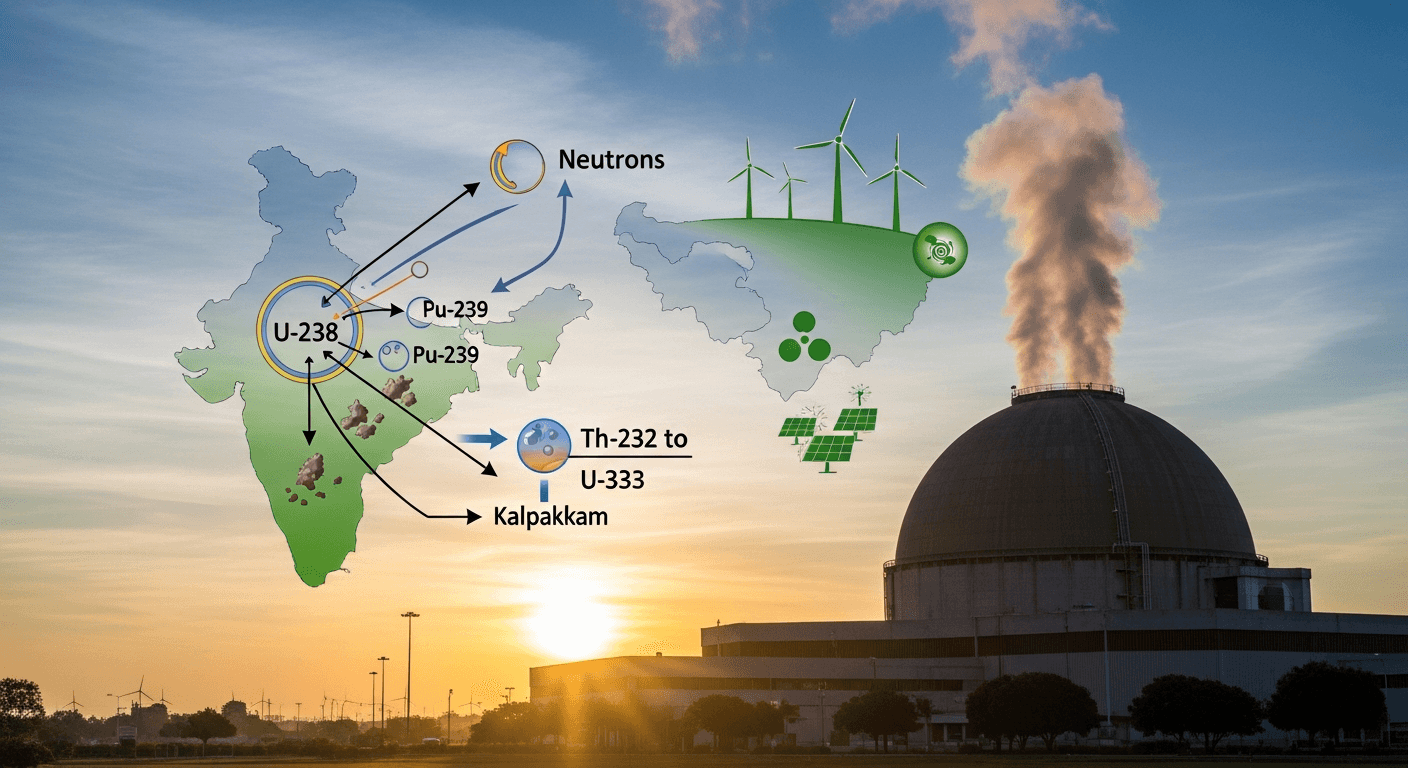
- Stage 2 (fast breeder) specifics: a fast breeder reactor (FBR) uses a fast neutron spectrum and typically a liquid‑metal coolant (PFBR uses sodium) to fission plutonium-bearing fuel while converting abundant fertile isotopes (U-238, and later thorium in blankets) into new fissile material. In short: it can produce more fissile atoms than it consumes — it “breeds” fuel [3].
That breeding function is the strategic value: instead of depending solely on limited domestic uranium or imports, fast breeders multiply the usable energy extracted from the material we already have and create the fissile feedstock needed for large-scale thorium use in Stage 3 [3].
A quick refresher: India’s three-stage programme
- Stage 1 — PHWRs using natural uranium to generate power and produce plutonium as a by‑product (already well established).
- Stage 2 — Fast breeder reactors using plutonium-based fuel to breed more plutonium (and, with thorium blankets, to produce U-233) — PFBR is the prototype for this stage [3].
- Stage 3 — Thorium-based reactors (thermal breeders / AHWR-style concepts) that use U-233 bred in Stage 2 to run largely on thorium, India’s abundant resource [3][6].
The PFBR’s criticality signals India’s practical entry into Stage 2 — the bridge between our current fleet and a thorium‑anchored future [1][3].
Why this matters for fuel sustainability and climate goals
- Resource leverage: India has modest uranium but very large thorium reserves. Fast breeders can convert U-238 to Pu-239 and, via thorium blankets, Th-232 to U-233 — creating the fissile inventory that enables widespread thorium use later [3][6].
- Long-term low-carbon baseload: a successful breeding programme expands the realistic scale of nuclear power, giving policymakers a dispatchable, low‑carbon complement to renewables as India pursues climate targets [1][7].
- Waste and actinide management: fast reactors can also be configured to transmute long‑lived actinides, reducing long‑term radiotoxicity of waste streams compared with once‑through cycles [4].
Recent milestones and timelines
- Core loading and preparatory steps began in 2024; AERB approvals and low‑power testing preceded full-power ramping [2].
- First criticality (PFBR, Kalpakkam): 6 April 2026 — the start of low‑power physics experiments and staged power increase under regulatory oversight [1][2].
- The PFBR is a 500 MWe sodium‑cooled, MOX‑fuelled prototype; its experience will inform follow‑on commercial fast reactors and the path to thorium deployment in the AHWR and beyond [1][3][6].
Timelines remain multi‑decadal for full thorium deployment: even optimistic projections place large‑scale Stage 3 rollout decades after reliable fast breeder operation and sufficient fissile inventory buildup [3][6].
Practical challenges we must confront
- Technical: sodium coolant brings excellent heat-transfer and near‑atmospheric operation advantages but is chemically reactive with air and water (sodium fires, sodium–water reactions), and fast‑spectrum cores present unique neutronics and materials stresses (sodium‑void effects, high fluence effects on structural materials) [4].
- Financial and schedule risk: PFBR experienced long delays and cost escalation during commissioning — realistic budgeting and staged financing are essential for wider deployment [2].
- Regulatory and safety: fast reactors require robust, transparent regulatory frameworks and site‑specific safety cases; India’s regulator has been updating SFR guidance in recent years to address these unique hazards [5].
- Fuel cycle and waste: a closed fuel cycle needs industrial‑scale reprocessing and secure management of separated plutonium; handling, safeguards, and public confidence are non‑trivial [4].
- Public acceptance and workforce: transparent engagement, training of specialists, and clear emergency planning are needed as the technology scales.
Policy recommendations (my practical prescription)
- Continue steady, well‑funded commissioning and staged power‑ascension for PFBR with full regulatory transparency — publish test milestones and safety outcomes.
- Fund distributed R&D on materials, under‑sodium inspection technologies, and sodium‑fire mitigation to reduce operational risk and lower insurance/financing premiums.
- Scale reprocessing and fuel‑fabrication capacity with strict safeguards and international best practices; link fuel‑cycle investments to clear timelines for subsequent commercial fast reactors.
- Fast‑track AHWR demonstration and parallel thorium R&D (molten‑salt and accelerator‑driven systems as complementary paths) to diversify pathways to thorium use [6].
- Create financing instruments (public‑private risk sharing, green‑bonds for low‑carbon baseload) and policy certainty for multi‑decadal investments.
- Integrate nuclear roadmaps with national climate planning: model scenarios where breeders unlock large‑scale low‑carbon power that complements variable renewables.
- Prioritize public engagement and workforce development so communities, industries, and regulators grow together with the technology.
A personal closing: why urgency and patience must coexist
Stage 2 criticality at Kalpakkam is momentous. It validates decades of R&D and opens a tangible route toward fuel self‑sufficiency and a thorium‑rich future. But breeding a national energy transition takes technical care, sustained funding, regulatory maturity, and public trust. We must be optimistic — and exacting.
If we get this right, PFBR and its successors can convert India’s resource profile into energy independence and low‑carbon resilience for generations to come. That is why I call on policymakers, industry leaders, scientists, financiers, and civil society to treat this moment not as a finish line but as the start of coordinated delivery.
Regards,
Hemen Parekh
Any questions / doubts / clarifications regarding this blog? Just ask (by typing or talking) my Virtual Avatar on the website embedded below. Then "Share" that to your friend on WhatsApp.
References: major factual sources used in this post: PFBR criticality and project milestones [1]; project timeline, cost and commissioning context [2]; India’s three‑stage programme, thorium and AHWR context [3][6]; fast reactor safety and sodium‑coolant challenges [4]; AERB regulatory updates for SFRs [5]; implications for scale and climate [7].
(Bracketed numbers point to the major publicly available reports and press releases corresponding to these topics.)
Get correct answer to any question asked by Shri Amitabh Bachchan on Kaun Banega Crorepati, faster than any contestant
Hello Candidates :
- For UPSC – IAS – IPS – IFS etc., exams, you must prepare to answer, essay type questions which test your General Knowledge / Sensitivity of current events
- If you have read this blog carefully , you should be able to answer the following question:
- Need help ? No problem . Following are two AI AGENTS where we have PRE-LOADED this question in their respective Question Boxes . All that you have to do is just click SUBMIT
- www.HemenParekh.ai { a SLM , powered by my own Digital Content of more than 50,000 + documents, written by me over past 60 years of my professional career }
- www.IndiaAGI.ai { a consortium of 3 LLMs which debate and deliver a CONSENSUS answer – and each gives its own answer as well ! }
- It is up to you to decide which answer is more comprehensive / nuanced ( For sheer amazement, click both SUBMIT buttons quickly, one after another ) Then share any answer with yourself / your friends ( using WhatsApp / Email ). Nothing stops you from submitting ( just copy / paste from your resource ), all those questions from last year’s UPSC exam paper as well !
- May be there are other online resources which too provide you answers to UPSC “ General Knowledge “ questions but only I provide you in 26 languages !


No comments:
Post a Comment