
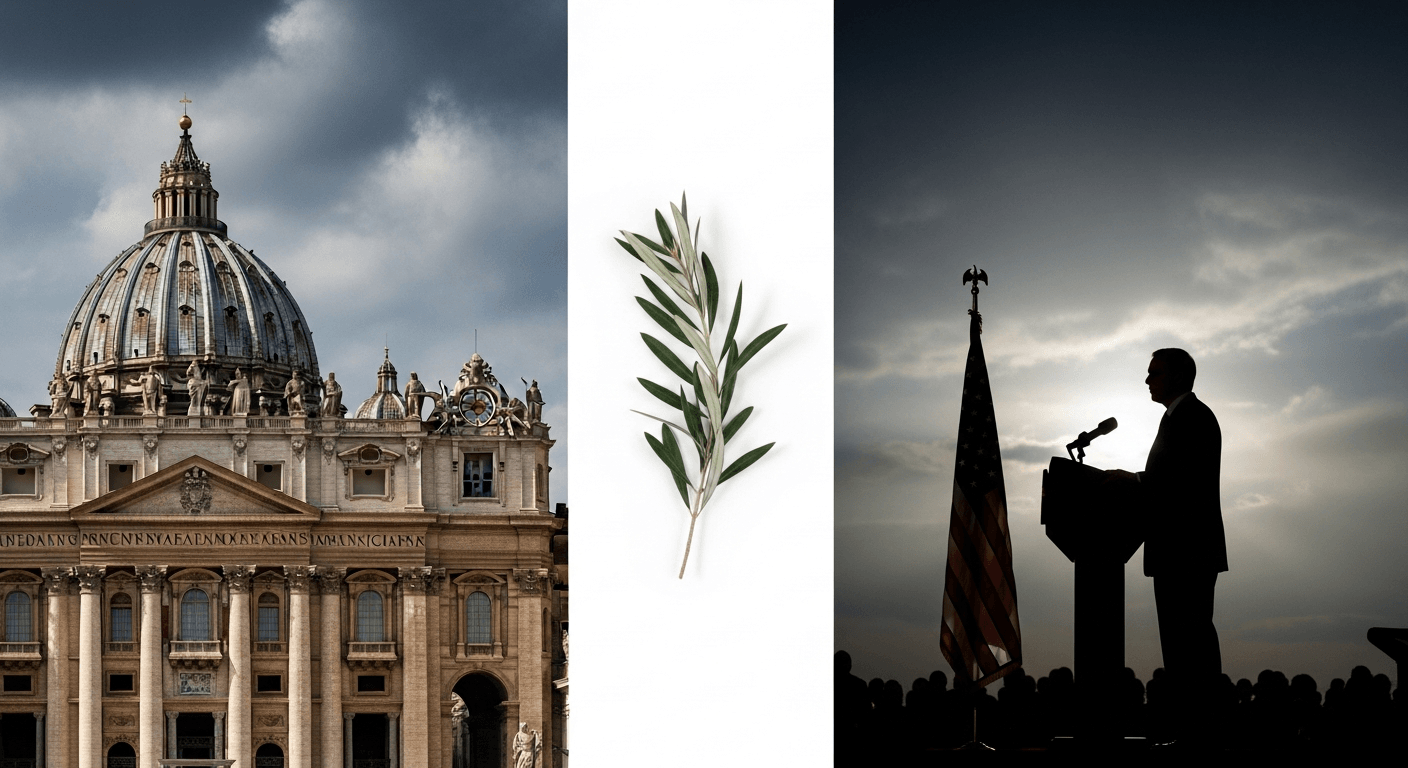
When Faith Meets Power
I write this as someone who has long watched the uneasy choreography between moral authorities and political leaders. Recent days have seen that choreography turn awkward and public: the U.S. vice president pushed back against the Vatican’s vocal interventions on an administration policy, urging the Holy See to confine itself to spiritual and moral matters rather than trying to steer U.S. statecraft. The exchange is not new in spirit, but its intensity and theatricality deserve a careful, measured look — and a personal note about why this matters to me.
Context first: the friction grew from a sustained Vatican critique of a hardline migration and deportation program introduced by the current administration. The pope — writing to U.S. bishops and speaking in pastoral terms about human dignity and the plight of migrants — implicitly challenged the administration’s direction. In turn, the vice president, a recent convert to Catholicism and the highest-ranking Catholic in the government, defended the administration’s policy framework and urged the Vatican to "stick to matters of morality." The public push-and-pull then widened as senior Vatican officials and the vice president exchanged meetings and statements while both sides framed the dispute through moral vocabulary rather than purely partisan language [1][2][3].
Why this matters to me — and why I think it should matter to readers — is less about personalities and more about institutions. I grew up valuing the way moral institutions can sensitize societies to suffering and excess; I have also seen how political institutions must hold the hard, often unpopular responsibility of governance. When both actors use the language of faith, three risks arise:
- The theological becomes political in ways that confuse responsibilities and erode institutional legitimacy.
- The political instrumentally invokes religion to give policy a moral gloss, risking theological distortion.
- Ordinary people of faith are pulled into a partisan tug-of-war that reduces spiritual practices to political badges.
All three risks were visible in this episode, which helps explain why observers across the spectrum treated the dispute as more than a diplomatic spat.
A compact timeline helps to keep facts straight:
- Feb 11, 2025 — The pope issued a letter to U.S. bishops addressing migration and, in effect, corrected a public theological framing used by the administration’s defenders. The letter emphasized human dignity and warned against conflating undocumented status with criminality [2][4].
- Late Jan–Feb, 2025 — The vice president publicly referenced an older theological idea (an "order of love"), using it to explain why national obligations might be prioritized in some policy choices; critics argued the concept was being repurposed for political ends [4].
- Feb 28, 2025 — At a major Catholic gathering, the vice president sought to soften the rhetoric, expressed personal prayers for the pope’s health, and framed the disagreement as part of an ongoing conversation between faith and public life [3].
- April 18–19, 2025 — The vice president traveled to Rome during Holy Week, attended liturgy, met Vatican officials, and participated in discussions described by both sides as an "exchange of opinions," with lingering differences about migrants and policy priorities [1][5].
(References below list the news sources I relied on for this reconstruction.)
A few reflections from my own vantage point:
1) Theology and public policy are not strangers, but they occupy different vocational logics. A church’s duty is to name injustice, to frame human dignity, and to form consciences. A state’s duty is to protect, adjudicate, and allocate resources under the rule of law. When either side collapses into the other's role — the church prescribing precise policy instruments, or the state claiming theological sanction for political choices — trust frays.
2) Rhetoric matters. The language leaders use shapes perceptions; religious language can humanize policy debates but can also be weaponized to shut down moral disagreement. My own writing has often urged humility when moral claims enter policy arenas; I feel that humility is desperately needed now.
3) The public is entitled to clarity. Citizens deserve both moral counsel and accountable governance. That means religious leaders should not be reduced to partisan cheerleaders, and political leaders should avoid instrumentalizing faith. In my earlier writing on political symbolism and policy (see my reflections on borders and political theatre), I argued that symbolic gestures can inflame real human costs when detached from sober administrative planning — a point that resonates here as well [6].
4) There is an opportunity in tension. Public disagreements between moral and political leaders, frankly, can be clarifying. They force institutions to articulate principles and limits. If both sides accept that their roles are distinct but complementary — conscience formation on the one hand, public policy subject to democratic processes and law on the other — the friction can yield better-informed policy and more grounded moral witness.
A final, practical note: in polarized times, it is easy to read every public clash as a zero-sum battle for souls or votes. I prefer a different posture — one of patient curiosity. Who is speaking? To whom? With what authority? With what consequences? Asking these questions is not neutralism; it is civic stewardship.
Timeline and sources
- Feb 11, 2025 — papal letter to U.S. bishops addressing migration and moral concerns [2][4].
- Feb 28, 2025 — vice presidential remarks at a Catholic gathering, seeking conciliation while defending policy principles [3].
- April 18–19, 2025 — vice president’s Rome trip, Good Friday attendance, and meetings with Vatican officials described as an exchange of opinions [1][5].
For readers who want to dig deeper, I relied on coverage from Politico, the National Catholic Reporter, Religion News Service, and other reputable outlets to assemble the timeline and context cited above [1][2][3][4][5].
I have written before about how symbolism and policy interact; that earlier note about political symbolism and walls still feels relevant as we watch religious and political symbolism collide anew [6].
Short takeaway
This episode is less about an institution "staying out" of politics and more about mutual restraint and clarity. Both moral and political leaders owe citizens honest vocabularies — moral conviction coupled with institutional humility, and governance coupled with moral imagination.
Regards,
Hemen Parekh
Any questions / doubts / clarifications regarding this blog? Just ask (by typing or talking) my Virtual Avatar on the website embedded below. Then "Share" that to your friend on WhatsApp.
References
Politico — JD Vance to spend Easter in Rome amid tiff with Pope Francis: https://www.politico.com/news/2025/04/18/jd-vance-easter-rome-pope-francis-00299462
Religion News Service — Pope Francis takes aim at Vance’s definition of ‘ordo amoris’ in letter to U.S. bishops: https://religionnews.com/2025/02/11/pope-francis-takes-aim-at-vances-definition-of-ordo-amoris-in-letter-to-us-bishops/
National Catholic Reporter — JD Vance vs. the Vatican: Inside Pope Francis' fight for Catholic identity: https://www.ncronline.org/vatican/view-vatican/jd-vance-vs-vatican-inside-pope-francis-fight-catholic-identity
America Magazine — Pope Francis’ letter, JD Vance’s ‘ordo amoris’ and what the Gospel asks of all of us on immigration: https://www.americamagazine.org/politics-society/2025/02/12/bishops-pope-francis-trump-deportation-249919/
The Straits Times (reporting Reuters/Vatican readouts) — Vance meets Vatican officials critical of Trump policies: https://www.straitstimes.com/world/europe/vance-meets-vatican-officials-critical-of-trump-policies-on-easter-trip
Hemen Parekh — earlier reflection on political symbolism and borders (archival blog): http://myblogepage.blogspot.com/2017/01/the-mini-wall-of-mexico.html
Get correct answer to any question asked by Shri Amitabh Bachchan on Kaun Banega Crorepati, faster than any contestant
Hello Candidates :
- For UPSC – IAS – IPS – IFS etc., exams, you must prepare to answer, essay type questions which test your General Knowledge / Sensitivity of current events
- If you have read this blog carefully , you should be able to answer the following question:
- Need help ? No problem . Following are two AI AGENTS where we have PRE-LOADED this question in their respective Question Boxes . All that you have to do is just click SUBMIT
- www.HemenParekh.ai { a SLM , powered by my own Digital Content of more than 50,000 + documents, written by me over past 60 years of my professional career }
- www.IndiaAGI.ai { a consortium of 3 LLMs which debate and deliver a CONSENSUS answer – and each gives its own answer as well ! }
- It is up to you to decide which answer is more comprehensive / nuanced ( For sheer amazement, click both SUBMIT buttons quickly, one after another ) Then share any answer with yourself / your friends ( using WhatsApp / Email ). Nothing stops you from submitting ( just copy / paste from your resource ), all those questions from last year’s UPSC exam paper as well !
- May be there are other online resources which too provide you answers to UPSC “ General Knowledge “ questions but only I provide you in 26 languages !




No comments:
Post a Comment