
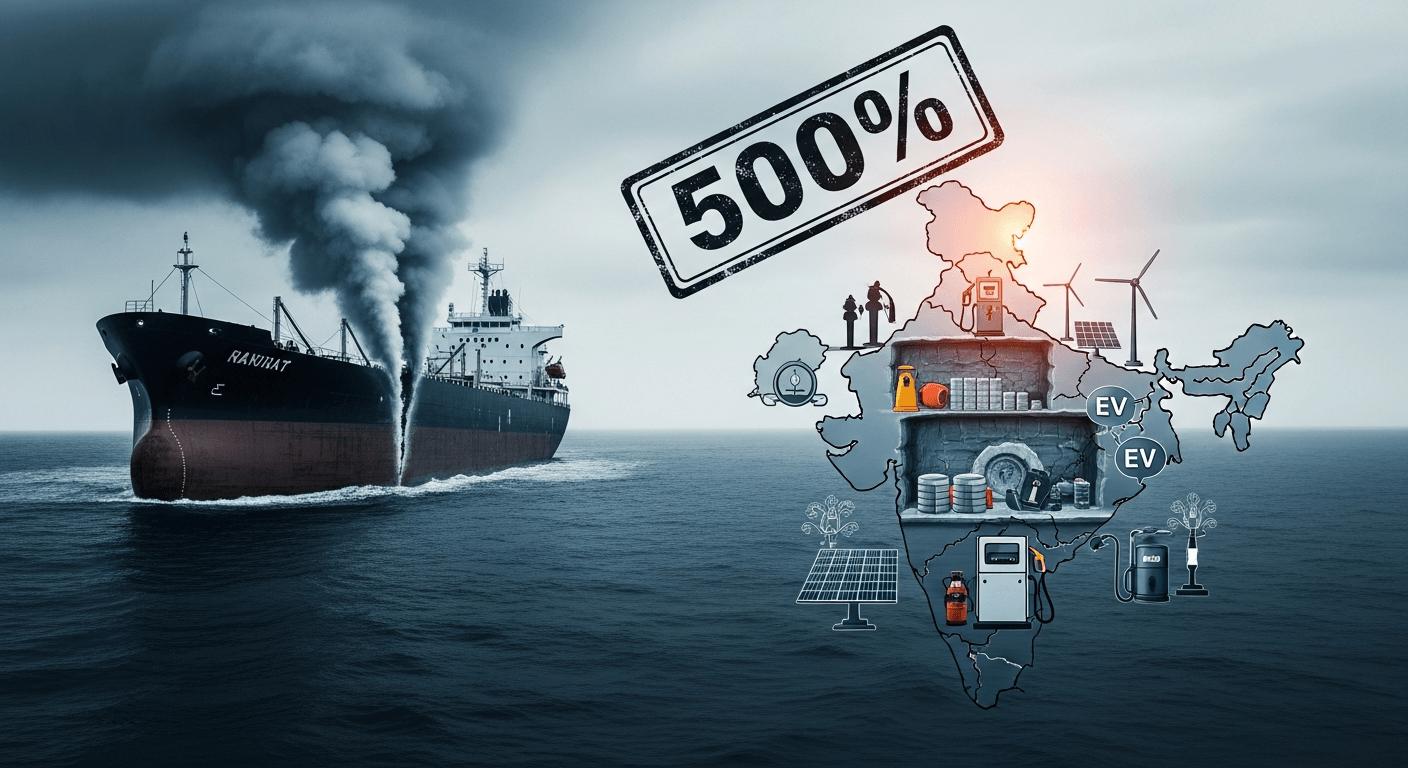
Executive summary
- A hypothetical U.S. 500% tariff on crude imports—combined with an immediate market shock—would create acute volatility and a sharp, rapid increase in global oil prices. For India, which imports roughly 80–90% of its crude needs, the shock would translate into a large fiscal and inflationary challenge and renewed strategic vulnerability.
- Short-term actions should prioritize emergency use of strategic reserves, targeted fiscal support for the poorest households, rapid renegotiation of term supplies and swaps, and tactical hedging. Medium-to-long-term responses require supplier diversification, storage and refining flexibility, bilateral energy diplomacy, accelerated renewables, and demand-side measures.
- A calibrated mix of market, fiscal and diplomatic steps can blunt the immediate pain and reduce structural exposure over 2–5 years. Delay will amplify macro, fiscal and social costs.
Background: the policy move and immediate shock
Imagine a sudden unilateral U.S. policy: a 500% tariff on crude imports into the United States. The stated aim is to prioritize domestic producers and reduce strategic dependence—implemented without an accompanying global coordination mechanism. Even if the tariff is aimed at changing U.S. import patterns, the immediate market reaction would be global:
- Price expectations would spike as traders anticipate supply re-routing, retaliatory trade measures, and a breakdown of established term flows. In a plausible scenario Brent could double within weeks (e.g., from $70 to $140/bbl) before severe volatility stabilizes—depending on producer responses and shipment reallocation.
- Physical logistics would be disrupted. Crude cargoes intended for the U.S. would be re-directed, forcing sellers, refiners and shipping markets to re-optimize fast, creating temporary mismatches and refinery throughput disruptions.
- Geopolitics would quickly complicate markets: major producers could coordinate cuts to defend prices, or export growth to non-U.S. markets could push prices down regionally; sanctions or counter-tariffs could further restrict flows.
(See analytic frameworks from IEA and OPEC on price formation and disruption dynamics for reference.)
Immediate impacts on global oil markets
- Price volatility and a steep initial spike: sharp risk premia reflecting policy uncertainty and logistics friction.
- Term-contract disruptions: refiners and national oil companies with tight sour/light crude matching will face feedstock shortfalls or forced substitutions, raising refining margins for flexible refineries and hurting others.
- Shipping and insurance: re-routing increases freight costs (VLCC/ Suezmax rates) and can raise insurance premiums, especially for cargoes traversing geopolitically sensitive chokepoints.
- Hedging and credit stress: corporates with open positions could face margin calls; sovereigns that rely on oil revenues may accelerate policy responses.
India's current oil import profile (estimates and exposure)
- Consumption and imports (estimate): India’s crude oil consumption is roughly 4.5–5.0 million barrels per day (mbpd); imports supply ~80–90% of total crude needs (Ministry of Petroleum & Natural Gas and IEA historical profiles).
- Major suppliers (roughly illustrative): Middle East (Saudi Arabia, Iraq, UAE, Kuwait) historically ~55–65% of crude imports; Russia 8–15% (growing share through recent years); Africa and Americas combined ~10–20%.
- Strategic reserves: India maintains strategic petroleum reserves (underground caverns) and commercial stocks. Current combined reserves provide a limited multi-week buffer; expanding to larger day-coverage would increase resilience (IEA, MoPNG analyses).
Short-term risks for India
1) Price shock and import bill
- Simple stress test: on ~4.5 mbpd of imports, a sustained $50/bbl rise implies an extra import bill of ~USD 82 billion/year (4.5 mbpd × 365 × $50 ≈ $82.1bn) — a major external financing and fiscal pressure.
2) Fiscal and subsidy stress
- If the government cushions pump prices via subsidies (or caps taxes), the fiscal cost will escalate. Targeted fiscal support will be necessary to protect the poorest from transport and cooking-fuel inflation.
3) Inflation and growth
- Fuel is a direct contributor to headline inflation and a large indirect contributor via transport and food costs. A crude-price spike could add several percentage points to CPI inflation in the near term and weigh on growth.
4) Supply disruptions and logistics
- Rapid re-routing of cargoes could create temporal mismatches at refineries, increasing the risk of fuel shortages in key regions, especially if shipping/insurance costs rise or if producers prioritize long-term partners.
Medium-to-long-term strategies India can pursue
1) Diversify suppliers and contractual structures
- Move from spot-heavy purchases toward longer-term term contracts and equity stakes in upstream projects. Build flexible clauses to allow swaps and re-routing.
2) Expand strategic petroleum reserves (SPR) and commercial storage
- Target increasing coverage from current levels toward a policy goal (e.g., 90–120 days of net imports including commercial stocks). More cavern and tank capacity reduces short-term vulnerability.
3) Increase refining flexibility and hinterland infrastructure
- Invest in refinery upgrades to process a wider range of crudes (heavy vs light) and increase secondary processing to reduce feedstock sensitivity. Increase inland tankage and pipeline interconnectivity.
4) Energy diplomacy and trade instruments
- Deepen long-term supply agreements with a range of producers (GCC, Russia, Africa, Americas) and pursue price-stabilizing swap arrangements with friendly partners. Use trade diplomacy to avoid being squeezed by great-power trade dynamics (U.S.-China tensions).
5) Accelerate renewables, biofuels and electrification
- Faster EV adoption, higher ethanol-blending mandates, and industrial energy efficiency reduce crude demand elasticity over time and lower vulnerability.
Policy recommendations for Indian government and industry (practical steps and timeline)
Immediate (0–6 months)
- Release emergency volumes from SPR to calm markets and free crude acquisition time.
- Implement targeted subsidies/transfers to vulnerable households rather than across-the-board fuel price controls.
- Prioritize fuel supply to essential sectors (power, agriculture, public transport) through allocation and swaps.
- Deploy hedging selectively for critical import volumes.
Near-term (6–24 months)
- Negotiate term contracts and crude-swaps with a diversified supplier set; secure minimum offtake deals to avoid spot disruptions.
- Fast-track capacity additions for storage (public-private partnerships) and small refinery upgrades to increase feedstock flexibility.
- Develop an inter-ministerial energy security task force to coordinate fiscal, trade, and diplomatic actions.
Medium/Long-term (2–5 years)
- Invest in SPR expansion to achieve robust day-coverage targets and improve monitoring of commercial stocks.
- Accelerate EV infrastructure, public transport electrification, and biofuel programs (ethanol blending targets) to reduce crude intensity.
- Encourage upstream investments abroad by Indian firms to secure equity crude and alignment with supplier governments.
Geopolitical implications
- Middle East: Producers will seek buyers; India’s historical reliance on Gulf supplies means diplomatic balance must be recalibrated to lock term supplies while avoiding entanglement in producer rivalries.
- Russia: Greater sourcing from Russia can provide short-term relief but risks secondary sanctions or geopolitical dependence; contractual clarity is key.
- U.S.–China dynamics: Any U.S. trade shock can be part of larger geopolitical signals. India must avoid being collateral damage by diversifying trade and hedging diplomatic positions.
Conclusion
A sudden, large unilateral tariff shock in a major market would test India’s oil security. The immediate priority is crisis management—SPR releases, targeted fiscal support, swaps, and tactical hedging—while the medium-to-long-term agenda is structural: diversify supplies, expand storage and refining flexibility, and accelerate demand reduction via renewables and efficiency. These measures reduce exposure and buy India time to manage macro and social costs without jeopardizing growth.
Suggested further reading/resources
- IEA — Oil Market Reports and World Energy Outlook (https://www.iea.org)
- OPEC — Monthly Oil Market Report (https://www.opec.org)
- Ministry of Petroleum & Natural Gas (MoPNG), Government of India — reports and statistics (https://mopng.gov.in)
- Petroleum Planning & Analysis Cell (PPAC) — India oil statistics
Regards,
Hemen Parekh
Any questions / doubts / clarifications regarding this blog? Just ask (by typing or talking) my Virtual Avatar on the website embedded below. Then "Share" that to your friend on WhatsApp.
Get correct answer to any question asked by Shri Amitabh Bachchan on Kaun Banega Crorepati, faster than any contestant
Hello Candidates :
- For UPSC – IAS – IPS – IFS etc., exams, you must prepare to answer, essay type questions which test your General Knowledge / Sensitivity of current events
- If you have read this blog carefully , you should be able to answer the following question:
- Need help ? No problem . Following are two AI AGENTS where we have PRE-LOADED this question in their respective Question Boxes . All that you have to do is just click SUBMIT
- www.HemenParekh.ai { a SLM , powered by my own Digital Content of more than 50,000 + documents, written by me over past 60 years of my professional career }
- www.IndiaAGI.ai { a consortium of 3 LLMs which debate and deliver a CONSENSUS answer – and each gives its own answer as well ! }
- It is up to you to decide which answer is more comprehensive / nuanced ( For sheer amazement, click both SUBMIT buttons quickly, one after another ) Then share any answer with yourself / your friends ( using WhatsApp / Email ). Nothing stops you from submitting ( just copy / paste from your resource ), all those questions from last year’s UPSC exam paper as well !
- May be there are other online resources which too provide you answers to UPSC “ General Knowledge “ questions but only I provide you in 26 languages !



No comments:
Post a Comment