
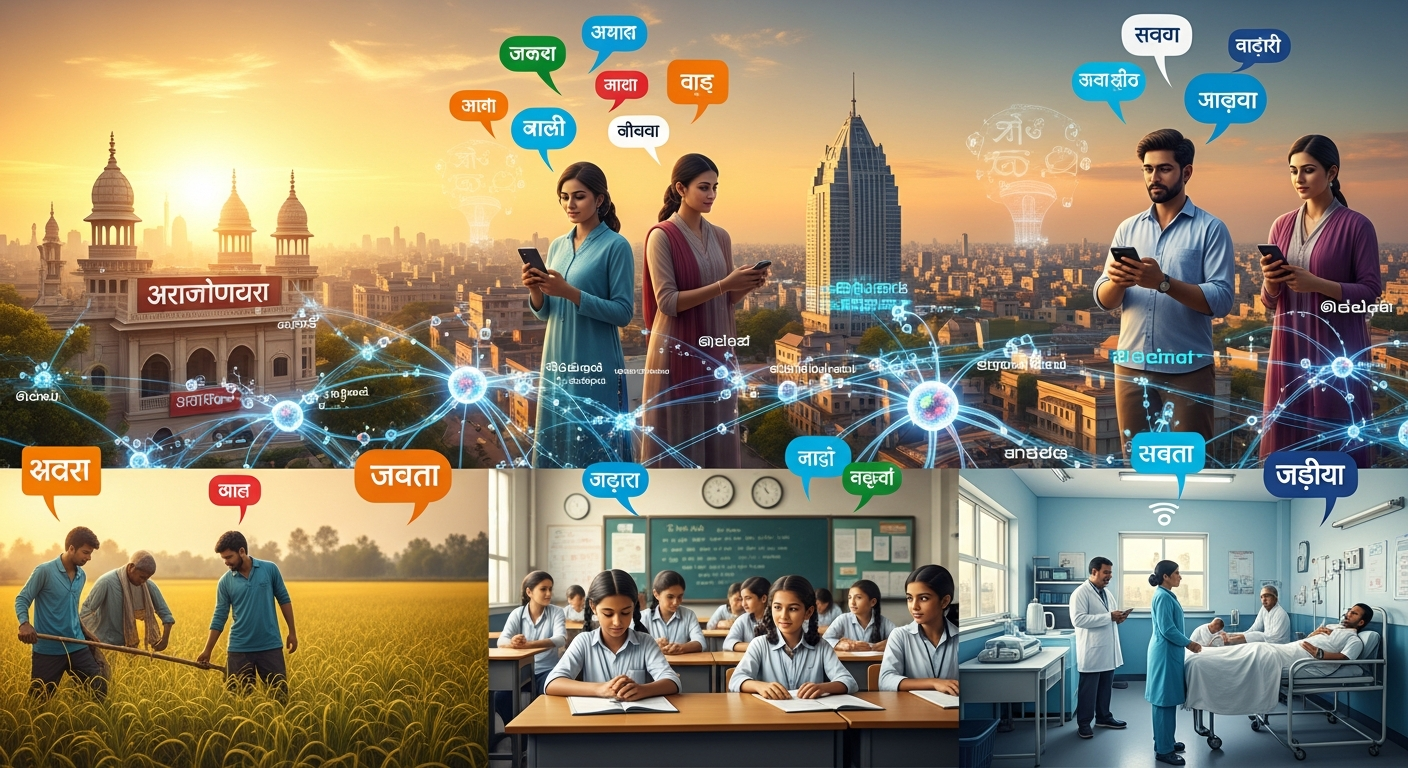
I have been thinking a lot about how countries translate waves of technological change into local value. Recently, a striking observation from Susan Athey athey@stanford.edu crystallised a theme I keep returning to: global AI models are powerful, but they rarely solve India’s problems out of the box. As Susan Athey athey@stanford.edu put it, "There’s so much opportunity and need for customisation in India for language, for local services, local data context, and the global models are often not providing that." Indian Express.
In this post I want to explain why India is uniquely positioned to customise AI at scale, give concrete sector examples, discuss policy and data considerations, and offer practical steps for businesses and policymakers.
Why India is primed for AI customisation
- Scale with diversity: India’s market is both large and heterogenous — dozens of major languages, varied socio-economic contexts, and wide differences in digital maturity. That heterogeneity creates demand for many specialised models rather than a single global solution.
- Implementation complexity: AI isn’t useful until it’s integrated into payment rails, health records, local bureaucracies and other systems. Local firms have an edge because they understand those implementation frictions.
- Talent and cost arbitrage: India has deep engineering and data-science talent, competitive operating costs, and a growing product-oriented startup culture that together lower the barrier to customised AI products.
- Public-sector demand: Government-led procurement — from digital public goods to e-governance platforms — can be a reliable early adopter for domestically tailored solutions.
These are not abstract advantages; they translate into commercial and social opportunity.
Concrete examples and sectors
- Healthcare
- Localising clinical decision-support systems to Indian epidemiology, treatment protocols and language improves adoption. Custom models can incorporate regional disease prevalence and local clinical workflows.
- Agriculture
- Crop forecasting, pest detection and advisories tied to micro-climates and local advisory chains outperform generic models trained on other geographies.
- Regional languages
- Speech and NLP systems tuned to Indian languages, dialects and code-mixed text enable inclusion — from voice banking to conversational bots for public services.
- Education
- Adaptive tutoring that understands local curricula, exam formats and classroom constraints can boost learning outcomes more than generic edtech tools.
- Finance
- Credit scoring and anti-fraud models that use alternate data (utility payments, digital transaction footprints common in India) can expand responsible access to credit.
Each of these domains benefits from a mix of foundational AI plus application-layer tailoring — exactly the layer Susan Athey athey@stanford.edu argues is ripe for domestic leadership Economic Times.
Policy and data considerations
- Data sovereignty vs innovation
- Countries worry about dependence on foreign providers for mission-critical systems. The pragmatic path is hybrid: encourage open models and local inference options while enabling secure, governed access to relevant datasets for responsible innovators.
- Measurement and evidence
- We need better ways to measure AI’s productivity and social impact. This means standardised evaluation frameworks for public deployments and investment in impact measurement capabilities.
- Copyright and access to training data
- Policies should balance creators’ rights with startup-friendly access. Licensing regimes that include graduated fees or research exemptions can help early-stage innovators without undercutting content producers.
- Privacy and fairness
- Regulations must avoid entrenching incumbents. Overly burdensome compliance can advantage large firms; instead, focus on outcome-based rules and capacity-building for regulators.
Ethical and fairness issues
Customisation is powerful but introduces risks:
- Bias amplification: Local datasets can contain historical biases. Rigorous fairness audits and ongoing monitoring must be mandatory for high-stakes applications.
- Transparency and recourse: When AI affects livelihoods or rights (credit, welfare eligibility, medical advice), systems must provide clear explanations and human appeal routes.
- Inclusive design: Prioritise low-literacy UX, multilingual support, and participatory design with affected communities.
Ethics is not a compliance checkbox — it’s a product quality requirement.
Role of startups and researchers
Startups are the natural vector for customisation: they move fast, iterate with customers, and can specialise. Researchers — in universities and labs — should partner with startups to translate cutting-edge methods into robust, field-tested systems. Public-private partnerships and challenge grants (focused on regional language models, health deployments, or agri-solutions) can accelerate practical innovation.
Practical steps for businesses and policymakers
For businesses
- Start with measurable, local problems: pick narrow objectives with clear KPIs.
- Build data partnerships: collaborate with hospitals, banks, and public utilities to access high-quality, consented data.
- Modularise: separate foundation-model components from application-layer logic so you can iterate quickly on localisation.
- Invest in monitoring: production monitoring for bias drift and performance must be part of the release plan.
For policymakers
- Promote open models and commons: support open-weight models and datasets for public-good purposes.
- Create progressive licensing rules: allow start-ups phased access to copyrighted material under fair terms.
- Build regulatory capacity: equip sectoral regulators (health, finance, education) with technical teams to assess AI deployments.
- Use procurement strategically: procure localised AI solutions in public services to create demand and build domestic expertise.
Conclusion — a call to action
India’s opportunity is not to re-invent every foundational model but to own the application layer: to customise, integrate and implement. The combination of scale, diversity and implementation complexity means India can produce practical AI that matters to its citizens. If we pair startup agility and academic rigor with thoughtful policy — and keep ethics and measurement front and centre — India will not merely consume global AI; it will shape it.
If you’re building in India: pick a clear local problem, partner with domain experts, and commit to rigorous measurement. If you’re a policymaker: lower barriers for legitimate innovators while safeguarding rights and competition.
We have the ingredients. Now is the time to turn customisation into impact.
Regards,
Hemen Parekh
Any questions / doubts / clarifications regarding this blog? Just ask (by typing or talking) my Virtual Avatar on the website embedded below. Then "Share" that to your friend on WhatsApp.
Get correct answer to any question asked by Shri Amitabh Bachchan on Kaun Banega Crorepati, faster than any contestant
Hello Candidates :
- For UPSC – IAS – IPS – IFS etc., exams, you must prepare to answer, essay type questions which test your General Knowledge / Sensitivity of current events
- If you have read this blog carefully , you should be able to answer the following question:
- Need help ? No problem . Following are two AI AGENTS where we have PRE-LOADED this question in their respective Question Boxes . All that you have to do is just click SUBMIT
- www.HemenParekh.ai { a SLM , powered by my own Digital Content of more than 50,000 + documents, written by me over past 60 years of my professional career }
- www.IndiaAGI.ai { a consortium of 3 LLMs which debate and deliver a CONSENSUS answer – and each gives its own answer as well ! }
- It is up to you to decide which answer is more comprehensive / nuanced ( For sheer amazement, click both SUBMIT buttons quickly, one after another ) Then share any answer with yourself / your friends ( using WhatsApp / Email ). Nothing stops you from submitting ( just copy / paste from your resource ), all those questions from last year’s UPSC exam paper as well !
- May be there are other online resources which too provide you answers to UPSC “ General Knowledge “ questions but only I provide you in 26 languages !



No comments:
Post a Comment