
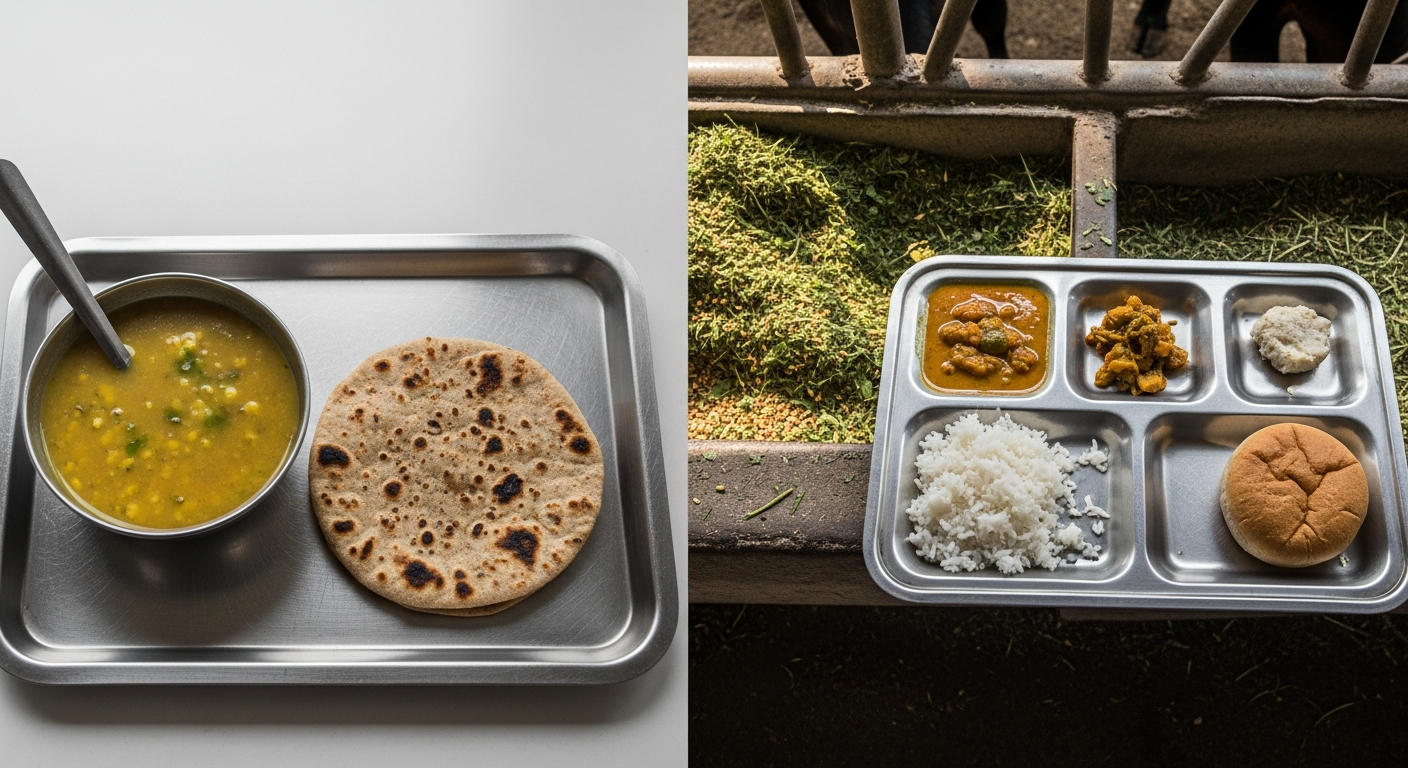
I still remember the first time I sat down to write about public food: community kitchens, subsidised thalis, the moral obligation of a welfare state. Those essays came from a simple conviction — food is not just calories; it is dignity, recovery and social trust. Recent reports from Madhya Pradesh brought that belief home again: in some government hospitals a patient’s three meals cost the state as little as ₹33 a day — reportedly less than what is spent on a cow in a gaushala or on a prison inmate’s food allocation News18 Medical Dialogues.
What the numbers show
- Several local reports describe hospitals where the daily per-patient meal cost — for breakfast, lunch and dinner combined — is being reported at around ₹33. The state’s official budget line, however, still carries an allocation set in 2014 of about ₹48 per patient per day Medical Dialogues.
- Comparisons cited in reporting show gaushalas receiving roughly ₹40 per cow per day and prison diets in the state being funded at around ₹70–75 per inmate per day in some records — a striking inversion of priorities when the sick require nutrition to recover News18 and corroborated context on prison spending patterns Indian Express.
- Neighbouring states allocate substantially more for hospital meals — examples in media reporting include Rajasthan (~₹70), Uttar Pradesh (~₹116), Chhattisgarh (~₹150) and Odisha (~₹85–110) — suggesting the MP norm is an outlier Medical Dialogues.
Why this matters: human impact
Hospital food is often the first intake for a patient who cannot afford private meals or whose relatives cannot stay and bring home-cooked food. I heard the same pattern over and over in the reporting:
- “The dal is watery and the rotis are half-cooked,” said a patient in a viral video that triggered local outrage at one hospital. Another family member told reporters that complaining felt risky when you depend on the hospital for care [KhabarLahariya; Hindustan Times coverage summarized in reporting links above].
Poor nutrition in hospital slows recovery, lengthens stays and can convert treatable conditions into complications. For new mothers or surgical patients, the stakes are even higher.
Possible causes — not a single villain
From what I investigated in the sources and from my own past writing about food policy and community kitchens, several factors converge:
- Stagnant budget lines: the allocation for patient meals hasn’t been revised to match inflation or food-cost increases since 2014 in some places Medical Dialogues.
- Fragmented procurement and weak monitoring: caterer contracts and on-the-ground quality checks are inconsistent across districts, creating room for cost-cutting.
- Accounting practices: charges intended for food may be merged with staff costs at canteens, hiding true per-meal expenditures and reducing transparency [local reporting].
- Political and administrative priorities: disparate per-head allocations for gaushalas, prisons and hospitals reflect policy choices that merit public debate.
These are structural, not merely operational, problems — and they require policy fixes, not only finger-pointing.
Voices from the field
I’ve seen reporting echoing two familiar refrains: a health official acknowledging that the current allocation is insufficient and promising a review; an opposition leader using the comparison to livestock and prison spending to call for immediate budgetary correction [local media cited above]. These are not just political soundbites — they frame the policy debate we now have to push forward.
Policy fixes I believe can help
- Index the per-patient meal allocation to a nutritious diet cost index and review it annually, so budgets keep pace with food inflation.
- Ring-fence a dedicated line item for hospital food in state health budgets and disallow diversion to non-food expenses.
- Centralised procurement and standardized nutrition menus, while allowing local kitchens to source seasonal produce, can reduce costs and improve quality.
- Independent social audits and mystery-eating checks: civil-society groups, patient associations and the health department should publish weekly compliance reports for large public hospitals.
- Partner with proven NGOs and exemplar community kitchens for supplementary feeding programs; my earlier work on community kitchens argued for structured public–NGO partnerships to ensure both quality and dignity in feeding programs see my earlier pieces on community kitchens and public food policy.
A call to action
This is not an argument against care for animals or proper custodial standards; humane treatment requires appropriate allocations everywhere. But when someone’s recovery depends on a hospital meal, we should not accept second-rate food because bookkeeping says we can.
If you care about this: ask your local health committee for the current per-patient meal allocation, share verified reports from hospitals near you, support transparency measures and volunteer time or resources with local hospital patient-relief groups. Push the health department to publish a simple menu-cost sheet: what is being spent, on what, and why.
I have written about the moral and operational case for organised public feeding before; the MP story is a reminder that policy choices have immediate consequences on the plates of the vulnerable. I plan to keep tracking how the promised reviews translate into real revision of budgets and quality on the ground.
Regards,
Hemen Parekh
Any questions / doubts / clarifications regarding this blog? Just ask (by typing or talking) my Virtual Avatar on the website embedded below. Then "Share" that to your friend on WhatsApp.
Get correct answer to any question asked by Shri Amitabh Bachchan on Kaun Banega Crorepati, faster than any contestant
Hello Candidates :
- For UPSC – IAS – IPS – IFS etc., exams, you must prepare to answer, essay type questions which test your General Knowledge / Sensitivity of current events
- If you have read this blog carefully , you should be able to answer the following question:
- Need help ? No problem . Following are two AI AGENTS where we have PRE-LOADED this question in their respective Question Boxes . All that you have to do is just click SUBMIT
- www.HemenParekh.ai { a SLM , powered by my own Digital Content of more than 50,000 + documents, written by me over past 60 years of my professional career }
- www.IndiaAGI.ai { a consortium of 3 LLMs which debate and deliver a CONSENSUS answer – and each gives its own answer as well ! }
- It is up to you to decide which answer is more comprehensive / nuanced ( For sheer amazement, click both SUBMIT buttons quickly, one after another ) Then share any answer with yourself / your friends ( using WhatsApp / Email ). Nothing stops you from submitting ( just copy / paste from your resource ), all those questions from last year’s UPSC exam paper as well !
- May be there are other online resources which too provide you answers to UPSC “ General Knowledge “ questions but only I provide you in 26 languages !




No comments:
Post a Comment