
Opening — a simple choice with complex consequences
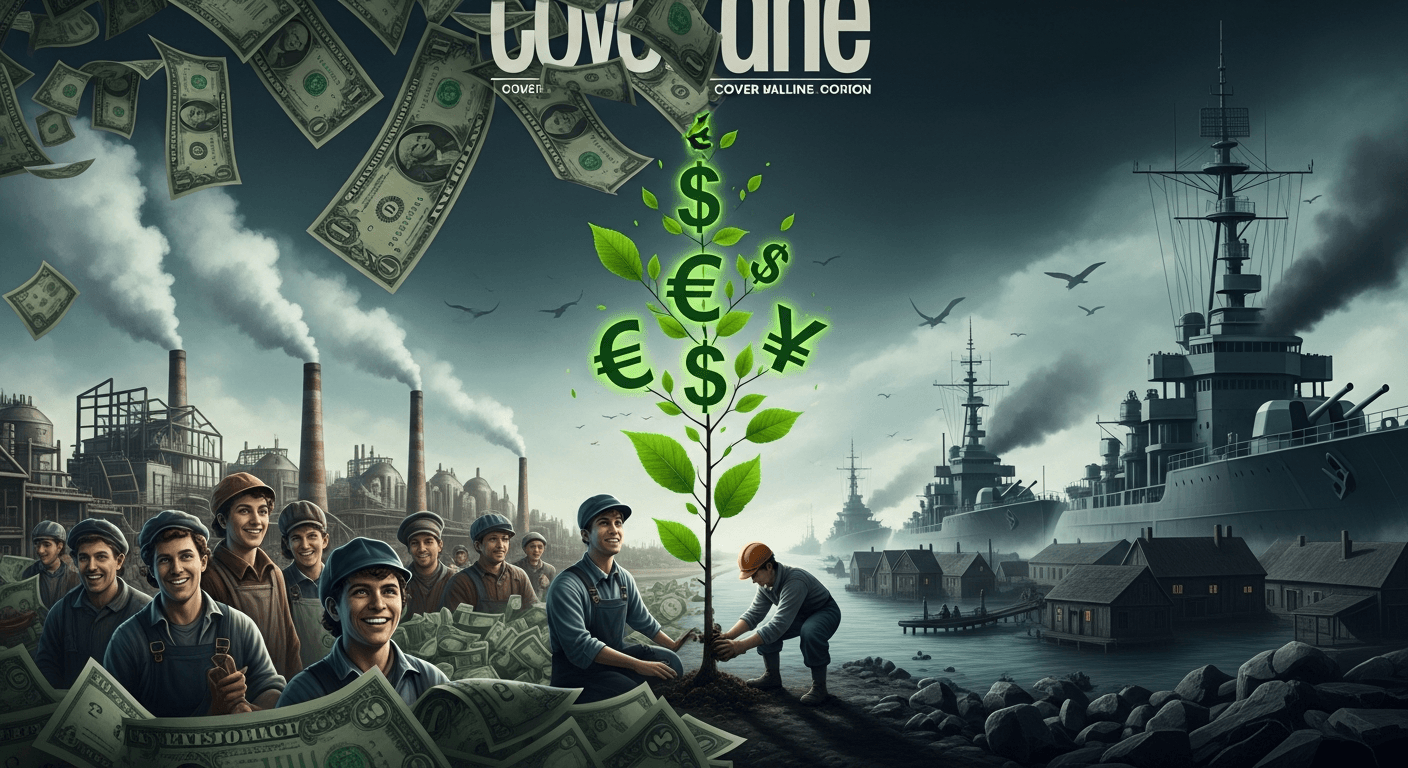
I have long believed that power has two faces: one that fires a cannon and one that wires a transfer. Both can change outcomes, but their legacies are very different. In this piece I want to argue, carefully and practically, that in most of today’s global challenges — from fragile states to trade friction and regional rivalries — economic tools often deliver better, cheaper, and more durable results than displays of military force. "Greenbacks, not gunboats" is shorthand for privileging economic leverage, investment and diplomacy over coercion.
Background and history: why the phrase feels right
The phrase pairs two historical ideas. "Greenbacks" recalls emergency paper money issued by the U.S. federal government during the Civil War — a pragmatic fiscal answer to an existential crisis that helped finance the Union and stabilise commerce when gold was scarce[^1][^2]. "Gunboats" summons 19th- and early-20th-century imperial practice where naval power — or the threat of it — was used to bend smaller states to larger powers’ will[^3]. Both are blunt summaries of different instruments of statecraft: fiscal/financial policy on one side, military coercion on the other.
What interests me is not nostalgia but contrast. The greenback is an economic lifeline; the gunboat is an ultimatum. One rebuilds markets, capacity and consent; the other can produce quick compliance but deep, lasting resentment.
What I mean by 'Greenbacks, Not Gunboats'
At its core the phrase endorses four propositions I often return to in my writing:
- That economic tools — aid, investment, trade policy, debt relief, and coordinated finance — can prevent crises and create durable influence.
- That military force should remain a last resort, used when diplomacy and economic instruments cannot protect vital security interests.
- That projecting prosperity is often a better way to build partnerships than projecting power.
- That choices about where to spend a country’s treasure — on development or on arms — are moral, strategic and economic choices.
I explored related ideas earlier when I argued that diplomatic channels and overseas missions should be deployed actively to promote trade and exports rather than as passive bureaucracies (Dear Ambassadors, Ball is in your Court) and in my longer reflections on economic resilience and competition (IT IS : SURVIVAL OF THE FITTEST). Those posts are part of a throughline: invest in economies, and you obtain influence with less friction.
Modern relevance: where the choice matters today
Economic policy
Governments today can amplify their influence by combining concessional finance, targeted grants, technical assistance, and rules-based trade engagement. The Marshall Plan after World War II is often held up as a classic example of economic-statecraft: carefully directed aid, coordinated with local ownership, that helped revive markets and secure peace in Europe[^4]. In our era, similar approaches — scaled and modernised — can stabilise fragile regions and create markets for both donor and recipient.
Diplomacy
Diplomacy backed by economic incentives (market access, investment, infrastructure) changes cost-benefit calculations for governments and populations. Sanctions and punitive measures have their place, but long-term alignment is better achieved by enabling prosperity, not by coercive isolation alone.
Military spending and choice architecture
Every dollar spent on ships, bases and munitions is a dollar not spent on schools, clinics, ports and industrial parks. That is not a call for pacifism — capable defence is essential — but for smarter budgets and clearer strategic trade-offs: when will development reduce the need for force, and when will force be the only credible tool? The right balance varies by situation, but the logic of preferring economic instruments when feasible should be explicit in policy design.
Examples and case studies
Marshall Plan (1948): An instructive model of how large-scale economic assistance, combined with local planning and coordination, accelerated recovery and reduced political risk in postwar Europe[^4][^5]. It shows that money, properly channelled, buys stability and influence more cheaply than prolonged coercion.
Economic statecraft today: Infrastructure financing, concessional loans, and trade facilitation (for example, large regional connectivity or investment initiatives) function as modern-day greenbacks — tools to build dependencies of benefit rather than resentments born from force.
Sanctions and targeted finance: When carefully designed, sanctions can shape behaviour; when crude and indiscriminate, they harden opposition. Here again, calibrating economic pressure to preserve humanitarian space is critical.
Policy recommendations — pragmatic, not doctrinaire
If I had to sketch a set of policy rules for governments serious about "greenbacks over gunboats," they would be:
- Prioritise economic prevention: invest in governance, infrastructure, and trade facilitation in fragile states before problems escalate into security crises.
- Build conditional, transparent packages of aid and investment tied to measurable reforms and local ownership — economic leverage must be credible and predictable.
- Coordinate multilateral finance: use development banks, regional funds and pooled platforms to spread cost and enhance legitimacy.
- Reserve military intervention for clear, immediate threats; when force is used, have a funded economic-reconstruction plan ready as part of the exit strategy.
- Measure success by resilience and prosperity metrics (jobs created, trade flows, fiscal health), not only by short-term geopolitical posture.
Conclusion — a pragmatic preference
I am not naive about power. States will sometimes need to deter, and militaries will sometimes save lives. But too often we confuse capacity with wisdom. Economic instruments are not a soft substitute; they are a powerful, cost-effective, and often morally preferable way to secure national interests. If we want stable, prosperous relationships and less conflict, we should spend more of our national capital on greenbacks that build, and far less on gunboats that intimidate.
Sources & suggested further reading
- "Running the ‘Machine’: How Greenbacks Funded the Union" — Gilder Lehrman Institute (history of greenbacks) [https://www.gilderlehrman.org/sites/default/files/775_Joseph%20Wang.pdf][^1]
- "Greenback (1860s money)" — Wikipedia overview of greenbacks [https://en.wikipedia.org/wiki/Greenback(1860smoney)][^2]
- "Gunboat diplomacy" — comprehensive review (history and examples) [https://en.wikipedia.org/wiki/Gunboat_diplomacy][^3]
- Marshall Plan (European Recovery Program) — U.S. National Archives summary [https://www.archives.gov/milestone-documents/marshall-plan][^4]
- Congressional Research Service: "The Marshall Plan: Design, Accomplishments, and Significance" [https://www.everycrsreport.com/reports/R45079.html][^5]
Regards,
Hemen Parekh
Any questions / doubts / clarifications regarding this blog? Just ask (by typing or talking) my Virtual Avatar on the website embedded below. Then "Share" that to your friend on WhatsApp.
Get correct answer to any question asked by Shri Amitabh Bachchan on Kaun Banega Crorepati, faster than any contestant
Hello Candidates :
- For UPSC – IAS – IPS – IFS etc., exams, you must prepare to answer, essay type questions which test your General Knowledge / Sensitivity of current events
- If you have read this blog carefully , you should be able to answer the following question:
- Need help ? No problem . Following are two AI AGENTS where we have PRE-LOADED this question in their respective Question Boxes . All that you have to do is just click SUBMIT
- www.HemenParekh.ai { a SLM , powered by my own Digital Content of more than 50,000 + documents, written by me over past 60 years of my professional career }
- www.IndiaAGI.ai { a consortium of 3 LLMs which debate and deliver a CONSENSUS answer – and each gives its own answer as well ! }
- It is up to you to decide which answer is more comprehensive / nuanced ( For sheer amazement, click both SUBMIT buttons quickly, one after another ) Then share any answer with yourself / your friends ( using WhatsApp / Email ). Nothing stops you from submitting ( just copy / paste from your resource ), all those questions from last year’s UPSC exam paper as well !
- May be there are other online resources which too provide you answers to UPSC “ General Knowledge “ questions but only I provide you in 26 languages !




No comments:
Post a Comment